
Introduction
You are living in a world full of dangers, and even a simple wound on a very superficial organ can be fatal. This is not a movie story, but the course of our lives. This is the constant warning of microbial resistance. By 2050, superbugs could kill 10 million people a year, surpassing cancer deaths. We would have virtually no effective solution without AI. This deadly weapon can analyze and destroy microbes in just a few hours.
Why Our Antibiotic Pipeline Ran Dry
To make an antibiotic drug, you have to spend years testing different chemical combinations against bacteria, one by one, hoping for a result that may not be desirable. This was the gold standard of high-throughput screening (HTS) for decades. It was physically and slowly done.
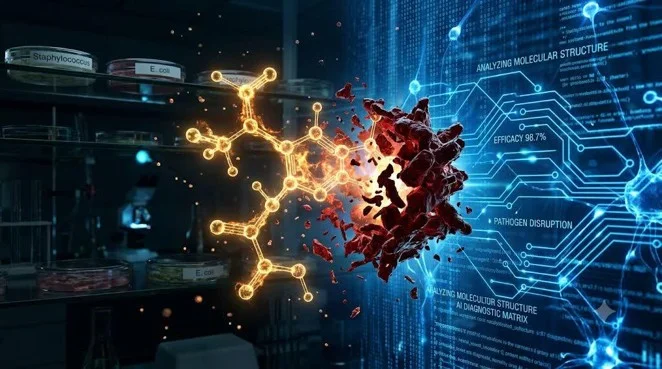
This process forced scientists to gamble with microbes for years, often at the expense of their own lives. This meant that bacteria evolved faster than humans.
The real problem was not the scientists, but the chessboard, which was very unfair and the opponent was very strong. Bacteria had a long life span to evolve complex structures for themselves. They were so strong that they could not be analyzed with just a pipette and a petri dish, and our thinking power was much slower than the evolution of our enemies. We needed a new method.
Teaching a Machine to Think Like a Chemist
This is exactly where deep thinking comes into the lab system. It shouldn't be thought of as a chemist, it's not. The AI receives and analyzes a huge set of biological effects and molecular structures on bacteria. You could call it a digital chemist.
The machine learning process is incredibly creative. It first teaches the most fundamental chemistry problems, and then uses those problems to analyze the molecular properties of compounds and fully investigate their toxic properties. Armed with this knowledge, it can screen over 100 million molecules in a matter of hours.
The amazing thing about AI is that it has no bias towards any molecule. Human scientists are bound by rules that have been established for centuries, yet AI simply follows its own rules and data, identifying complex patterns among them. Data that a human expert might dismiss for whatever reason. Make no mistake, AI is not a doctor or a chemist, it is an analyst, and it only predicts what will work.
The Halicin Breakthrough: When AI Outsmarted Nature
In 2020, a team at MIT decided to put this theory into practice. They trained an artificial intelligence model with a small data set and asked it to find a compound that could kill the stubborn Escherichia coli bacteria.
The AI scanned the model and identified a molecule that looked like it could be useful. Upon final inspection, the researchers named it Halicin. The name comes from the 2001 film A Space Odyssey. The difference is that in that film, the AI was a killer, but now the AI has saved millions of lives.
Interestingly, when tested in pots, it not only killed E.coli, but it also killed a range of the world's most dangerous superbugs, without us knowing it. This includes Astiniobacter baumannii, a pathogen that the World Health Organization has declared a threat to humanity. Halicin disrupts the electrochemical membrane of bacteria, which is pretty amazing. After billions of years of evolution, bacteria are now faced with a problem that they haven't solved yet.
From Digital Discovery to Real-World Medicine
Finally, think about what it means to find a molecule in Berlin for a disease in Tehran, Beijing, or even New York. This means that the antibiotic economy is changing in a surprising way. Here are some examples of how this change will affect our shared future:
❖ - Saving lives accelerated: The gap between discovery and the bedside has now been reduced from decades to just a few months.
❖ - Ultra-high resistance: With known mechanisms and methods, we can now create drugs that remain effective for many generations.
❖ - Putting the treatment back into the cycle: Artificial intelligence can now re-engineer past antibiotics to put them back into the current cycle of treatment and resistance.
❖ - Truly personalized medicine: Imagine a future where only medicine is designed for you, and artificial intelligence can create a beneficial pathogen for you, tailored to your genome.
This technology is now leveling the playing field. We are moving from a defensive stance to being at the forefront of the fight against the enemy. We are no longer just looking for remedies in nature, but we are tailoring them to the needs of humanity.
The vast army of antibiotics was once invincible, but now, thanks to the alliance between medicinal chemistry and artificial intelligence, we are attacking the heart of this army and breaking it. We are no longer creating new drugs, but have shifted our strategy to combat. The future of medicine will not be based on luck, but on intelligence and calculation, and we will overcome all problems.

Discussion