
Introduction
Stress is something we all deal with. Whether it’s a tight deadline, a tough conversation, or just the weight of a busy day, we’ve all felt that familiar kick in the chest. Evolutionarily speaking, this is actually a brilliant design. Your body is essentially a high-performance machine that knows exactly how to switch into survival mode the moment it senses a threat. It’s an incredible, split-second reaction meant to keep you safe.
But there’s a catch. Our bodies were built for short-term emergencies like running away from a predator, not for the endless, low-level stress of modern life. What happens when that danger never really goes away? When you’re under pressure for weeks, months, or even years, that same internal system meant to save you starts to take a toll.
Now, let's look into the intricate workings of your internal stress response system. In this piece, we’re going to pull back the curtain on what’s happening under the hood. We’ll look at the chemical messengers that hijack your vital organs when stress hits, explore what happens when the body gets stuck in that mode, and talk about the 'off' switches your brain uses to finally bring things back to a calm, steady state.
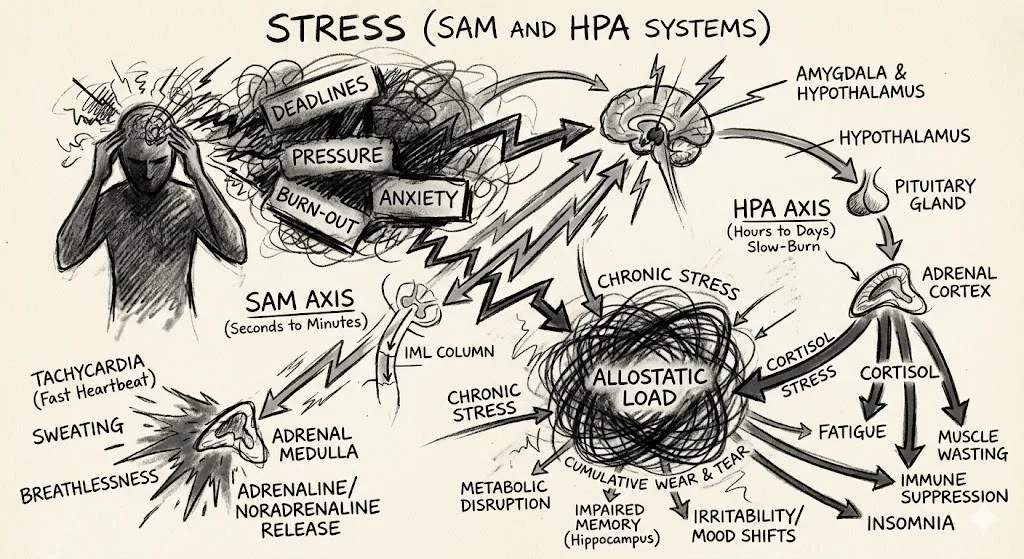
The Acute Phase: The SAM(Sympatho AdrenoMedullary System)-Seconds to Minutes
The Anatomy of the Fast-Track Response
To understand the SAM axis, you have to follow the signal from the brain’s “alarm” all the way to the adrenal glands.
1. The Detection (The Amygdala)
It starts with a threat, whether a physical danger or a high-pressure deadline. The basolateral nucleus (BLA) of the Amygdala acts as the scanner. Once it identifies a stressor, it communicates with the Central Nucleus (CeA). The CeA, acting as the output hub, sends a rapid glutamatergic pulse to the Paraventricular Nucleus (PVN) of the Hypothalamus.
2. The Command (The Hypothalamus)
The PVN is the control room. Once it receives that surge of glutamate, it initiates a massive electrical discharge. This signal travels through the brainstem and into the Reticulospinal tract, then descends into the spinal cord.
3. The Highway (The IML Cell Column)
The signal descends to the Intermediolateral (IML) cell column in the thoracic spinal cord. These neurons, known as preganglionic sympathetic neurons, send their axons out through the greater splanchnic nerve. This nerve acts as a direct, high-speed line to the adrenal glands, bypassing the typical synaptic relays of the sympathetic nervous system.
4. The Trigger (The Adrenal Medulla)
Upon reaching the adrenal medulla, these nerves release acetylcholine, which binds to nicotinic acetylcholine receptors on the chromaffin cells. This triggers the immediate release of a chemical payload consisting of 80% adrenaline (epinephrine) and 20% noradrenaline (norepinephrine) directly into the bloodstream.
The System-Wide Effect
Once these catecholamines(adrenaline and noradrenaline) enter the bloodstream, they act on adrenergic receptors throughout your body to reconfigure your physiology for immediate action:
Organ | Physiological effect | Receptor involved | Why it happens |
Heart | Increased Heart Rate & Force | β1 Receptor Activation | To pump oxygenated blood to muscles faster |
Lungs | Bronchodilation (Widened airways) | β2 Receptor Activation | To maximize oxygen intake for peak effort. |
Vasculature | Selective Constriction/Dilation | α1 (Constrict) / β2 (Dilate) | Shunts blood away from the gut to the muscles. |
Liver | Glycogenolysis | α and β Activation | Converts stored energy (glycogen) into "quick fuel" (glucose). |
Pupils | Dilation/midriasis | α1 Receptor Activation | To let in more light and sharpen peripheral vision. |
Digestive system | Inhibition (Decreased motility) | α2 / β2 Activation | Pauses "non-essential" energy-intensive tasks |
Urinary system | Bladder Sphincter Constriction | α1 Receptor Activation | Temporarily suspends the urge to urinate. |
As we’ve seen, the SAM axis is a masterpiece of survival designed for acute, short-term demands. The system functions beautifully when the physiological output, like rapid movement or intense focus, matches the intensity of the chemical signal. However, modern life often keeps the alarm system ringing without the physical movement required to discharge the reaction. This raises an important question: what happens when stress is not just immediate, but persistent? When the SAM axis is insufficient to manage a long-term challenge, the body pivots to a more profound, hormonal strategy. This is where the HPA axis, the body’s long-term management system, takes the stage.
The Chronic Phase: The HPA Axis (Hypothalamic-Pituitary-Adrenal axis) – Hours to Days
Unlike the SAM axis, which relies on electrical signals and rapid-fire neurotransmitters, the HPA axis is a hormonal cascade. It is slower to initiate but longer-lasting, designed to alter your metabolism, immune function, and brain chemistry to survive a prolonged period of adversity.
1. The Initiation (The PVN Slow-Burn)
When a stressor persists, the Paraventricular Nucleus (PVN) of the hypothalamus initiates a different chemical output. Instead of glutamate pulses, it releases Corticotropin-Releasing Hormone (CRH) into the hypophyseal portal system, a specialised network of blood vessels that connects the hypothalamus directly to the anterior pituitary gland.
2. The Relay (The Pituitary Gland)
Once CRH arrives at the anterior pituitary, it stimulates the production and release of Adrenocorticotropic Hormone (ACTH) into the systemic circulation. ACTH acts as the "messenger" that travels through the blood specifically toward the adrenal glands.
3. The End-Effector (The Adrenal Cortex)
Upon reaching the adrenal cortex (the outer layer of the adrenal gland), ACTH binds to receptors that trigger the synthesis and secretion of cortisol, often called the stress hormone. Unlike the adrenaline of the SAM axis, which lasts for minutes, cortisol is lipophilic (fat-soluble), meaning it can cross cell membranes and enter the nucleus of almost any cell in your body to alter gene expression.
The Metabolic Strategy: Cortisol’s Role
While adrenaline revs the engine, cortisol manages the fuel supply. Its primary goal is to ensure the body has sufficient glucose to sustain activity over a long duration.
Action | Physiological Goal |
Gluconeogenesis | Instructs the liver to create new glucose from non-carbohydrate sources (like amino acids). |
Protein Breakdown | Breaks down muscle tissue to provide the raw materials for glucose synthesis. |
Anti-Inflammation | Temporarily suppresses the immune system to prevent an overreaction during a crisis. |
Cognitive Shift | Directs neural resources toward the amygdala (fear/survival) and away from the prefrontal cortex (complex reasoning). |
The Allostatic Load: When the System Doesn't Shut Off
This hormonal cascade is perfectly engineered for short-term survival, a week of food scarcity or a period of physical illness. But in a modern environment, we often keep our HPA axis switched on for months due to chronic work stress, sleep deprivation, or persistent social anxiety.
This is the biological definition of Allostatic Load: the cumulative "wear and tear" on the body resulting from chronic overactivity of the stress systems. When cortisol remains elevated, the very things it did to save you start to break you down:
Muscle Wasting: You are effectively eating your own muscle tissue to fuel a brain that is merely worried about a presentation.
Immune Suppression: Persistent cortisol levels leave you vulnerable to infection and impair wound healing.
Metabolic Disruption: Chronic glucose spikes contribute to insulin resistance and abdominal fat deposition.
A chronic period of stress ultimately results in an increase of blood glucose (glycogen to glucose in the liver), suppression of the immune system, and affects mood (irritability)
Affects memory (hippocampus), sleep disturbances, Fatigue, weight gain and decreases metabolic activity. It is said that cortisol is related to decreasing the PFC activity of the brain, which is responsible mainly for logical thinking. It is observed that Right PFC activity increases in stressed or anxious people, which is linked to negative thinking, worrying, withdrawal behaviour and fear. Whereas the left PFC is more active in happy or relaxed people and is linked to positive thinking, optimism, motivation, and approach behaviour.
It is well known that certain activities, such as breathing exercises like unilateral nostril breathing/ Nadi shodhana pranayamam, meditation, guided relaxation and exercises, are related to reducing stress. Now we are going to see how exactly these are going to protect our bodies from the effects of stress.
Meditation/mindful awareness rewires the brain circuits via neuroplasticity and activates the left prefrontal cortex of the brain. Slow breathing exercises tend to activate the parasympathetic system responsible for antagonising the actions of the sympathetic system and produce a calming effect. Guided relaxation involves one to scan their body internally, which in turn reduces muscle tension.
Biochemically, these activities tend to release the following neurotransmitters, which are responsible for producing respective effects.
Neurotransmitter | Effect produced |
GABA – Gamma amino butyric acid | Inhibitory/ calming neurotransmitter - lowers amygdala activity-feeling of calmness, less anxious |
Serotonin-The Happy hormone | Mood stabilizer, reduces depressive thoughts |
Dopamine | Improves focus, attention to detail |
Endorphins- Natural pain killers | Makes one to feel energetic, uplifts mood, joy |
Oxytocin- The bonding hormone | Reduces stress, anxiety and social fear |
Melatonin- The sleep hormone | Improves sleep |
Reduction in cortisol | Leads to decrease in blood glucose, insulin sensitivity, improves metabolism, |
NK cells | Improves Immunity and Inflammatory markers |
Ach | Slower heart rate, relaxed body, antagonises sympathetic activities |
The beauty of these techniques, meditation, focused breathing, and physical activity, is that they are not just relaxing. They are biological interventions. When you engage in slow, rhythmic breathing or mindful awareness, you are essentially providing the discharge that your survival systems have been waiting for.
By deliberately activating the parasympathetic nervous system, you are signalling to the hypothalamus that the threat has passed. This effectively:
Downregulates the HPA axis: By signalling the hypothalamus to stop the production of CRH, you lower the set point for cortisol in your bloodstream.
Restores PFC Function: As cortisol levels drop, the prefrontal cortex, the brain’s executive suite, begins to come back online, allowing for clearer reasoning and emotional regulation.
Resets the Baseline: Over time, these practices leverage neuroplasticity to strengthen the pathways that lead to the left prefrontal cortex, making it easier to return to a state of calm in the future.
Conclusion
Your body is not a machine that breaks; it is a dynamic system that constantly seeks equilibrium. The stress we feel in modern life is not a flaw in our design; it is a system designed for a different world, struggling to adapt to ours. By understanding the neurobiology of the SAM and HPA axes, we stop viewing our stress as a failure of character and start viewing it as a call to action.
The next time you feel that familiar kick in the chest, remember that your system is doing exactly what it was evolved to do. Your job is simply to provide it with the physical and mental signals it needs to know that, for now, it is safe to stand down.


Discussion