
Imagine finding a microscopic piece of volcanic ash trapped inside a deep ice core in Antarctica, or embedded within layers of lake sediment in Europe, and using it to reconstruct the global climate thousands of years ago. This is not science fiction—it is the core mechanism of Tephrochronology, the science of using volcanic ash (tephra) layers as precise geological time-markers.
While volcanic eruptions are often viewed as abrupt, destructive disasters, their airborne deposits leave behind indelible signatures across the globe. For Earth scientists and palaeoclimatologists, tephra serves as an essential tool to decode past climate variability, synchronize regional paleoclimate records, and understand the historical drivers of atmospheric change.
What is Tephra and Why is it Unique?
The term tephra encompasses all fragmental material ejected into the atmosphere during a volcanic eruption, regardless of size—ranging from fine ash to large pumice blocks. When a high-explosive eruption occurs, fine volcanic ash is swept high into the stratosphere, carried by planetary wind patterns, and deposited across vast geographical regions within days or weeks.
Tephra layers possess two key characteristics that make them extraordinary climate archives:
Chemical Fingerprinting: Every magma chamber has a distinct geochemical signature (major, minor, and trace elements). Through micro-analytical techniques like Electron Microprobe Analysis (EMPA) and Laser Ablation ICP-MS, glass shards from tephra can be linked to a specific eruption event.
Isochronous Boundaries: A tephra layer is deposited almost instantaneously on a geological timescale. Therefore, a single tephra horizon across different locations acts as a synchronous time marker (an isochron), locking disparate climate records into an absolute, shared timeline.
How Tephra Reconstructs Palaeoclimate
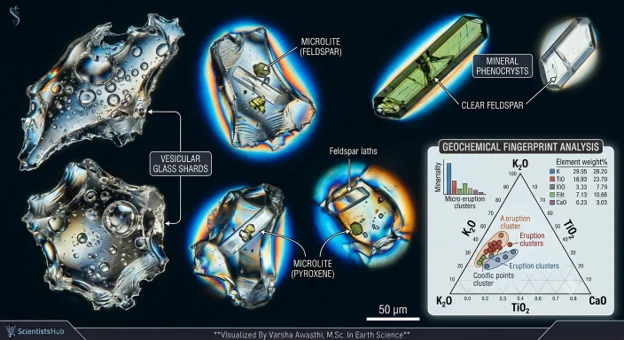
Palaeoclimate reconstruction relies heavily on natural archives such as ice cores, marine sediments, peat bogs, and speleothems (cave deposits). However, comparing climate changes across different geographic zones often suffers from age uncertainties in dating methods like radiocarbon (^{14}\text{C}) or uranium-series.
Tephra bridges this gap in three critical ways:
1. Precision Synchronization of Paleoclimate Archives
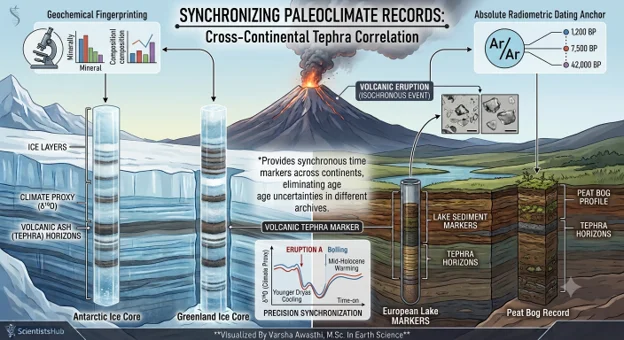
To determine whether past climate events (such as the abrupt warming during the Bølling–Allerød or the severe cold of the Younger Dryas) occurred simultaneously across the globe, scientists need precise alignment. When the same tephra layer is identified in both a Greenland ice core and a European lake bed, it locks the climate signals from both archives to the exact same instant, eliminating dating errors.
2. Direct Climate Forcing Indicators
Volcanic eruptions release massive quantities of sulfur dioxide (\text{SO}_2) into the stratosphere, forming sulfate aerosols that reflect solar radiation and induce global cooling (volcanic winter). By studying tephra layers combined with sulfate peaks in ice cores, scientists can directly measure the scale of volcanic cooling and evaluate how past climate systems responded to short-term atmospheric disturbances.
3. Absolute Radiometric Dating
Tephra often contains minerals like feldspar and mica suitable for high-precision radiometric techniques, such as Argon dating. Establishing an absolute age for a tephra layer automatically anchors the surrounding sediment and the climate proxies enclosed within it (such as fossil pollen, diatoms, or oxygen isotopes).
Tephra in Action: Case Examples
The Cryptotephra Revolution: Modern advancements allow scientists to detect cryptotephra—volcanic ash particles invisible to the naked eye less than100 present in extremely low concentrations. This has expanded tephra studies far beyond volcanic centers into regions previously thought to be untouched by ash falls.
The Campanian Ignimbrite (CI) Ash: Erupted roughly 40,000 years ago from the Phlegraean Fields in Italy, this massive eruption spread ash across Southeastern and Eastern Europe. The CI ash layer serves as a critical marker for studying human evolution and severe cooling events during the Palaeolithic era.
The Big Picture: Predicting Future Climate
Understanding past climate sensitivity to rapid atmospheric shifts is essential for refining modern climate models. By transforming explosive volcanic events into precise temporal markers, tephrochronology allows us to read Earth’s ancient climate diary with unprecedented accuracy.
As analytical techniques refine our ability to detect ever-smaller glass shards, tephra will continue to illuminate the complex interplays of Earth's climate history, proving that even in the smallest specks of volcanic ash lie the secrets to our planet's past and future.

Discussion