
Hypertrophic cardiomyopathy (HCM) is a common genetic disorder in which the heart muscle becomes thicker and stiffer, a condition called hypertrophy. (1) The thickened heart muscle makes it harder for the heart to work properly. Many individuals with HCM do not realize that they have it. However, in a small number of affected people, the thickened heart muscle can cause serious symptoms. Some of the serious symptoms could be shortness of breath, chest pain, irregular heartbeats, and even sudden death.
HCM affects 1 in 500 people worldwide. (2) This disease sometimes runs in families. In such cases, a child of an affected parent has a 50% chance of having hypertrophic cardiomyopathy. (3) HCM is the most common cause of sudden cardiac death in athletes below 35 years of age.
Let's learn more about Hypertrophic cardiomyopathy, its causes, symptoms, diagnosis, and treatments.
Types of Hypertrophic Cardiomyopathy
HCM has two types: obstructive and non-obstructive. Read below to learn how the two types are different from each other.
Obstructive HCM
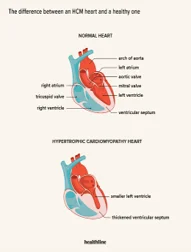
In these cases, the affected person’s heart muscle becomes too thick in the area leading to the aortic valve, which sends blood out of the heart. An “obstruction” is caused by the thick muscle, and that may limit how much blood can leave the heart.
Obstructive HCM is more common than non-obstructive HCM.
Non-Obstructive HCM
In non-obstructive hypertrophic cardiomyopathy, there is no obstruction near the aortic valve, but other areas of the patient’s heart muscle may be too stiff and thick. This in turn, can result in blood flow issues.
Signs and Symptoms of Hypertrophic Cardiomyopathy
Some of the most common symptoms of HCM include:
Shortness of breath, especially during physical activity.
Fatigue
Dizziness
Heart Palpitations
Fainting
Chest pain and discomfort
Causes of Hypertrophic Cardiomyopathy
Gene changes can cause hypertrophic cardiomyopathy, which thickens the heart muscle. HCM affects the septum, or the wall between the two bottom ventricles of the heart. The thickened septal wall might block blood flow out of the heart. This is called obstructive HCM.
When there is no significant blockage of blood flow, the condition is called non-obstructive HCM. However, in such cases, the heart’s main pumping chamber (left ventricle) might stiffen. This can make it hard for the heart to relax. This stiffness also reduces the amount of blood the ventricle can hold and pump to the body with each heartbeat.
Heart muscle cells also become arranged differently in patients with HCM. This is called myofiber disarray. In some people, myofiber disarray can trigger irregular heartbeats.
Complications of Hypertrophic Cardiomyopathy
HCM can cause many complications in the affected person. Some of those include:
Atrial Fibrillation (AFib)
Atrial fibrillation, or AFib, is a complication that occurs in people with HCM, where a thickened heart muscle and changes in the structure of heart cells trigger an irregular and rapid heartbeat. Atrial fibrillation also increases the risk of blood clots, which can travel to the person’s brain and lead to a stroke.
Blocked Blood Flow
Sometimes in people with HCM, symptoms like shortness of breath with physical activity, chest pain, and fainting can occur because of the thickened heart muscle that blocks the blood flow leaving the heart.
Dilated Cardiomyopathy
In some cases, people with hypertrophic cardiomyopathy, the thickened heart muscle becomes weak and stops working well. This condition tends to start in the left lower chamber of the heart. The chamber becomes larger, and the heart pumps blood with less force.
Mitral Valve Disease
The mitral valve lies between the left heart chambers. If the thickened heart muscle blocks blood flow leaving the heart, the mitral valve may not close properly, causing blood to leak backward into the left upper chamber. Such a condition is called mitral valve regurgitation. This condition may worsen HCM symptoms.
Heart Failure
Over time, the heart muscle can become thick and stiff, making it difficult for the heart to fill with blood. This can lead to a condition where the heart cannot pump enough blood to meet the body’s needs.
Fainting
Sometimes individuals with hypertrophic cardiomyopathy can experience fainting, due to an irregular heartbeat or blockage of blood flow, which can cause fainting. The most important thing to note is that unexplained fainting can cause sudden cardiac death.
Sudden Cardiac Death
People of all ages with HCM can suffer from heart-related sudden death. Many individuals with hypertrophic cardiomyopathy do not realize they have it.
Diagnosis of Hypertrophic Cardiomyopathy
Diagnosing HCM requires a medical history, physical examination, and testing. Your healthcare provider reviews your health records and asks about the symptoms. They will also want to know if any other member of your family has a history of hypertrophic cardiomyopathy, or other diseases related to the heart, or sudden death. Your healthcare provider will also listen to your heart and lungs with a stethoscope. If they hear a heart murmur, you might have HCM.
Some of the tests you may need are:
Echocardiogram (echo)
This is the most important test that diagnoses hypertrophic cardiomyopathy. An echo can show whether certain areas of the heart muscle are too thick. It also shows blood flow through the heart. An echo can help distinguish between different types of HCM.
Exercise Stress Echo
This special test shows how your heart responds to exertion. This test is usually prescribed if a resting echo shows no signs of obstruction, but you experience symptoms with exertion.
Electrocardiogram (EKG/ECG)
An electrocardiogram records the heart’s electrical activity. It usually shows abnormal results in case of patients with hypertrophic cardiomyopathy.
Holter or Patch Monitor
These devices record the heart’s electrical activity for longer than an ECG.
Cardiac MRI
Cardiac MRI is an imaging test that gives your healthcare provider another look at your heart to fill in any gaps from the echo. It also helps your provider better assess your risk of sudden cardiac death.
Gene Testing
This blood test can find abnormal genes, or gene changes, linked to hypertrophic cardiomyopathy.
Digging Deeper into the Diagnosis: The HCM Screenings
HCM screenings are routine tests for individuals at risk due to family history. You should go for the HCM screening if you have a biological parent, sibling, or child with the condition.
Tell your healthcare provider if a family member has been diagnosed with the condition. Usually, HCM screening involves having an echo test and an EKG every few years.
Management and Treatment
What Would Your Treatment Plan Include?
The primary goal of HCM treatment is to reduce symptoms and lower the risk of complications. A treatment plan includes monitoring, medications, and procedures.
Monitoring
If you have HCM, you should get routine checkups and tests, such as an echocardiogram and EKGs. You may need monitoring for many years.
If you are diagnosed with the condition and are receiving treatments, such as medications, your healthcare provider will also monitor it closely. You will have tests every so often to check that your heart functions well and assess your risk level. Such tests can help your healthcare provider to adjust your treatment as required
Medications
The medications your doctor prescribes depend on the type of HCM you have. Cardiac myosin inhibitors are the recently approved medications by the U.S. Food and Drug Administration (FDA). These medications treat obstructive HCM. Mayacamten and Aficamten target the root cause of the disease.
However, there are currently no targeted treatments for non-obstructive HCM. The main treatments your healthcare provider may prescribe help your heart work better and reduce symptoms. These medications include Beta-blockers, Calcium channel blockers, and diuretics.
Procedures
HCM patients may need surgery or a less invasive medical procedure to manage symptoms or lower their risk of cardiac arrest. Below are some options.
Septal myectomy
This is an open-heart surgery and is only for patients with obstructive HCM.
The surgeon removes a small amount of thickened heart muscle. This widens the path your blood takes from the left ventricle to your aorta.
Alcohol septal ablation
Alcohol septal ablation is a less invasive procedure for people who cannot have a septal myectomy.
Here, the doctor injects isopropyl alcohol into an artery that supplies blood to the thickened heart muscle, shrinking the tissue to improve blood flow.
Implantable cardioverter defibrillator (ICD) placement
An ICD is a small device that your cardiologists will place in your chest. This small device constantly monitors your heart. It shocks your heart back to a normal rhythm if a dangerous heart rhythm occurs.
Final Thoughts
Hypertrophic cardiomyopathy (HCM) is a common genetic condition. Early detection can be life-changing. If you are concerned about symptoms or your family history, talk to your doctor and get tested as soon as possible.



Discussion