
Introduction
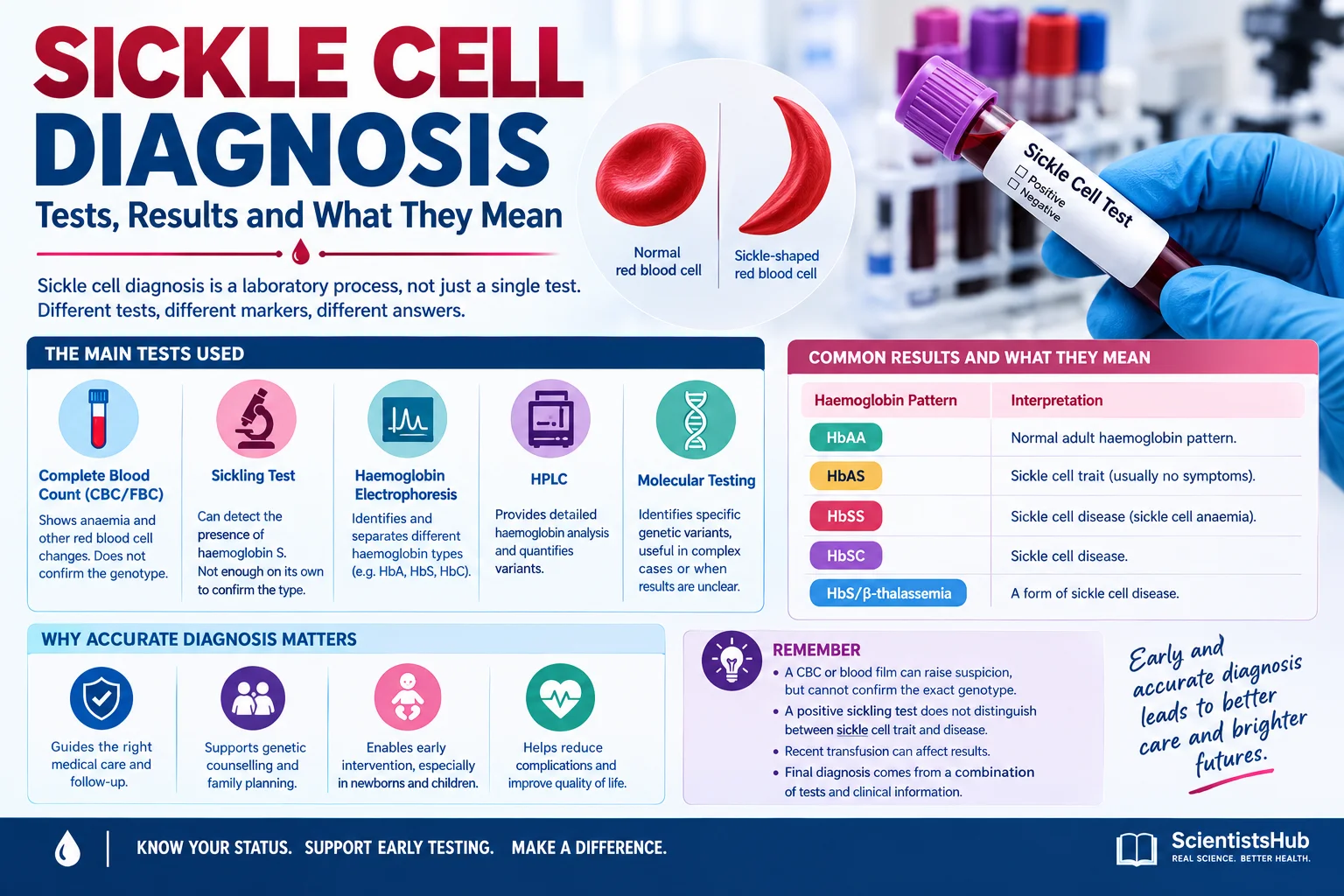
Sickle cell disease is one of the best-known inherited blood disorders, but the process of diagnosing it is more than simply asking whether someone has “sickle cell.”
Behind a diagnosis is a laboratory process designed to identify abnormal haemoglobin, determine which haemoglobin variants are present, and distinguish sickle cell disease from sickle cell trait and other haemoglobin disorders.
Why does this distinction matter?
A person with sickle cell trait may carry the haemoglobin S gene without having sickle cell disease, while different forms of sickle cell disease can have different clinical implications. Accurate diagnosis therefore provides more than a label. It helps healthcare professionals determine the appropriate follow-up and care.
In this article, we explore sickle cell diagnosis, the laboratory tests used, what common results mean, and why confirmation and quality testing are so important.
What Is Sickle Cell Disease?
Sickle cell disease (SCD) is a group of inherited disorders affecting haemoglobin, the protein in red blood cells responsible for carrying oxygen.
In SCD, abnormal haemoglobin can cause red blood cells to become rigid and take on a characteristic sickle shape under certain conditions. These cells can break down prematurely and may obstruct small blood vessels, contributing to anaemia, episodes of severe pain, infections, stroke, and other complications.
Sickle cell disease is genetic, meaning it is present from birth and results from inherited haemoglobin variants. The most familiar form is HbSS, commonly referred to as sickle cell anaemia, but other forms exist, including HbSC and HbS/β-thalassemia.
This is why simply finding haemoglobin S is not always enough to describe a person's haemoglobin status. The laboratory needs to determine which haemoglobins are present and in what pattern.
Why Is Sickle Cell Diagnosis Important?
Sickle cell disease can cause serious complications, particularly when it is not identified and managed early.
Early diagnosis allows healthcare teams to establish appropriate care and preventive measures. This is especially important in infants and children because early identification can help connect affected children with interventions designed to reduce preventable complications.
WHO's 2026 guideline on sickle cell disease in children and adolescents places particular emphasis on early identification and diagnosis.
Diagnosis is also important for families, because knowing whether a person has sickle cell disease, sickle cell trait, or another haemoglobin pattern can provide useful information for genetic counselling and reproductive decision-making.
For this reason, sickle cell testing is relevant not only when someone is experiencing symptoms but also as part of screening programmes and assessment of haemoglobin status.
The First Step: Clinical Suspicion and Blood Tests
A suspected case of sickle cell disease may come to attention because of symptoms, family history, anaemia, or screening.
A complete blood count (CBC/FBC) is often part of the initial laboratory assessment, because it can identify anaemia and provide information about red blood cell indices such as haemoglobin concentration, mean corpuscular volume (MCV), and other parameters.
A blood film may also reveal morphological abnormalities, including sickle-shaped red cells in some patients. But, there is an important limitation to this:
A CBC or blood film alone cannot establish the exact haemoglobin genotype.
For example, someone with sickle cell trait may have a relatively normal CBC, which means routine blood-count findings cannot reliably distinguish all haemoglobin states.
This is why additional testing that directly identifies haemoglobin variants is required.
The Sickling Tests: Useful for Screening, but Not the Whole Story
Traditional sickling tests are designed to detect the presence of haemoglobin S by exposing red blood cells to conditions that promote sickling.
These tests can demonstrate that haemoglobin S may be present, but they have important limitations. A positive result does not necessarily distinguish sickle cell disease from sickle cell trait because both can contain haemoglobin S.
This distinction is particularly important when interpreting older or basic screening methods. Sickle cell solubility testing should not be used by itself to determine sickle cell status because results can be misleading.
Instead, haemoglobin electrophoresis, high-performance liquid chromatography (HPLC), or DNA testing can be used to determine the type of haemoglobin present.
Therefore, a screening test should be viewed as part of a diagnostic pathway rather than automatically treated as the final answer.
Haemoglobin Electrophoresis
Haemoglobin electrophoresis is one of the established laboratory methods used to identify and separate different types of haemoglobin. The technique uses differences in the physical properties of haemoglobin molecules to separate them, allowing the laboratory to identify haemoglobin variants.
In the context of sickle cell diagnosis, electrophoresis can help determine whether haemoglobin S is present and identify patterns consistent with different haemoglobin disorders.
For example, an individual with a pattern consistent with HbAS has sickle cell trait, whereas a pattern dominated by HbS with absent or very low HbA may indicate a sickling disorder such as HbSS, depending on the clinical and laboratory context.
Interpretation should therefore be performed by appropriately trained professionals and should take factors such as age and recent transfusion history into account. WHO's laboratory guidance identifies haemoglobin electrophoresis as a confirmatory method for sickle cell disease.
High-Performance Liquid Chromatography
High-performance liquid chromatography (HPLC) is another important method for haemoglobin analysis. It separates haemoglobin fractions and provides information that can help laboratories identify haemoglobin variants and quantify relevant fractions.
It is particularly useful in the screening and diagnosis of haemoglobinopathies because several haemoglobin fractions can be assessed during the same analytical process.
Yet, HPLC results still require proper interpretation. Different haemoglobin variants can produce overlapping or complex patterns, and additional testing may sometimes be necessary.
WHO identifies HPLC, electrophoresis, and other haemoglobin-analysis techniques as laboratory approaches for evaluating sickle cell disease and other haemoglobin disorders.
Newborn Screening for Sickle Cell Disease
One of the most important opportunities for early diagnosis is newborn screening. Rather than waiting until a child develops symptoms, newborn screening can identify haemoglobin abnormalities shortly after birth.
WHO has emphasized the importance of expanding newborn screening because early detection creates an opportunity to begin appropriate care before serious complications develop.
Depending on the programme and available resources, newborn screening can use methods such as isoelectric focusing (IEF), HPLC, haemoglobin electrophoresis, or validated point-of-care technologies.
WHO's 2026 guidance for children and adolescents specifically includes point-of-care approaches for early identification of sickle cell disease, reflecting the importance of diagnostic access in different healthcare settings.
A newborn screening result, even so, may not always represent the final diagnostic interpretation. Follow-up testing may be required to confirm the haemoglobin pattern and establish the child's haemoglobin status.
Molecular Testing and Genetic Diagnosis
Laboratory diagnosis does not always end with haemoglobin analysis. In selected situations, molecular or DNA-based testing may be useful.
Genetic testing can identify specific variants in the genes involved in haemoglobin production and can help resolve cases where conventional haemoglobin analysis does not provide a clear answer.
This can be particularly useful when distinguishing complex haemoglobin disorders or when the haemoglobin pattern is affected by factors such as recent blood transfusion.
Molecular testing is therefore generally considered an additional tool rather than a replacement for all forms of haemoglobin analysis.
The CDC lists DNA testing alongside haemoglobin electrophoresis and HPLC as methods that can help determine the type of haemoglobin present.
Understanding Common Sickle Cell Results
One of the most important parts of sickle cell diagnosis is understanding that different haemoglobin patterns mean different things.
Some commonly encountered patterns include:
HbAA - typical adult haemoglobin pattern
HbAS - sickle cell trait
HbSS - sickle cell disease/sickle cell anaemia pattern
HbSC - sickle cell disease
HbS/β-thalassemia - a form of sickle cell disease
These patterns should not be interpreted as isolated labels without considering the testing method, patient's age, transfusion history, and other laboratory or clinical information.
For example, the presence of HbS does not automatically mean that a person has sickle cell disease. HbAS represents sickle cell trait, while HbSS, HbSC, and HbS/β-thalassemia are examples of sickling disorders.
Can Blood Transfusion Affect Sickle Cell Test Results?
Yes.
Recent red blood cell transfusion can introduce donor haemoglobin into a patient's circulation. This can complicate the interpretation of haemoglobin analysis because the laboratory may detect haemoglobin from both the patient and the donor.
WHO laboratory guidance therefore highlights recent transfusion as an important consideration when evaluating suspected sickle cell disease. In some circumstances, testing may need to be delayed or interpreted with additional information.
This is one reason the laboratory should always have relevant clinical information when interpreting haemoglobin studies.
Sickle Cell Trait Is Not the Same as Sickle Cell Disease
This distinction deserves particular attention.
Sickle cell trait (SCT) occurs when a person inherits one copy of the gene associated with haemoglobin S.
People with sickle cell trait generally do not have the same disease manifestations as people with sickle cell disease and are often asymptomatic.
A person with sickle cell trait can, even so, pass the haemoglobin S gene to their children.
Sickle cell disease, on the other hand, results from inheriting haemoglobin variants that produce a disease-causing sickling disorder. It can lead to chronic anaemia, recurrent pain and organ complications.
Accurate laboratory testing is therefore essential because calling someone “sickling positive” without identifying the haemoglobin pattern does not provide enough information.
Why Diagnosis Requires More Than One Piece of Information
Sickle cell diagnosis is a good example of why laboratory medicine is about more than running a test. The final interpretation may depend on several factors:
Patient age
Clinical history
Family history
CBC/FBC findings
Blood-film findings
Screening results
Haemoglobin electrophoresis or HPLC findings
Previous blood transfusion
Other haemoglobin variants
Molecular testing when indicated
A reliable diagnosis emerges when these pieces of information are interpreted together.
Laboratory quality is equally important.
WHO emphasizes that testing and investigations should be performed under appropriate quality-control procedures, while modern screening programmes also require reliable follow-up systems to ensure that abnormal results lead to appropriate confirmation and care.
The Role of Medical Laboratories
Medical laboratories sit at the centre of sickle cell diagnosis. From collecting the blood specimen to performing haemoglobin analysis and reporting the results, each stage can affect the reliability of the final result.
Laboratory professionals must therefore consider specimen quality, analytical methods, internal quality control, instrument performance, and appropriate interpretation.
This becomes even more important in newborn screening and settings where access to advanced laboratory equipment may be limited. WHO has highlighted both conventional laboratory methods and point-of-care approaches as part of efforts to expand early diagnosis, particularly in high-burden regions.
For patients and families, this means that choosing an appropriately equipped and quality-assured testing facility matters.
Why Early Diagnosis Matters
Sickle cell disease is a lifelong inherited condition, but early diagnosis can change the trajectory of care.
WHO estimates that the majority of people living with sickle cell disease are in sub-Saharan Africa, where the burden of the disease is particularly high. The organization identifies early diagnosis as an important component of improving outcomes.
Newborn screening can identify affected infants before severe complications occur, while diagnosis later in life can clarify a person's haemoglobin status when it has not previously been established.
For individuals and families, knowing their sickle cell status also creates an opportunity for appropriate counselling and informed healthcare decisions.
Conclusion
Sickle cell diagnosis is a laboratory process, not simply a single “sickle test.”
Initial investigations such as the CBC and blood film can provide useful clues, but they cannot by themselves establish the specific haemoglobin genotype.
Screening methods can identify the possible presence of haemoglobin S, while techniques such as haemoglobin electrophoresis, HPLC, and, when appropriate, molecular testing provide more detailed information about haemoglobin variants.
Equally important is the distinction between sickle cell disease and sickle cell trait. Correct interpretation requires attention to the haemoglobin pattern, patient age, transfusion history, clinical information, and the limitations of each testing method.
During Sickle Cell Awareness Month, conversations about the condition should go beyond symptoms and misconceptions. Understanding how diagnosis actually works reminds us that behind every result is a laboratory process, and that accurate, timely diagnosis can be the starting point for better care and better outcomes.

Discussion