
Introduction
For thousands of years, people have looked up at the night sky and tried to make sense of the stars.
Before we had telescopes, satellites, or digital observatories, people used stars to guide them.
They helped with navigation, made calendars from the movements of the stars, and created stories and symbols that became part of different cultures.Today, astronomy has taken that old way of thinking and made it more advanced by creating detailed maps of the universe using starlight.
A map made of starlight is not just a picture of stars in the sky.
It’s a scientific record showing where the stars are, how they move, how far away they are, what they are made of, and how they relate to the bigger structures around them.By measuring light and combining it with information about how stars move, astronomers can create huge, three-dimensional models of the universe that we can not see with our eyes.
One of the most important examples is mapping our galaxy, the Milky Way.
The Milky Way has hundreds of billions of stars, along with planets, gas, dust, dark matter, and other things. Since Earth is inside the galaxy, we can not take a picture of it from the outside. Instead, we build up a picture by looking at the stars around us.
Modern space missions, like the European Space Agency’s Gaia spacecraft, have completely changed how we do this.
Gaia has measured the positions, distances, and motions of millions of stars with great precision. These observations help scientists create more detailed maps of the Milky Way and learn more about how the galaxy was formed and has changed over time.
But stellar maps do not stop at our galaxy.
Light from distant galaxies gives us information from billions of years ago.By studying that light, scientists can learn about how the universe is expanding, find large structures in space, estimate distances, and understand how galaxies have changed over time.
In this way, starlight acts like a message from the cosmos.
Every photon that reaches a telescope brings information about where it came from and how it traveled. The farther the source, the further back in time we are seeing.
So, "A Map Made of Starlight" is both a scientific achievement and a bigger idea: the universe can be understood by reading the information that light carries.
Every recorded position, movement, color, spectrum, and brightness adds another part to the story of the cosmos.
1. What Does It Mean to Map the Universe?
Short description: A cosmic map is a scientific way to show the positions, distances, motions, and other properties of space objects.
Mapping the universe is very different from drawing a regular map of the Earth.
On Earth, we can use longitude and latitude to find places and measure distances. But in space, objects are so far away that we can only see their position in the sky, which gives us two dimensions.
Astronomers need extra information to find the third dimension: distance.
A modern map of the universe may include several types of data
Position: Where an object appears in the sky.
Distance: How far it is from Earth.
Motion: How its position changes over time.
Brightness: How much light reaches our telescopes.
Color: Information about temperature and the object's makeup.
Spectrum: Detailed data about the object’s physical properties.
Age and chemical makeup: Clues about how stars and galaxies formed.
When all these are combined, we get something much more than a simple star chart.
It helps build a complex, multi-dimensional model of the universe's structure.
2.Starlight as a Cosmic Messenger
Short description: Light carries physical information from stars and galaxies across vast distances.
The main idea behind mapping the universe is simple: we can not usually travel to the stars, so we study the light they send us.
Starlight can tell us
The temperature of a star.
What elements it is made of.
If it is moving toward or away from Earth.
How old it is.
How bright it appears.
If there is material around it.
Scientists study the inside and surroundings of stars by using spectroscopy.
When starlight passes through a spectrograph, it breaks into different colors.
The pattern of these colors shows lines that show which elements are there. For example, hydrogen, helium, calcium, sodium, and iron each have their own patterns that help scientists know what the star is made of.
Light can also show how a star is moving.
If a star is moving toward or away from us, the colors in its light change a little.
This change is called the Doppler effect. This helps scientists find out how fast the star is moving toward or away from us.So, one star can provide a lot of information that helps create a map of the universe.
3.Measuring Stellar Distances
Short description: Finding out how far away stars are is a big challenge in astronomy.
Just knowing where a star is in the sky does not tell us how far it is.
To find out the distance, astronomers use different methods.
One of the most direct methods is parallax.
As Earth moves around the Sun, nearby stars seem to shift slightly against the background.
By measuring this shift, scientists can calculate the distance to the star using simple geometry.Space-based telescopes have made these measurements much more accurate.
Parallax is a direct method because it uses real measurements, not guesses about a star's brightness.
For distant stars, scientists use a series of methods called the cosmic distance ladder.
These methods include
Stellar parallax.
Cepheid variable stars.
Type Ia supernovae.
Other standard candles.
Galaxy relationships and cosmological models.
Each method helps scientists learn more about the universe and create better maps.
4.Gaia and the Three-Dimensional Milky Way
Short description: Gaia has changed how we map the stars by measuring the positions and movements of millions of The European Space Agency’s Gaia mission is one of the largest projects ever done to make a detailed map of the Milky Way.
Instead of just taking normal photos, Gaia keeps watching stars again and again to find out exactly where they are and how they move with very high accuracy.
The mission has provided data on several important things
Where stars are located.
How far away they are.
How they move across the sky.
How fast they are moving towards or away from us.
How bright they are.
What colors they have.
What types of stars there are.
This information helps scientists create a 3D picture of our galaxy.
Gaia’s work is more than just making a nice map of the stars.
The way stars move can tell us about the Milky Way’s past gravitational history.
If a group of stars moves together, it could mean they were born in the same area.
If another group follows a strange path, it might have come from a smaller galaxy that was later pulled into the Milky Way.
In this way, the movement of stars acts like a history book for the galaxy.
Reading the Milky Way from the Inside
Short description: Because we live inside the Milky Way, astronomers have to study the galaxy from the outside.
Think about trying to understand the shape of a forest when you are standing in it.
You can see individual trees and measure their positions, but you can not see the whole forest at once.
Astronomers face a similar problem with the Milky Way.
From Earth, we see the galaxy as a band of light in the night sky.
However, thick clouds of dust block parts of the galaxy, and the huge number of stars makes it hard to see the full shape.
To get a better view, scientists use different types of light.
Visible light shows many stars, while infrared light can go through some of the dust.
Radio waves are especially helpful for studying gas and the big picture of the galaxy.
Together, these observations show us
The flat disk of the galaxy.
The thick center bulge.
The spiral arms.
Places where new stars are being made.
Groups of old stars called globular clusters.
Clouds of gas.
Faint trails of stars.
The outer halo of the galaxy.
Stellar Motion as a Record of Galactic History
Short description: How stars move can tell us about how galaxies were formed and changed over time.
A galaxy is not a fixed group of stars.
All its parts are moving around due to gravity.
Stars go around the center of the galaxy, but their paths are not all the same.
Some follow round paths, while others have more unusual movements.
These movements can show important events in the galaxy’s past.
For example, the Milky Way has run into smaller galaxies over time.
When a galaxy is pulled apart by the Milky Way’s gravity, its stars can stretch out into long streams.
These streams are like ancient clues.
By studying them, scientists can find out about past collisions and interactions.
Important clues include
Stars that are the same age.
Stars that have similar chemical makeup.
Stars that share the same path.
Unusual groups of stars.
Long chains of stars in the galaxy’s halo.
The stars act like history books.
Their current positions and motion keep information about events that happened billions of years ago.
The Hidden Architecture of the Galaxy
Short description: Stellar maps show that the Milky Way has a complex structure that goes far beyond what we can see in regular pictures.
When people think about the Milky Way, they usually imagine its bright spiral shape.
But the galaxy has much more than the part we can see in ordinary photos.
The Milky Way includes
A supermassive black hole at the center.
A dense area at the heart of the galaxy.
A rotating flat disk of stars.
Spiral arms and star-forming regions.
Groups of old stars called globular clusters.
A spread-out halo of stars.
Large amounts of gas and dust.
An invisible halo of dark matter.
The stars we see make up only a small part of the galaxy’s total mass.
Mapping the stars is really important because how they move can show us where hidden matter is pulling with gravity.
We can not see this matter directly, but we can feel its pull.
Dark Matter and the Invisible Map
One of the biggest mysteries in astronomy is dark matter.
It does not look like normal matter because it does not emit, absorb, or reflect light. But even though we can not see it, we can feel its gravity. Scientists figure out where dark matter is by watching how stars and galaxies move. If gravity only came from what we can see, it would be hard to explain how galaxies move.Instead, scientists notice there is more mass hidden from view. Stellar maps help us understand this invisible matter.
By carefully measuring
How fast stars move.
How galaxies spin.
The paths stars take around the galaxy.
How galaxies move relative to each other.
The bending of light by gravity.
Scientists can find out where this hidden mass is located.
A map made from starlight can show things that light alone does not directly reveal.
From the Milky Way to the Cosmic Web
The Universe is not just a random collection of galaxies.
On large scales, galaxies form a structure called the cosmic web. This structure has
Long strands called filaments.
Groups of galaxies called clusters.
Smaller groups of galaxies.
Large empty areas called voids.
Sheets of matter.
Galaxies often come together along these long, thread-like structures, with big empty regions in between.
Mapping these structures helps scientists understand how matter has changed since the early Universe. The way galaxies are spread out also gives clues about dark matter and how big structures formed.In this way, astronomical maps cover many different scales—from individual stars to galaxies, and from galaxies to structures that stretch hundreds of millions of light-years.
10.Looking Back in Time
Short description: Because light travels at a limited speed, the maps of the sky also show the history of the universe.
One of the most amazing things about astronomy is that when you look at space, you are actually seeing back in time.
Sunlight takes about eight minutes to reach Earth.
Light from faraway stars can take years, hundreds of years, or even thousands of years to get to us.
When astronomers look at a galaxy that is millions of light-years away, they see how it looked millions of years ago.
This creates a special link between distance and time.
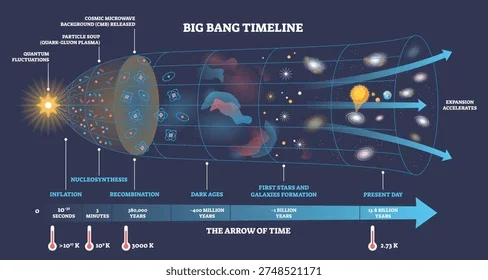
The further back astronomers look in space, the earlier in the universe's history they can see.
Very distant galaxies can act like windows into the earlier stages of galaxy building.
This makes a spatial map also a kind of history map.
A cosmic map does not just show where things are.
It can also show what the universe looked like at different times in its past.
11.The Expanding Universe
Short description: The movement of distant galaxies shows that the universe is expanding.
In the 1900s, scientists found that distant galaxies generally show a redshift, which means their light is shifted to longer wavelengths.
The connection between distance and how fast things are moving became a key idea in modern astronomy.
This idea is known as Hubble’s law, which says that, on large scales, the farther away a galaxy is, the faster it appears to be moving away.
Modern measurements have greatly improved our understanding of this relationship.
The universe is expanding, so cosmic maps need to take into account how distances change over time.
Astronomers use redshift to determine how fast an object is moving away and, using cosmological models, to find out how far away it is and how far back in time we are seeing it.
This means the spectrum of a galaxy becomes another part of the cosmic map.
12.Standard Candles and the Cosmic Distance Ladder
Short description: Some objects in space help scientists measure distances that are too far for direct methods.
Astronomers use objects that have a known or predictable brightness as standard candles.
Cepheid variable stars are an example.
Their brightness changes in a way that is connected to how bright they are in reality.
By comparing how bright they appear to how bright they actually are, scientists can find out how far away they are.
Type Ia supernovae are another important tool for measuring distance.
These events can be very bright and are visible even from great distances, which makes them useful for studying the history of the universe's expansion.
The cosmic distance ladder connects different methods of measuring distance.
Each step on the ladder helps astronomers find more accurate distances further into space.
13.The Role of Space Telescopes
Short description: Space-based telescopes help overcome many problems caused by Earth’s atmosphere.
Earth’s atmosphere is important for protecting life but can make astronomy difficult.
Atmospheric turbulence can make images blurry, and some types of light can not pass through the atmosphere.
Space telescopes avoid these issues.
Telescopes like the Hubble Space Telescope and the James Webb Space Telescope have greatly improved our ability to observe distant and faint objects.
Different telescopes study different types of light and therefore show different parts of the universe.
For example
Optical telescopes study visible light and show stars as we see them.
Infrared telescopes can see through dust and reveal cooler objects.
Radio telescopes can detect gas and other features.
X-ray telescopes observe very energetic environments.
To make a complete cosmic map, we need to look at the universe from many different angles.
14.Mapping Through Color and Chemistry
Short description: The colors and spectra of stars tell us about their physical and chemical makeup.
A star’s light is not just bright or dim.
Its spectrum gives a detailed fingerprint of its chemical makeup.
Astronomers can use this information to find out how much of different elements are present, such as
Hydrogen.
Helium.
Carbon.
Oxygen.
Magnesium.
Silicon.
Calcium.
Iron.
The composition of a star gives hints about which generations of stars it belongs to.
The first stars were mostly made of hydrogen and helium.
Later stars had heavier elements that were made by earlier stars.
So, stars made of different chemicals can help astronomers learn how the Milky Way has changed through time.
A map of the stars can show where they are and also what they are made of.
15.Mapping Star Formation
Short description: Stellar maps can show where new stars are being born.
Stars form in thick clouds of gas and dust.
When these clouds collapse due to gravity, they can form protostars and, under the right conditions, new stars.
Areas where stars are forming can be found by looking at different types of light.
Looking at infrared and radio waves is especially useful because new stars can be hidden by thick dust clouds.
By mapping these areas, scientists can learn how galaxies keep making new stars over time.
The way young stars are spread out can also show spiral patterns and areas where a lot of activity is happening in galaxies.
16.Stellar Populations and Galactic Archaeology
Short description: Different groups of stars hold clues about how galaxies were formed and changed over time.
Scientists often group stars into different categories based on things like their age, how much metal they have, and where they are located.
Newer stars are usually found in the galaxy's flat part, especially where stars are being made.
Older stars can be found in the galaxy's outer area and in groups called globular clusters.
Studying these groups is like doing archaeology.
Instead of looking at old buildings or objects, scientists look at
How old the stars are.
What elements they contain.
How they move around.
Where they are located.
How different groups of stars are connected.
These clues help scientists understand the history of the Milky Way.
This field is sometimes called galactic archaeology because the stars we see today hold evidence of past events in the universe.
17.Building a Dynamic Star Map
Short description: The most advanced star maps show not only where stars are now, but also where they are going.
In the past, star charts treated stars as if they do not move.
But modern astronomy shows this is not entirely true.
Stars actually move in space, and their positions change over time.
A dynamic star map can show:
Where stars are right now.
How they move across the sky.
How fast they are moving toward or away from us.
Where they will be in the future.
Where they came from.
This means star maps are becoming more like four-dimensional models.
Instead of just asking, “Where is this star?” astronomers can also ask, “Where is it now, where did it come from, and where will it go?”
This kind of information is important for understanding how the Milky Way changes over time.
18.Challenges in Creating a Map Made of Starlight
Short description: Building a good star map is hard because of many tough challenges.
Even with great technology, making an accurate star map is still very difficult.
Some big challenges include
Stars are very far away, so measuring their distances is hard.
Space dust can block some of the light.
There are mistakes in measuring distances and speeds.
When many stars are close together, it’s hard to tell them apart.
Very distant stars are too faint to see.
Stars don’t move in simple paths.
No one telescope can see everything.
Modern surveys create a lot of data.
Because of these challenges, scientists use tools like math, computer models, AI, and better equipment.
19.Why These Maps Matter
Short description: Cosmic maps help scientists learn about the beginning, history, and future of the Universe.
A full map of the stars is not just useful for finding objects in space.
It can help answer important questions like:
How did the Milky Way form?
How many small galaxies joined it?
Where is dark matter spread out?
How do stars move inside galaxies?
How fast is the Universe expanding?
How did galaxies change over time?
Where do new stars form?
How are elements spread throughout space?
How did the structure of the Universe develop?
These maps are not just products.
They are important tools for scientists to test and improve theories.
As observations become more accurate, astronomers can compare what is seen with what was expected by theories.
20.The Future of Cosmic Cartography
Short description: Future observatories and surveys will create larger, deeper, and more accurate maps of the Universe.
The future of making cosmic maps is likely to involve huge amounts of data and even better tools.
New and continuing surveys will help us better understand
Groups of stars.
How galaxies change.
Dark matter.
Dark energy.
Exoplanets.
The structure of the cosmos.
The early Universe.
By using large surveys, space telescopes, ground-based telescopes, spectroscopy, machine learning, and advanced simulations, astronomers can build very detailed models of the Universe.
The future map might have billions of objects, with lots of information about each one.
It might become more like a moving digital model of the Universe than a traditional map.
Conclusion
A map made of starlight is one of the most amazing scientific achievements of our time.
It starts with light coming from distant stars and changes it into information about distance, movement, chemistry, structure, and time.
Each star seen becomes a clue.
Every movement measured adds more information.
Every spectrum gives a chemical signature.
Every distant galaxy shows a part of the Universe’s past.
Modern missions like Gaia show how powerful this method can be.
By measuring stars’ positions and motion precisely, astronomers can build a 3D picture of the Milky Way and find evidence of its complex history.
Things like stellar streams, unusual orbits, chemical patterns, and different star populations help build a bigger picture of the galaxy’s origins and changes.
On a larger scale, this same idea applies beyond the Milky Way.
Galaxies form groups and clusters that connect through giant filaments, creating the cosmic web.
Their positions and movements help scientists learn about dark matter, how the Universe is expanding, and how large structures have evolved.
The most beautiful part of this map is that it’s also a map of time.
Because light takes time to travel, when we look at distant stars, we're actually seeing what the universe looked like in the past.
The farther we look, the older the light we see.
A telescope is not just a tool for seeing farther—it’s also a tool for looking deeper into the history of the cosmos.
The map is not complete yet.
Large parts of space are hard to see, many measurements are uncertain, and some parts of the universe are still not well understood.
Dark matter and dark energy remind us that much of the universe’s reality still can’t be explained directly.
But every new discovery adds another piece to the puzzle.
In the past, people used the stars to find their way across the oceans.
Now, we use them to understand the history of the universe.
What was once just a collection of mysterious lights in the sky has become a huge set of scientific data.
“A Map Made of Starlight” is more than just a description of mapping the stars.
It’s a way of thinking about how human knowledge grows.
We take weak signals from incredibly far away places, find meaning in them, link millions of observations, and slowly turn scattered points of light into a clear picture.
The universe may be huge, old, and mostly unknown, but its light still reaches us.
And through that light, we find a map.


Discussion