
The Promise of Plant Mucilage in Biomaterials
Plant mucilage is a thick, glue-like substance produced by plants that supports seed germination, water and nutrient storage, and defense. Flax and chia seeds are particularly rich sources of mucilage and are widely available, making them valuable in food and pharmaceutical applications. Mucilage also possesses well-documented medicinal properties due to its bioactive compounds and contains diverse polysaccharides. These natural sugars can mimic certain properties of the extracellular environment surrounding cells, making plant mucilage a promising material for the development of novel biomaterials.
Enhancing Collagen Scaffolds with Plant Mucilage
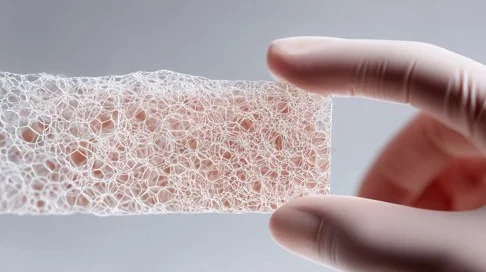
In recent studies, two types of collagen-based scaffolds were developed by incorporating flax and chia seed mucilage. Although collagen is widely used in tissue repair, it has limitations, including relatively low mechanical stability and other properties that can affect its performance. Therefore, plant mucilage was incorporated into collagen to improve its properties. A series of studies was conducted at the structural, cellular, and animal levels to evaluate how effectively these mucilage-blended collagen biomaterials could support wound healing.
Structural and Biological Properties of Scaffolds
Microscopic analysis showed that the mucilage-blended scaffolds had a well-connected network of fibers, which is important for supporting tissue growth. The scaffolds also showed good thermal stability, retained water effectively, and resisted enzymatic breakdown. In addition, they were well tolerated by cells and did not cause harmful effects when in contact with blood, making them promising candidates for use as biomaterials. The scaffolds also encouraged the formation of new blood vessels, an important step in supplying oxygen and nutrients to a healing wound.
In Vivo Evaluation in Animal Models
The scaffold was then evaluated as a wound dressing in Wistar rats following the creation of full-thickness skin wounds. The results showed that wounds treated with the mucilage-blended collagen scaffold closed significantly faster than those treated with collagen alone, indicating improved wound healing. Microscopic examination of the skin tissue showed appropriate collagen deposition and re-epithelialization, a process in which new skin cells grow to restore the damaged skin surface. These changes helped the injured tissue recover toward a structure similar to that of healthy skin.
The researchers also examined VEGFR2, a protein involved in the formation of new blood vessels. The results further confirmed that adding mucilage to the collagen scaffold promoted new blood vessel formation, supporting the development of a healthy blood supply during wound healing.
Conclusion and Future Potential
Overall, this preliminary study highlights the potential of plant mucilage as a natural ingredient for developing multifunctional biomaterials for soft tissue repair. Because plant mucilage is readily available and derived from renewable sources, it may offer an eco-friendly, cost-effective, and sustainable approach to wound healing and tissue regeneration.


Discussion