
Professional cycling is a sport defined by marginal gains. At the highest levels of competition, the difference between victory and the middle of the pack can be measured in seconds, watts, or subtle physiological advantages accumulated over months of preparation. For elite athletes, a balanced and carefully planned diet remains the foundation of health, recovery, and performance. Yet modern racing places extraordinary metabolic demands on the human body, often pushing competitors to seek strategies that extend beyond conventional nutrition.
Recent scientific research has revealed a growing interest in evidence-based nutritional interventions designed to optimize specific physiological processes before and during competition. Rather than replacing sound dietary practices, these approaches aim to fine-tune factors such as energy availability, fatigue resistance, muscle function, and cognitive performance. Among the many compounds investigated, one of the most familiar, and scientifically intriguing, remains caffeine, a substance whose influence on athletic performance continues to reshape how elite cyclists prepare for competition.
Takeaway I: Caffeine is More Than a Morning Cup of Joe
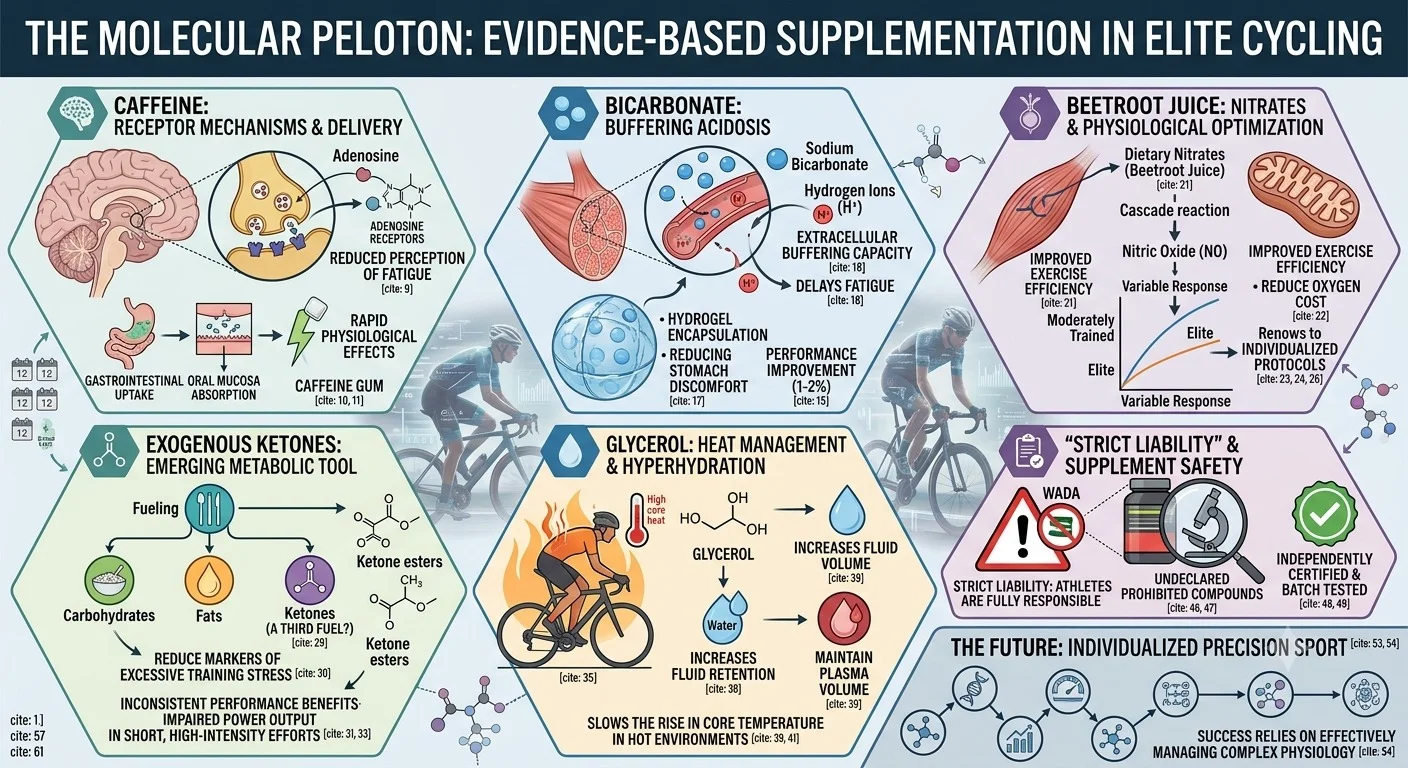
In modern cycling, caffeine has evolved from a morning ritual into one of the most extensively studied performance-enhancing nutritional aids. Its primary effect stems from blocking adenosine receptors in the central nervous system, helping reduce the perception of fatigue and effort while supporting focus, decision-making, and pacing during demanding stages.
Recent research has also changed how athletes consume caffeine. While capsules remain common, caffeine gum has gained attention because it allows absorption through the oral mucosa, producing faster physiological effects than traditional gastrointestinal uptake. This rapid delivery offers greater tactical flexibility, particularly during long races when timing can influence performance outcomes. Studies have further shown that smaller, repeated doses administered throughout prolonged events can be as effective as a large pre-race dose, while potentially improving gastrointestinal comfort and maintaining cognitive sharpness.
Yet optimizing mental performance is only one part of the equation. Beyond the brain, sports scientists have increasingly turned their attention to the body's internal chemistry and its ability to resist fatigue during repeated high-intensity efforts.
Takeaway II: The Bicarbonate Breakthrough, No More "Bicarb Guts"
One of the major physiological challenges during intense cycling efforts is acidosis, the accumulation of hydrogen ions that contributes to muscular fatigue and reduces force production. To counter this effect, sodium bicarbonate has become one of the most researched ergogenic aids in endurance sports, with studies consistently reporting performance improvements of around 1–2% during high-intensity events.
Despite its effectiveness, widespread use was historically limited by gastrointestinal side effects. Recent advances in delivery technology, however, have changed this landscape. Hydrogel-based formulations encapsulate bicarbonate within a protective matrix, reducing stomach discomfort and improving tolerance. As a result, athletes can increase their extracellular buffering capacity more reliably, helping delay fatigue during time trials, breakaways, and decisive race-ending attacks.
By extending the body's ability to sustain efforts above critical power, bicarbonate supplementation can influence race tactics in meaningful ways. Yet buffering the blood is only one strategy; the next frontier focuses on improving the efficiency of the muscle fibers themselves.
Takeaway 3: The Fitness Paradox of Beetroot Juice
Dietary nitrates, most commonly consumed through concentrated beetroot juice, have attracted significant attention for their ability to improve exercise efficiency. By increasing nitric oxide availability, nitrates can reduce the oxygen cost of exercise and enhance tolerance to high-intensity efforts. These benefits are particularly evident in recreational and moderately trained athletes.
However, research has revealed a notable limitation at the highest levels of performance. Elite cyclists with exceptionally high aerobic capacities often experience smaller or even negligible gains, likely because years of intensive training have already optimized many of the physiological pathways influenced by nitric oxide. In response, researchers have begun investigating longer supplementation protocols and higher nitrate doses rather than relying solely on acute pre-race intake.
Emerging evidence also suggests that nitrates may influence muscle contractile function, including calcium handling and force production, potentially benefiting explosive efforts such as attacks, sprints, and track events. This variability in response highlights the growing need for individualized nutrition strategies in elite sport.
Takeaway 4: Exogenous Ketones, Miracle Fuel or Energy Illusion?
Exogenous ketones have emerged as one of the most debated developments in sports nutrition. Often described as a potential “third fuel” alongside carbohydrates and fats, they have attracted interest for their possible role in supporting energy metabolism during the extreme demands of multi-stage cycling events. Yet their performance benefits remain far from settled.
Current evidence suggests that ketones may help reduce markers of excessive training stress during prolonged competitions, but their effects on performance are inconsistent. In some situations, particularly short, high-intensity efforts, ketone supplementation may even impair power output due to alterations in acid-base balance. Researchers have therefore explored combining ketone esters with sodium bicarbonate to offset these effects and improve tolerance.
Another intriguing observation is that athletes consuming ketones often increase their overall energy and carbohydrate intake, raising the possibility that some reported benefits may stem from improved fueling and recovery rather than from ketones themselves. As a result, their precise role in elite cycling remains an active area of investigation.
Takeaway 5: Glycerol’s Legal Comeback for Heat Management
Heat management is one of the most important challenges in endurance sport. As core body temperature rises, physiological strain increases and performance can decline, regardless of an athlete’s fitness level. For this reason, strategies that improve hydration and temperature regulation have become valuable tools in elite cycling.
One approach is glycerol-induced hyperhydration. When consumed alongside a large volume of fluid, glycerol increases fluid retention by creating an osmotic effect that helps the body store more water than hydration alone. This expanded fluid reserve can help maintain plasma volume, support cardiovascular function, and slow the rise in core temperature during competition in hot environments.
The strategy is not without drawbacks. Retaining additional fluid increases body mass, which may reduce climbing efficiency in cooler conditions. As a result, glycerol supplementation is typically reserved for races where heat stress is expected to be a major performance limiter. In those settings, even small improvements in thermoregulation can translate into meaningful competitive advantages.
Takeaway 6: The "Strict Liability" Trap, The Dangers of the Wild West
In elite sport, performance gains are only valuable if they are achieved safely and within anti-doping regulations. This has become increasingly challenging in a supplement industry that remains inconsistently regulated across many regions of the world. Under the principle of strict liability, athletes are fully responsible for any prohibited substance detected in their samples, regardless of whether contamination was intentional or disclosed on the product label.
Recent investigations have highlighted the scale of this risk. Analyses of commercially available supplements have repeatedly identified undeclared stimulants, anabolic agents, and other prohibited compounds in products marketed as performance enhancers or weight-management aids. Such findings underscore a critical reality: marketing claims and “natural” labels offer no guarantee of safety or compliance.
As a result, elite athletes and professional teams increasingly rely on independently certified supplements that undergo rigorous batch testing. In a sport where marginal gains matter, protecting an athlete’s health, reputation, and eligibility remains the most important performance strategy of all.
The Future of the High-Tech Human
Elite cycling is increasingly shaped by the ability to optimize physiology at the molecular level. From caffeine and bicarbonate to nitrates, ketones, and advanced hydration strategies, modern sports nutrition has evolved beyond simply meeting energy demands. The focus is now on precisely targeting the biological mechanisms that influence fatigue, recovery, and performance.
Yet the growing sophistication of these interventions also highlights an important reality: supplements cannot replace training, recovery, and sound nutrition. Their value lies in fine-tuning an already highly developed athlete.
As research continues to uncover new ways of enhancing performance, the future of cycling will likely depend on increasingly individualized approaches tailored to specific athletes and race demands. In this era of precision sport, success may be determined not only by power output and endurance, but by how effectively athletes manage the complex physiology that underpins them.



Discussion