
Drop a grain of sand and a feather from the same height. The sand plummets straight down. The feather drifts, swirls, and might never land where you expect. Now imagine those particles are medicine, your lungs are the target, and getting the landing wrong means the difference between treatment and failure.
This is the challenge facing every inhaled medication, from asthma relievers to experimental vaccines. Too large, and particles crash into your throat before reaching the lungs. Too small, and they behave like that feather, floating right back out with your next exhale. The solution lies in a precise window, a Goldilocks zone where particle size determines not just whether medicine reaches your lungs, but exactly where inside them it lands.
The Breathing Highway: Where Different Particles End Up

Your respiratory system is a branching highway network spanning from your mouth to microscopic air sacs deep in your chest. But unlike roads, this system sorts traffic by size, and the sorting is ruthless.
Particles larger than 10 micrometers never make it past the upper airways. These behemoths slam into the back of your throat through a mechanism called inertial impaction (Darquenne, 2020). As air rushes around corners in your windpipe and bronchi, heavy particles cannot follow the curves. They impact the airway walls like trucks that cannot make a tight turn, depositing in the oropharyngeal region, where they are swallowed rather than absorbed.
The magic happens between 1 and 5 micrometers. These particles are small enough to navigate the respiratory tree but large enough to settle where needed through gravitational sedimentation. A particle in this range entering the central airways slows as air velocity drops in the smaller bronchioles, allowing gravity to pull it onto the airway surfaces. This is the sweet spot for most inhaled drugs.
Particles smaller than 1 micrometer present a different problem. They are so light that Brownian motion takes over, the random jittering caused by air molecules bouncing them around. Many remain suspended in the air you breathe and exit your lungs entirely during exhalation. For particles below 100 nanometers, this effect is so strong that most never deposit at all despite reaching the deepest lung regions.
The data backing these ranges is solid. Studies tracking particle deposition in human volunteers show that the 1-5 micrometer window achieves the highest lung deposition, typically 20-30% of the inhaled dose reaching the lower respiratory tract (Heyder et al., 1986). Compare this to particles above 10 micrometers, where throat deposition can exceed 80%, meaning most of your medicine ends up swallowed, not inhaled (Carvalho et al., 2011).
The Physics Behind Precision Landing
Understanding where particles land requires understanding how they move. Three forces govern particle behaviour in your airways, and each dominates at different size ranges.
Inertial impaction rules large particles. When airflow changes direction rapidly at airway bifurcations, particles with high momentum cannot follow. The aerodynamic diameter determines this momentum, accounting for both particle size and density. A porous 10-micrometer particle might behave like a solid 5-micrometer sphere, which is why pharmaceutical scientists obsess over particle density and shape, not just size.
Gravitational sedimentation takes over for intermediate particles. In the smaller airways where airflow slows dramatically, particles drift downward at rates determined by their aerodynamic diameter. A 3-micrometer particle settles about 10 times faster than a 1-micrometer particle, giving it more opportunity to deposit during the brief seconds air spends in small airways. The residence time in each airway generation determines deposition efficiency, which is why breath-holding after inhalation improves drug delivery.
Brownian diffusion governs the smallest particles. Below 0.5 micrometers, random thermal motion overwhelms gravity and inertia. These particles drift in random walks, occasionally contacting airway walls. The smaller the particle, the faster it diffuses, which is why nanoparticles below 100 nanometers can deposit in alveoli through diffusion despite lacking gravitational settling. However, many also diffuse right back into the airstream and exit the lungs.
Breathing patterns interact with these mechanisms in ways that matter clinically. Slow, deep inhalation favours sedimentation by allowing more time for particles to settle. Rapid, shallow breaths increase impaction in central airways (Labiris & Dolovich, 2003). This is why proper inhaler technique is so critical and why some patients fail therapy, not because their medicine is ineffective, but because they breathe incorrectly.
Engineering the Pharmaceutical Sweet Spot
Creating particles in the therapeutic window is harder than it sounds. You cannot simply grind drug powder to the right size because the same forces that determine where particles land in the lungs also determine how they behave in powder form. Particles around 3 micrometers are small enough to be highly cohesive, clumping together into aggregates that behave like much larger particles.
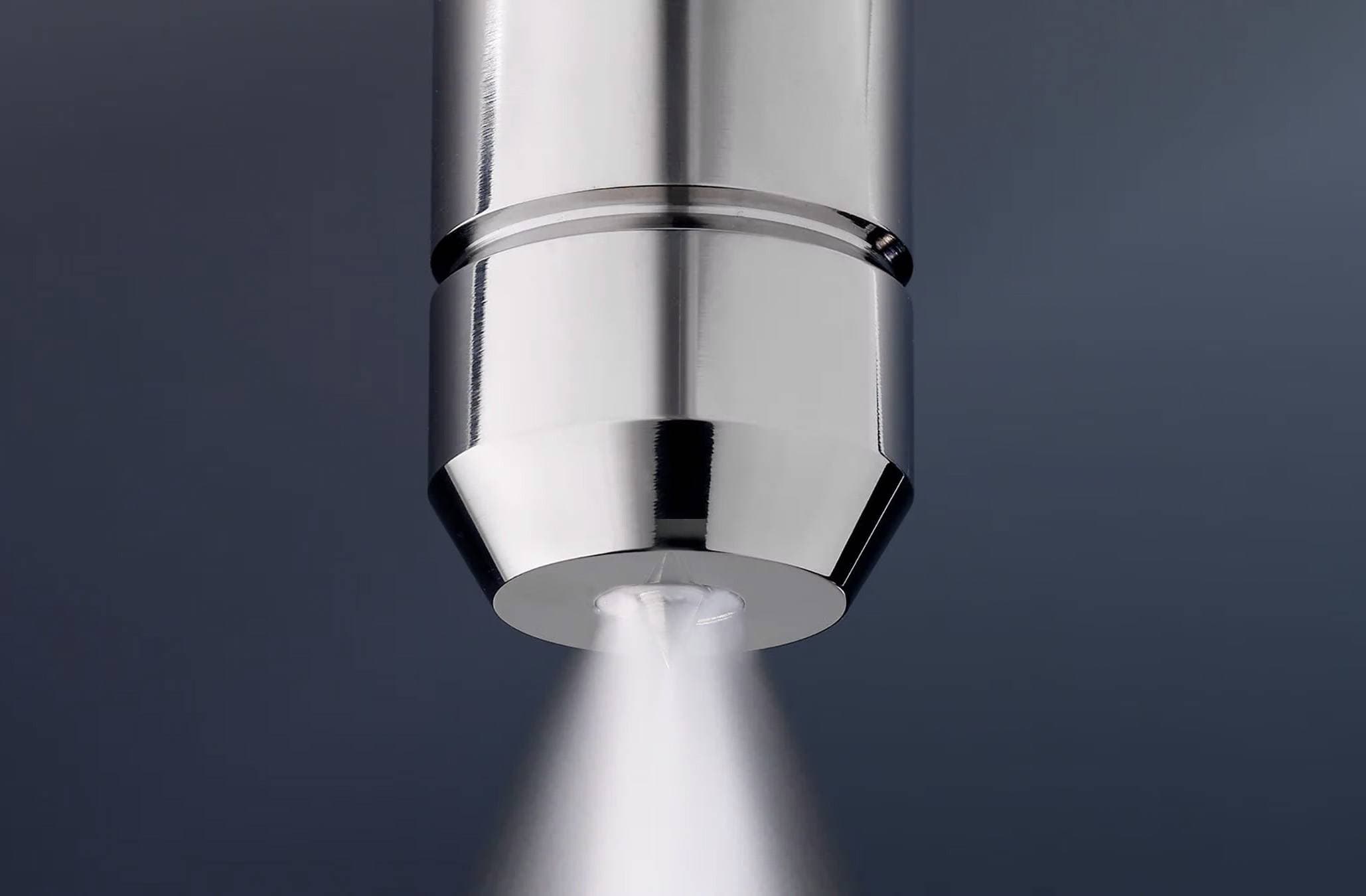
Pharmaceutical scientists solve this through particle engineering. Spray drying is a technique where drug solutions are atomized into hot gas, evaporating solvent to leave behind precisely sized particles (Vehring, 2008).
By controlling droplet size, feed concentration, and drying conditions, manufacturers can target specific aerodynamic diameters. The technique is elegant, a continuous process that converts liquid formulations into dry powders in seconds, but it requires careful optimization. Outlet temperatures must be low enough to preserve heat-sensitive drugs while high enough for complete drying.
Surface modification provides another tool. Coating particles with hydrophobic amino acids like leucine reduces aggregation by minimizing particle contact area. These excipients migrate to particle surfaces during drying, creating a smoother exterior that improves powder flow and makes it easier to break up aggregates during inhalation (Chow et al., 2007).
Carrier-based formulations take a different approach, mixing micronized drug particles with larger carrier particles, typically lactose crystals (Pilcer & Amighi, 2010). During inhalation, drug particles separate from carriers through turbulent forces in the inhaler and the patient's airways. The carriers are too large to enter the lungs and are safely swallowed. This strategy leverages the better flow properties of large particles while ultimately delivering small particles to the lungs, although separation efficiency varies among patients and devices.
When Size Goes Wrong: Clinical Consequences
Getting particle size wrong has real consequences. Consider inhaled corticosteroids for asthma, where particles larger than optimal deposit in the throat and mouth. This causes local side effects like oral thrush and hoarseness while delivering less drug to the inflamed airways. Conversely, particles that are too small may reach the deep alveoli, where there are fewer corticosteroid receptors, and inflammation is less relevant for asthma control. The result is wasted drug and potentially increased systemic absorption, raising the risk of side effects like growth suppression in children.
The challenges multiply when you consider that lungs change with disease. Airways in COPD patients are narrowed and obstructed, altering deposition patterns (Labiris & Dolovich, 2003). Mucus hypersecretion in cystic fibrosis traps particles before they can reach epithelial surfaces. Inflammation swells airway walls, changing branching angles and airflow patterns. Particle sizing optimized for healthy lungs may perform differently in diseased tissue, which is why clinical trials sometimes show unexpected variability in drug response.
The Future: Precision Beyond Size
The next generation of inhaled therapies is moving beyond simple size control toward multifunctional particle engineering. Researchers are developing particles that change size after inhalation, starting small enough to evade mucociliary clearance, then swelling in the aqueous lung environment to prevent exhalation. The concept, called a "Trojan horse" approach, could extend residence time from hours to days.
Shape is emerging as another control parameter. Elongated particles deposit differently than spheres, with rod-shaped particles more likely to impact in airways, while discs can evade macrophage uptake. Porous particles achieve large geometric sizes with low aerodynamic diameters, improving dispersibility while maintaining respirable properties. Early data suggest these advanced particles can double fine particle fractions compared to conventional formulations.
Your lungs are a sophisticated sorting machine, separating particles with micrometer precision. Pharmaceutical science has learned to work with this machinery rather than against it, engineering particles that navigate your airways to land exactly where needed. Particle size is a fundamental constraint imposed by physics, and respecting it is the difference between medicine that works and powder that goes nowhere.




Discussion