
1. Introduction: A Different Starting Point
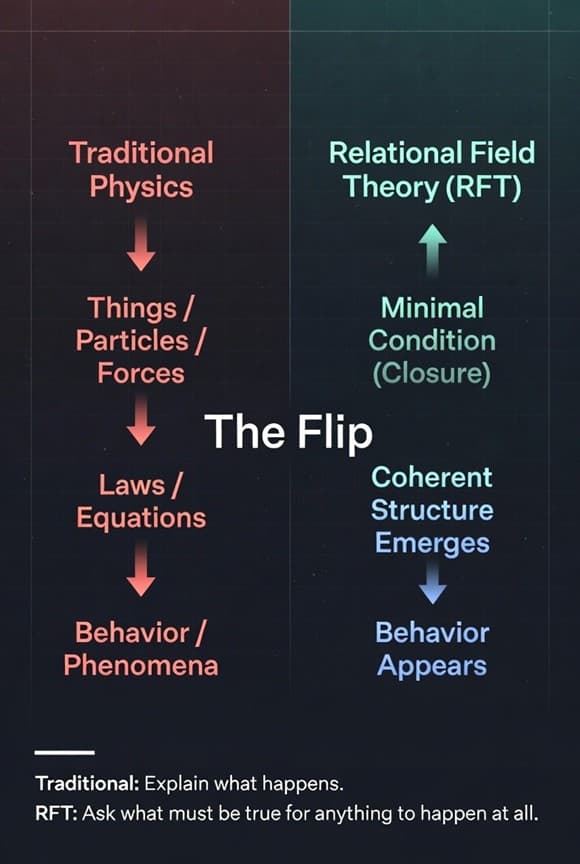
Most scientific frameworks begin by assuming the existence of fundamental entities:
particles
fields
spacetime
They then ask how those entities interact.
This work begins with a different question:
What allows anything stable to exist at all?
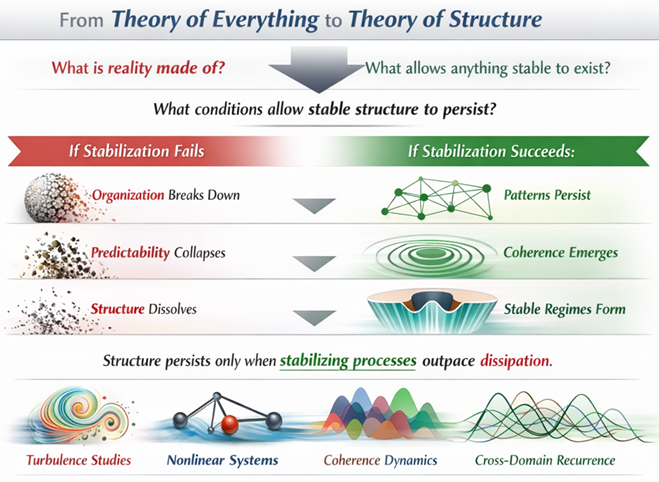
Before objects, laws, or equations can be described, something more basic must occur:
something must persist long enough to be identified.
This shifts the focus from what exists to the conditions under which anything can exist stably.
2. Core Concept: Persistence Under Constraint
Across systems, a simple but powerful pattern appears.
In any system, there is a continuous tension between:
stabilization — processes that build, maintain, or reorganize structure
dissipation — processes that break down, disperse, or degrade structure
If stabilization is insufficient, structure collapses.
This leads to a minimal structural statement:
Structure persists only when stabilization processes outpace dissipation.
This idea is not limited to physics. It applies to:
physical systems
biological systems
social systems
computational systems
It is directly observable in everyday experience.
3. Governing Principle: A Minimal Structural Constraint
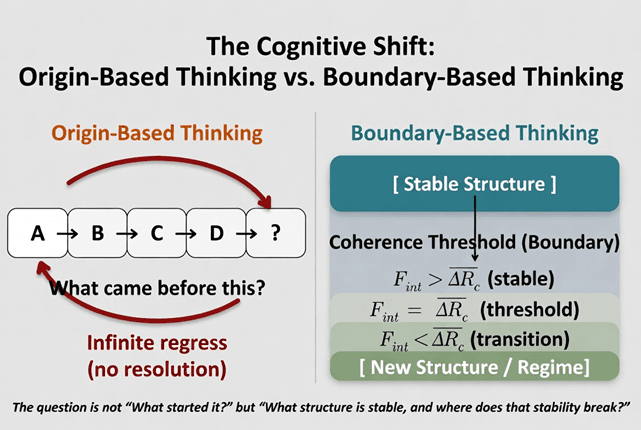
This balance can be expressed in a simple form:
This is not proposed as a universal physical law.
Instead, it is a minimal structural constraint:
Any system that persists must satisfy a balance between stabilization and dissipation.
4. Recurrence Across Systems
This structural pattern appears independently in many systems:
Turbulence
Near boundaries, directional organization stabilizes structures.
In bulk flow, mixing dominates and structure dissipates.
Nonlinear Systems
Solitons persist when nonlinear self-focusing balances dispersive spreading.
Otherwise, waves disperse.
Quantum Systems
Stable, definite records appear only under conditions where relational structure remains sufficiently persistent against decoherence.
Biological Systems
Living organisms survive through continuous repair and regulation against degradation.
Despite very different underlying mechanisms, the same condition appears:
Persistent structure requires stabilization to overcome dissipation.
5. Implications: A Shift in Perspective
This principle leads to a reframing of several foundational ideas:
1. Structure is not fundamental
Stable objects and laws are not starting points.
They are late-stage outcomes of sufficient stabilization.
2. Stability is regime-dependent
Structure exists only in environments where stabilization dominates.
3. Breakdown is the default without sustained stabilization, dissipation dominates.
Without sustained stabilization, dissipation prevails.
4. Predictability emerges
Stable regimes allow consistent behavior, enabling laws and mathematics.
This leads to a broader shift:
From searching for a “Theory of Everything”
toward exploring a Theory of Structure
6. Minimal Formal Connection to Relational Field Theory
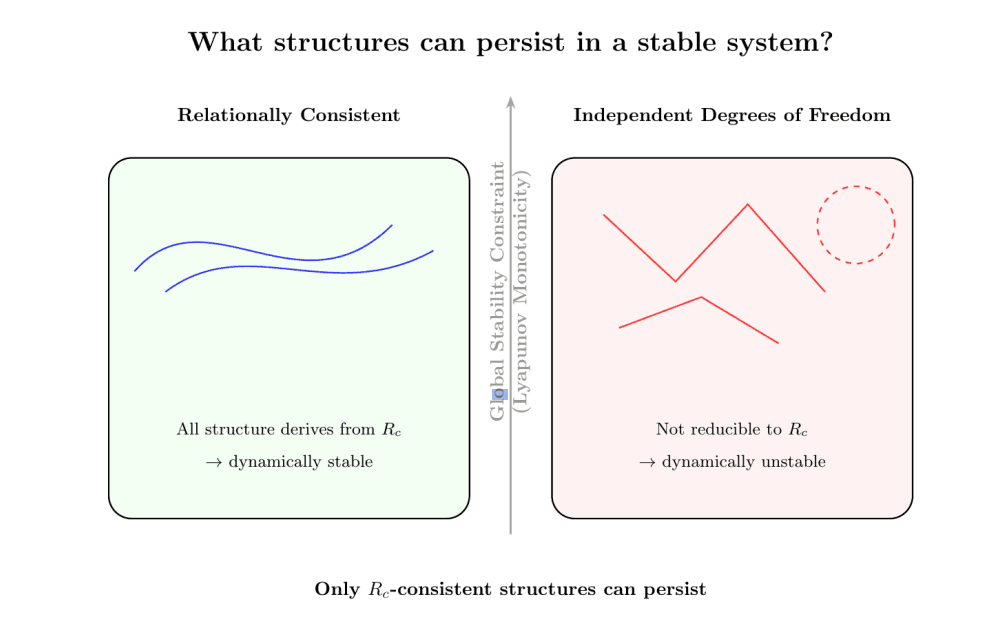
Within Relational Field Theory (RFT), this idea is formalized using coherence dynamics:
represents relational coherence
captures dissipative decay
represents coherence-preserving interactions
This provides a concrete framework for measuring and testing persistence in physical systems.
7. Why This Matters
The principle presented here does not introduce new particles, forces, or mechanisms.
Instead, it identifies a shared structural condition:
stability is not assumed — it must be maintained.
This perspective allows:
comparison across disciplines
identification of stability regimes
interpretation of emergence in a unified framework


Discussion