
Training for an Olympic-distance triathlon is an exercise in managing a "three-headed beast." It is a relentless juggling act where the anaerobic power of a 1.5km swim, the tactical drafting of a 40km bike leg, and the metabolic endurance of a 10km run collide. For decades, coaches relied on "old school" intuition and linear progressions to solve this puzzle. Yet, we have all seen the "paper-perfect" athlete, the one with elite V02 max and power numbers, suddenly crumble in the final miles.
Why does the "perfect" plan fail when the heat rises in the Pain Cave? The answer lies in the non-linear complexity of human resilience. Fortunately, we are moving into a data-driven era. By applying advanced machine learning models like NGBoost (Natural Gradient Boosting) and LASSO (Least Absolute Shrinkage and Selection Operator), sports scientists are finally peeling back the layers of race-day reality. These models don't just predict averages; they handle the messy, non-linear interactions between drafting, fatigue, and recovery that traditional statistics miss. The findings are often counter-intuitive, challenging the very hierarchy of how we train.
The Running Paradox
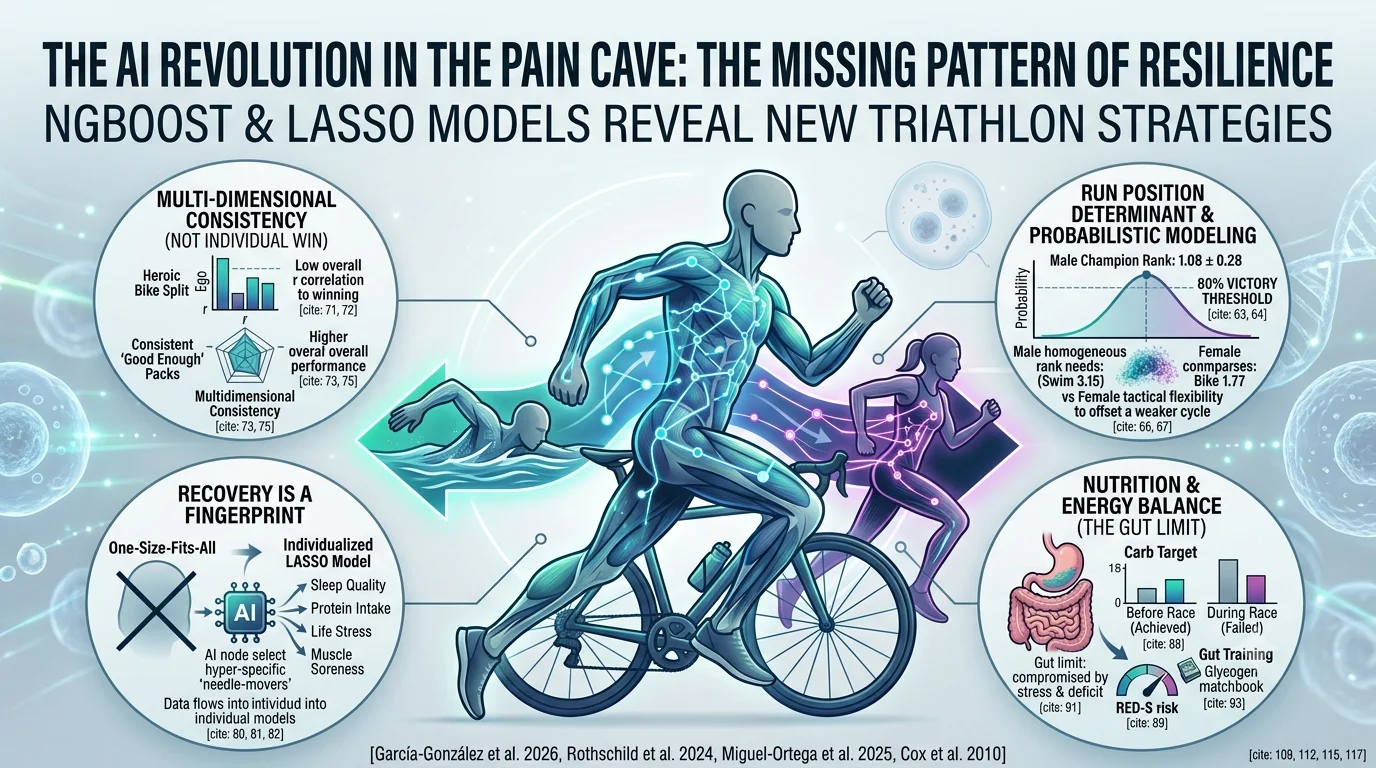
In elite triathlon, the swim and bike segments are often viewed as the "decisive" moments. However, the data reveals a far more lopsided reality. According to García-González et al. (2026), running is the ultimate "great separator." Utilizing NGBoost probabilistic modeling, researchers identified the exact positions required to ensure victory.
While staying "in the game" (a 40% probability threshold) allows for some flexibility, ensuring a win (the 80% threshold) requires a surgical level of run performance. For male winners, the average run position must be a staggering 1.08 ± 0.28. This isn't just about being fast; it’s about being undisputed. Interestingly, the path to this run differs by sex. Female winners exhibit a unique tactical flexibility, occasionally offsetting a weaker cycling rank (averaging 25th at the 80% threshold) with exceptional swim and run splits. Male winners, by contrast, must be far more homogeneous, requiring a swim rank of 3.15 and a bike rank of 1.77 to protect their 80% victory probability.
This creates a new training hierarchy. Competent swimming and cycling are merely the "barriers to entry", the prerequisites that keep you in the tactical lead group. But elite running is the only "Legend" leg. If you aren't training to be the fastest runner in the field, your probability of standing on the top step drops precipitously, regardless of a "heroic" bike split.
The Consistency Myth
Perhaps the most liberating finding for the modern athlete is that individual brilliance in a single segment is almost entirely uncorrelated with overall success. García-González et al. (2026) found a near-zero correlation (r = 0.004 to -0.012) between being the fastest performer in a specific discipline and winning the race.
The data on winners (Mean ± SD) shows that male champions actually average a swim position of 7.72 ± 8.62 and a bike position of 8.81 ± 10.69. They aren't "winning" these segments; they are maintaining "multidimensional consistency." This highlights the "Tactical Pack" concept: in drafting-legal races, finishing 10th or 30th in the bike leg often results in the exact same time if you are in the lead group.
Success isn't about being the absolute best at three sports; it’s about the intelligence to be "good enough" in the first two to allow your superior running to settle the score. Pushing for a segment win is often an ego-driven strategic error that drains the metabolic tank for no measurable time advantage.
Your Recovery is a Fingerprint, Not a Formula
If tactical consistency is the goal, then your ability to absorb training load is the primary currency. However, machine learning is proving that recovery is a biological fingerprint. Research by Rothschild et al. (2024) utilized LASSO models to predict Perceived Morning Recovery Status (AM PRS). They found that individualized models were significantly more accurate than group averages, because the "needle-movers" for recovery are hyper-specific.
For one athlete, "sleep quality" and "protein intake" might be the top predictors of readiness. For another, the model might identify "life stress" or "muscle soreness" as the primary drag on performance. The LASSO models are particularly effective here because they perform "feature selection," cutting through the noise of dozens of metrics to highlight the three or four that actually matter for you.
Stop using one-size-fits-all recovery plans. If your data shows your recovery is hyper-sensitive to life stress rather than training volume, your "training" should focus on stress management. Monitoring internal load, how your unique system responds to the stress, is now more vital than measuring external volume.
The "During-Race" Nutrition Trap and the RED-S Risk
Even a perfectly recovered athlete can fail if they enter the "Nutrition Trap." Miguel-Ortega et al. (2025) and Cox et al. (2010) highlight a frustrating gap: elite triathletes often hit carbohydrate targets before a race but fail to meet them during the event.
There is a "Double Trap" at play here. Many athletes, especially females, risk entering a state of Relative Energy Deficiency in Sport (RED-S) due to a "Negative Energy Balance." This is often exacerbated by high-fiber or plant-protein-heavy recovery diets that can lead to early satiety and insufficient caloric density. When this metabolic deficit meets the physiological stress of a 1.5km swim, the gut’s ability to process fuel is compromised.
Performance in the final 10km is limited not by your heart, but by your gut. "Gut training", practicing high-carb intake under race-intensity stress, is a strategic necessity to ensure you don't enter the run with an empty "glycogen matchbook."
The Hidden Metric: Drafting as Physiological Preservation
Resilience is often framed as the ability to suffer, but the data suggests that the most resilient athletes are those who suffer the least through intelligent tactics. Synthesis from García-González et al. (2026) and Miguel-Ortega et al. (2025) shows that the bike leg is actually a test of "physiological energy preservation."
Staying in the pack offers massive aerodynamic benefits, but it creates a paradox: this aerobic sport requires a highly efficient anaerobic system. You need the "burst" capacity to handle transitions and surges to stay in the pack. If you lack that anaerobic efficiency, you're forced to "yo-yo" at the back, burning through your glycogen stores just to stay attached.
Intelligence is a form of stamina. By using your anaerobic system to secure a spot in the pack, you are protecting the glycogen you will desperately need for the final leg. Resilience isn't just pushing harder; it’s the discipline to push less when physics allow it, saving your "matches" to light the fire during the final 10km.
Conclusion
As we look toward the future, it is clear that Artificial Intelligence is not here to replace the "soul" of the athlete. Instead, it provides a high-resolution map of the Pain Cave. The data tells a powerful story: Success in the modern triathlon is a multidimensional game where being "good enough" in two things gives you the physiological permission to be "extraordinary" in the third.
As you review your training, ask yourself: Are you training to win the stats on your watch, or are you training for the messy, tactical reality of race day? The algorithms have spoken, the road to the podium is paved with consistency, gut training, and the wisdom to save your best for last.



Discussion