
Introduction — Why This Question Matters
Few concepts in modern physics carry as much significance—or as much mystery—as the Planck scale.
It is the regime where gravitational effects become comparable to quantum effects, suggesting that both General Relativity and Quantum Field Theory should contribute to our description of nature.
Yet despite decades of extraordinary success, these two foundational theories do not combine into a single coherent framework at this scale. General Relativity accurately describes gravity and the large-scale structure of spacetime, while Quantum Field Theory successfully explains matter and the fundamental interactions at microscopic scales. Each has been validated extensively within its own domain, but neither provides a complete description of physical reality in the Planck regime.
This has made the Planck scale one of the deepest open questions in theoretical physics.
Traditionally, the discussion begins by asking:
What theory replaces our current descriptions?
But there is another question worth asking first.
Why do our two most successful physical descriptions appear to reach the limits of their validated domains at approximately the same scale?
A Different Perspective
The conventional search for quantum gravity focuses on constructing a new theory capable of unifying General Relativity and Quantum Field Theory.
Boundary Science approaches the problem from a different direction.
Instead of immediately searching for a replacement, it asks whether the Planck regime itself may represent a structural feature of scientific description.
Perhaps this remarkable coincidence is not accidental.
Perhaps the Planck scale marks a region where multiple descriptive frameworks simultaneously approach the limits of their applicability.
The conceptual interpretation proposed here is illustrated in Figure 1. Rather than treating the Planck regime solely as the point where existing theories fail, the figure presents it as a shared descriptive boundary where both General Relativity and Quantum Field Theory simultaneously approach the limits of their validated domains.
This shifts the question from:
"What theory comes next?"
to
"What determines the structural limits of our existing descriptions?"
The Boundary Science Interpretation
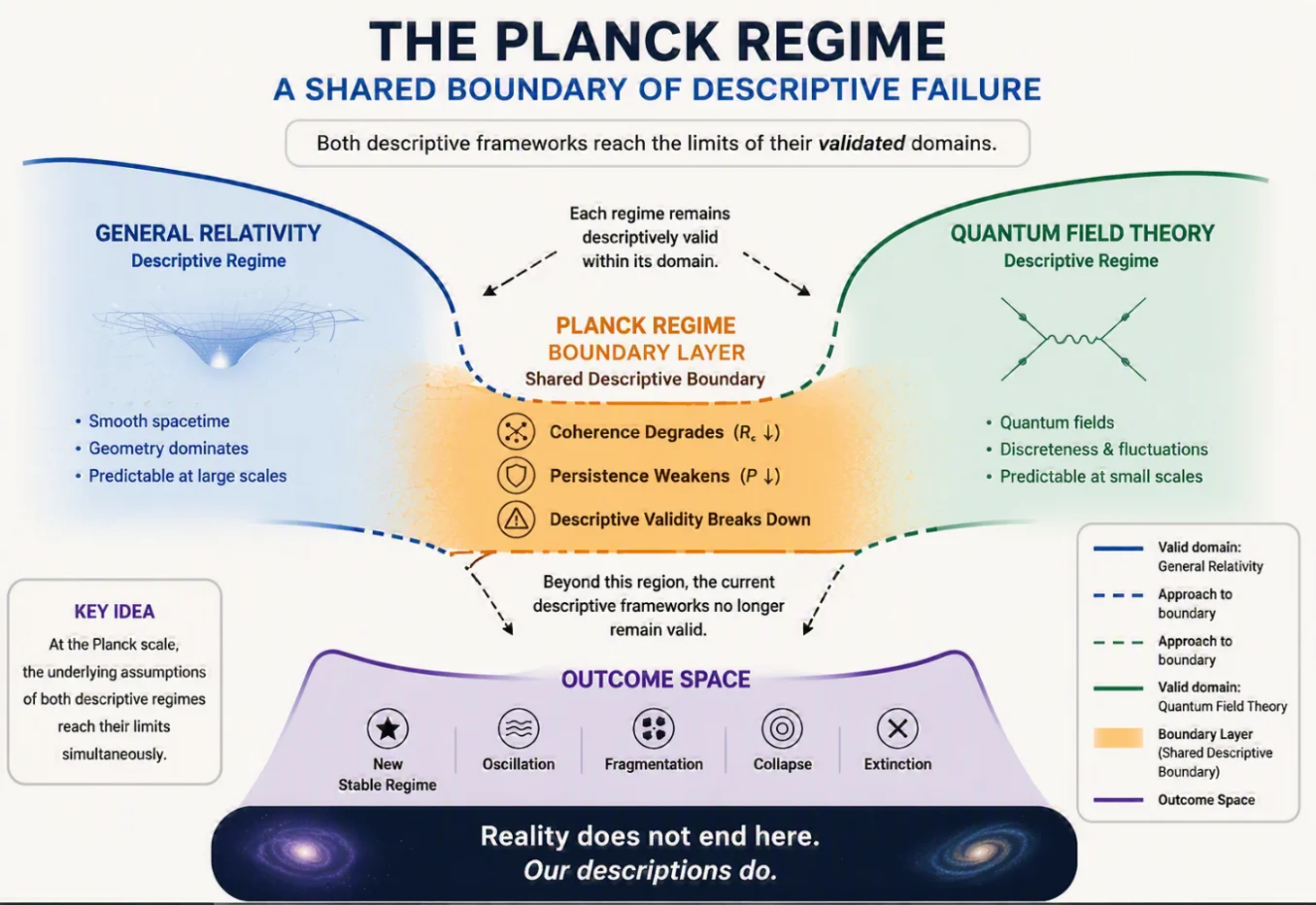
General Relativity and Quantum Field Theory each provide remarkably successful descriptions of nature within their respective domains.
From a Boundary Science perspective, the Planck regime can be interpreted as a shared descriptive boundary—a region where both frameworks simultaneously approach the limits of their validated applicability.
Conceptually, this relationship may be expressed as
indicating that the descriptive boundaries of the two frameworks intersect.
Within this shared boundary layer,
relational coherence degrades,
persistence weakens,
and the descriptive validity of both frameworks progressively diminishes.
The important distinction is that this interpretation concerns our descriptions, not necessarily reality itself.
The Planck regime may therefore represent a boundary of descriptive validity rather than an absolute boundary of nature.
Rethinking Descriptive Limits
This interpretation introduces three simple structural concepts.
Descriptive Regime
A descriptive regime is a mathematical framework whose variables, assumptions, and governing relationships remain internally consistent within a defined domain.
General Relativity and Quantum Field Theory are both highly successful descriptive regimes.
Boundary
Every successful description possesses limits.
A boundary represents the region where the assumptions supporting that description can no longer remain mutually consistent.
Shared Boundary
Sometimes multiple descriptive frameworks may approach those limits simultaneously.
Rather than representing the failure of reality itself, such regions may simply indicate that several independently successful models have reached the edge of their validated applicability.
Viewed in this way, the Planck scale becomes not merely a mathematical difficulty, but a structural boundary separating descriptive regimes.
What This Interpretation Does Not Claim
This perspective deliberately avoids several common misunderstandings.
It does not propose a completed theory of quantum gravity.
It does not replace General Relativity.
It does not replace Quantum Field Theory.
It does not claim to reveal the ultimate structure of physical reality.
Instead, it proposes a structural interpretation of why multiple successful physical descriptions appear to encounter their limits at approximately the same scale.
The emphasis shifts from replacing theories to understanding the conditions under which scientific descriptions remain valid.
Beyond the Planck Scale
If descriptive boundaries can themselves become objects of scientific investigation, then the Planck regime may represent only one example of a much broader class of phenomena.
Across physics—and perhaps across many scientific disciplines—stable mathematical descriptions exist only within identifiable domains of validity.
Understanding how those domains emerge, persist, and ultimately transition may itself become an important scientific question.
Within the developing Boundary Science framework, the Planck regime serves as a compelling illustration of this broader principle.
Rather than asking only,
"What theory comes next?"
Boundary Science also asks,
"How do we recognize when our current descriptions are approaching their structural limits?"
Conclusion
The Planck scale remains one of the deepest unsolved problems in modern physics.
Whether future progress comes through quantum gravity, new mathematics, or entirely different conceptual frameworks remains unknown.
Viewing the Planck regime as a shared descriptive boundary offers a complementary perspective.
It suggests that one of the most important scientific questions may not simply be how to replace our current theories, but how to understand the structural conditions under which scientific descriptions themselves remain valid.
Perhaps the Planck regime does not represent the end of physics.
It may instead represent the place where our most successful descriptions simultaneously reach the limits of their validated domains.




Discussion