
The Ghost in the Joyner Model
We have all witnessed the physiological "decoupling" that occurs late in a race, where at mile 20 of a marathon, a pace that felt like a metabolic steady-state two hours ago suddenly demands an all-out effort. Your velocity hasn't changed, but your internal load has shifted. This phenomenon exposes a significant gap in traditional performance modeling. For decades, the Joyner Model has predicted endurance success based on three pillars: VO2max, running economy (RE), and metabolic thresholds. However, as Jones & Kirby (2025) argue, these are "fresh state" snapshots. They fail to account for the "ghost in the model", the reality that these pillars are dynamic, decaying systems. Enter Physiological Resilience (or "durability"), the missing fourth dimension that explains why two athletes with identical "starting line" stats can finish twenty minutes apart.
Resilience is an Independent "Fourth Pillar" of Performance
Traditional exercise physiology often views an athlete’s profile as static. However, modern research, most notably the analysis of Eliud Kipchoge’s sub-two-hour marathon, suggests that elite dominance is defined by the slope of decline. While most runners see their critical speed and metabolic boundaries crumble under the weight of accumulated work, Kipchoge remains remarkably stable.
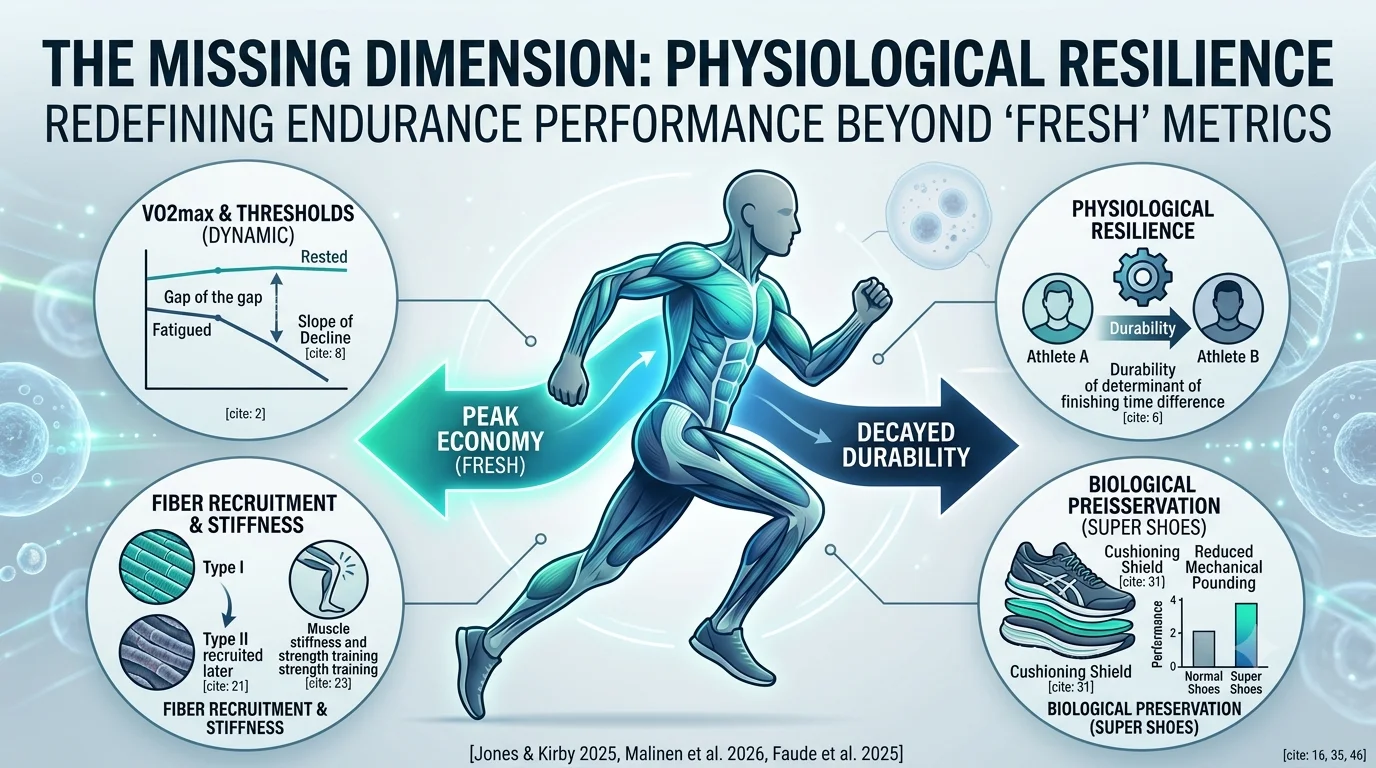
According to Jones & Kirby (2025), this stability is not just about a massive aerobic engine. It is about resisting "cardiovascular drift" and efficiency losses. A critical finding reveals that as a bout progresses, oxygen cost rises significantly. Approximately 30% of this increased VO2 during a 2-hour effort is attributed to a substrate utilization shift (a drop in RER), as the body transitions from carbohydrate to fat utilization, which requires more oxygen for the same rate of ATP resynthesis. True performance is determined not just by your peak capacity, but by your ability to maintain that capacity as your internal metabolic environment shifts.
The Reliability Trap, Not All Fatigue is Created Equal
How much of the observed decline reflects true physiology, and how much is simply measurement error? Until recently, this uncertainty limited the practical value of physiological resilience testing. Malinen et al. (2026) addressed this issue by examining the test–retest reliability of key resilience metrics in well-trained runners. Their findings revealed that maximal running speed (sPeak) was the most robust indicator of resilience, while heart rate and running economy drift also demonstrated good reliability, particularly during the later stages of prolonged exercise. The picture becomes more nuanced for VO₂max. Although the magnitude of its decline after prolonged exercise showed poor reproducibility, the fatigued VO₂max itself remained highly reliable. In other words, practitioners can confidently assess an athlete's physiological profile under fatigue, even if quantifying the precise extent of its deterioration remains considerably more challenging.
The Shield Effect
The "just run more" dogma is being replaced by a more sophisticated neuromuscular strategy. Jones & Kirby (2025) and Zanini (2024) highlight that the late-race collapse in running economy is often a failure of muscle fiber recruitment hierarchies.
As Type I fibers suffer from glycogen depletion or mechanical damage, the body is forced to recruit less-efficient Type II fibers. These "gas-guzzlers" require more oxygen to produce the same force, leading to a rise in VO2 for a given speed. Heavy strength training and plyometrics serve as "physiological armor" by increasing musculotendinous stiffness and delaying this Type II recruitment. The performance impact is staggering: Ronnestad et al. demonstrated that elite cyclists who added heavy strength training improved their 5-minute all-out performance even after 185 minutes of cycling, effectively shielding their top-end power from the erosive effects of volume.
The Female Resilience Advantage
Although men generally produce greater absolute power and speed in a fresh state, accumulating evidence suggests that women may possess superior physiological resilience during prolonged endurance exercise. In marathon running, women exhibit smaller late-race performance declines than men, indicating a greater ability to sustain pace as fatigue develops. Experimental studies report similar findings: during prolonged running, women preserve knee extensor strength more effectively, a response closely associated with maintaining running economy despite increasing fatigue. Together, these observations suggest that resilience is shaped not only by aerobic capacity but also by sex-specific neuromuscular and metabolic characteristics. Understanding the mechanisms underlying this apparent advantage could provide valuable insights into training strategies aimed at improving fatigue resistance across all athletes.
"Super Shoes" Are Not Just for Speed, They are Resilience Tech
The debate over advanced footwear (carbon plates and resilient foams) has shifted from mechanical "springs" to biological preservation. Jones & Kirby (2025) and Black et al. (2022) hypothesize that these shoes act as a "cushioning" shield, reducing the mechanical pounding that leads to muscle damage.
Critically, Black et al. (2022) found that these shoes improve performance in both the absence and presence of muscle damage. By retarding the timeline of Type II fiber recruitment and preserving glycogen stores, "super shoes" allow athletes to maintain their efficiency deeper into a race. Beyond race day, this technology enables higher training volumes and accelerated recovery, allowing athletes to "condition" their resilience over years of high-volume training without the traditional orthopedic cost.
The Future of the Greater Human
The emerging science of resilience presents us with a "Methodological Paradox." As Faude et al. (2025) observe, we currently prescribe training intensity based on a fixed percentage of a rested state (e.g., "90% of threshold"). However, because thresholds are dynamic, the athlete with the fastest fatigue onset is inadvertently working at a much higher relative intensity than intended. This "fixed intensity vs. shifting internal load" problem is the next frontier for coaches and physiologists.
Becoming a "greater human" in the high-performance community is not about your peak speed on a fresh set of legs. It is about the chronic, long-term training volume—accumulated over years—that converts Type II fibers and builds an unshakeable physiological base.
Are you training to be fast at the start, or are you training to be the one who hasn't slowed down by the finish?


Discussion