
Most people imagine biofortification as a simple recipe: add a few genes, make more vitamin, solve malnutrition. The papers here tell a more interesting story. In plants, the hard part is not just producing a nutrient. It is getting that nutrient into the right tissue, in the right form, without upsetting the plant’s own balance. That is why the most convincing advances in vitamin B1 engineering are not just about “making more,” but about rerouting, sequestering, and bypassing bottlenecks.
The biggest target is not the leaf, it is the part people actually eat
The review by Wang and Liu (2025) frames biofortification around a deceptively simple challenge: hidden hunger is widespread, but conventional fortification is limited because it is one-size-fits-all and can be unstable or inefficient. Their key point is that biofortification has to move nutrients into edible tissues, especially grains like rice, where polishing removes much of the vitamin content.
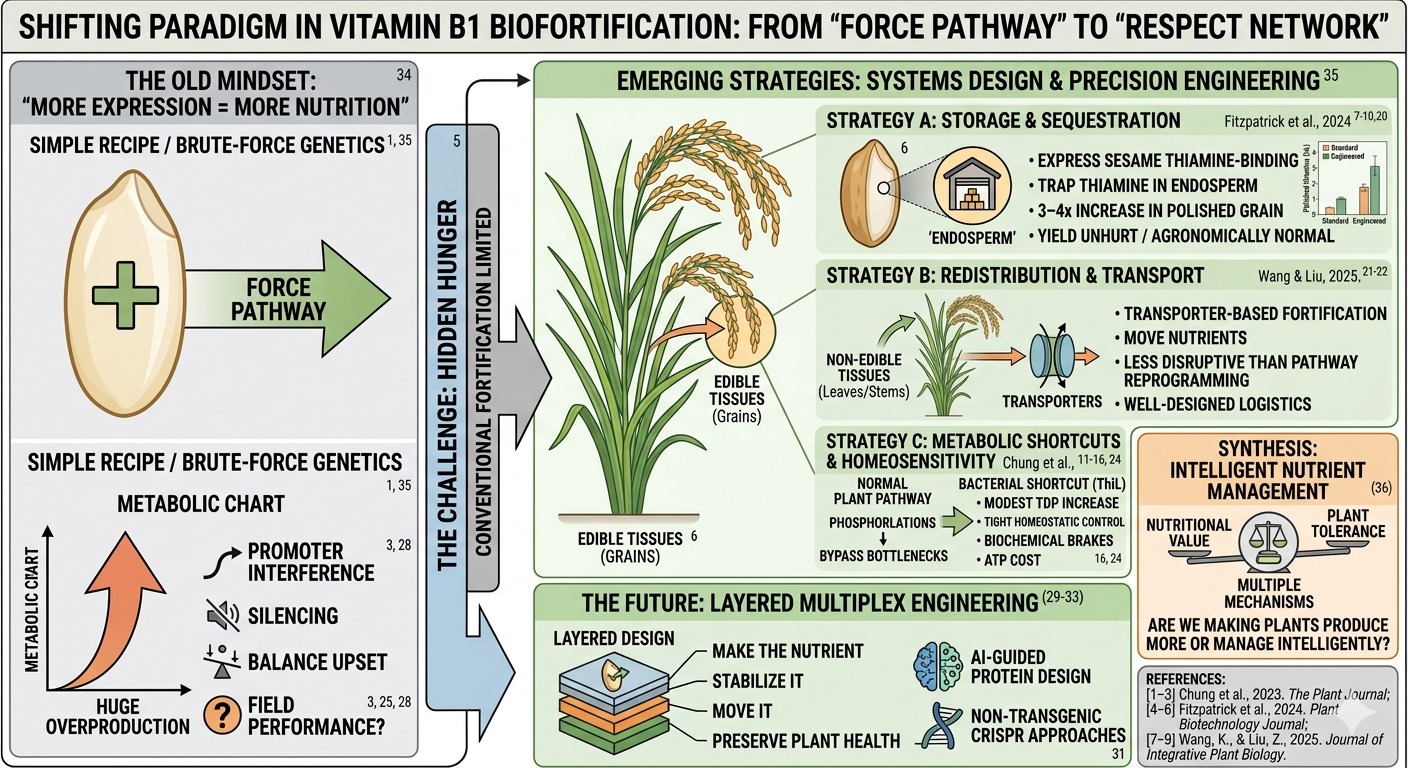
That is exactly why Fitzpatrick et al. (2024) are so interesting. Instead of trying to flood the whole plant with more thiamine, they expressed a sesame thiamine-binding protein in rice endosperm and saw thiamine rise in polished grain without hurting yield. The surprise is that a “storage” strategy can be more practical than a pure “production” strategy. Sometimes the plant already has enough nutrient; the trick is keeping it where people can actually consume it.
A bacterial enzyme can do in plants what plants never evolved to do
Chung and colleagues (Chung et al., 2023) took a bold detour: they introduced the bacterial ThiL enzyme, a TMP kinase, into Arabidopsis and rice. In bacteria, ThiL converts thiamin monophosphate directly into the active cofactor TDP. Plants do not normally use that shortcut; they first dephosphorylate TMP to thiamine and then phosphorylate it again.
What makes this paper compelling is not just that ThiL worked, but that it rescued a mutant phenotype and increased TDP in multiple compartments. In rice, endosperm-specific ThiL expression raised TDP and total vitamin B1 in seeds, but only modestly. That modesty is actually informative: plants keep vitamin B1 under tight homeostatic control, so even a clever shortcut runs into biochemical brakes.
Sometimes the smartest engineering move is not to synthesize more — it is to trap what is already there
The Fitzpatrick paper is a nice counterpoint to the “push harder” logic of metabolic engineering. Instead of forcing more thiamine biosynthesis, the authors used thiamine sequestration in the endosperm. The result was a 3–4-fold increase in polished grain thiamine, while the field-grown plants stayed agronomically normal. That is a powerful reminder that nutritional value can be improved by redistribution, not just by increased synthesis.
Wang and Liu place this in a broader framework: transporter-based biofortification can move nutrients from non-edible tissues into edible ones, which can be more efficient and less disruptive than reprogramming entire metabolic pathways. In other words, the future may belong less to “super-producing plants” and more to well-designed nutrient logistics.
Plants defend their vitamin balance so tightly that bigger edits do not always mean bigger gains
One of the most important lessons across these papers is that metabolism is not a hose you can simply turn up. Chung et al. show that even with an added bacterial pathway, TDP increases were moderate, and the authors point to ATP cost and homeostatic regulation as likely constraints. Wang and Liu similarly emphasize that multi-gene engineering is often limited by promoter interference, silencing, and co-expression imbalance.
This is why the field is moving toward more precise strategies: tissue-specific promoters, transporter engineering, promoter editing, and even protein evolution. The logic is shifting from “force the pathway” to “respect the network.” That shift matters because it may be the difference between a trait that looks good in a greenhouse and one that actually survives in the field.
The next wave of biofortification may be built from combinations, not single tricks
The review makes the future direction especially clear: the most promising path is likely multiplex engineering. That means combining biosynthetic pushes, nutrient-specific transport, promoter optimization, and AI-guided protein design. Wang and Liu even highlight the possibility of using non-transgenic CRISPR approaches to improve acceptance and reduce regulatory friction.
That matters because the most ambitious nutritional traits will probably not come from one hero gene. They will come from layered design: make the nutrient, stabilize it, move it, and preserve the plant’s own health while doing it. That is a much more elegant vision of crop engineering than the old “more expression = more nutrition” mindset.
Taken together, these studies point to a simple but powerful idea: biofortification is becoming less like brute-force genetics and more like systems design. The best outcomes may come from deciding not only what plants make, but where they store it, how they move it, and whether the plant can tolerate the change. That leaves a provocative question for the next generation of crop engineering: are we trying to make plants produce more nutrients, or to make them manage nutrients more intelligently?



Discussion