
Introduction
Space bioethics is not a simple continuation or exact replica of terrestrial bioethics; this would be such a narrow vision to carry. It is rather an unprecedented scenario that requires fresh ethical investigation and an enhanced moral compass. It is not just about establishing a settlement in a new place, but also about housing people who must build their moral foundations from the ground up due to the unknown environment they have chosen to inhabit. While classical bioethics examines moral issues arising in medicine, health, and life sciences on Earth, space bioethics addresses those same issues of sustaining life. However, it does so in a realm chartered by unprecedented conditions—such as chronic radiation exposure, reduced gravity, closed ecologies, long communication delays, and severe resource constraints—that require a reconfiguration of risks and responsibilities.
The survival-oriented interventions that fall outside of classical realm of living pose dilemmas and without any analogue to base the foundations off of the known criteria which makes it crucial to know what kind of framework would need to be applied in conditions that are no less than being strenuous making the portability of standard moral norms impossible to address under the lens of terrestrial bioethics that also looks into moral faced in the space.
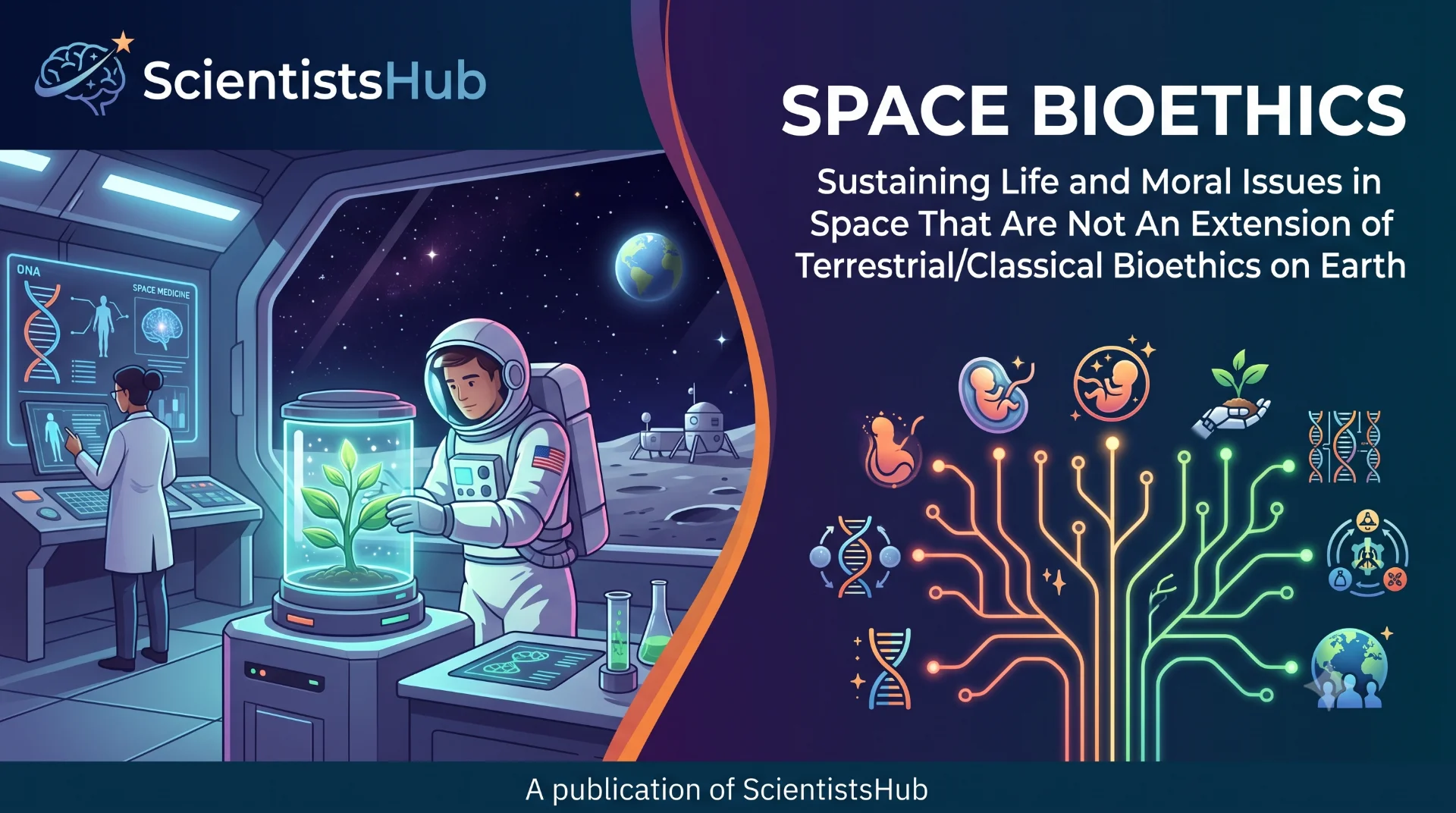
What is being explored in this article is about space bioethics. As stated above, space bioethics is about addressing moral issues of sustaining life in space but in a domain that is chartered by unprecedented conditions, It’s important to look into space bioethics due to presence of human life in space and because of the development of survivial - oriented interventions adopted in the space such as human bio-enhancement, human-machine integration, germline editing for adaptation and off-world reproduction (potentially via ectogenesis) that pose dilemmas similar to those on earth when dealing with moral issues around medicine, health sciences and life sciences. The fact that we are dealing with the same concepts in the space as well, it is imperative to delve into these issues in space as well to address ethical challenges in terms of doing no harm and justice.
Being in space does not free anyone of the obligation to do the right thing as we would on earth. Space bioethics examines the specific ethical concerns for humans in space and for earth-based activities that are undertaken in preparation for missions to space or for settlement in space. As pointed out by some other philosophers, one being Szocik, the only difference between space bioethics and classical bioethics is that space bioethics does not introduce further distinct moral dilemmas and issues like earth that requires fresh principles or situations.
This viewpoint does not hold true. While earth is faced with hostile environments from highly demanding situations, space is faced with extreme conditions where creating a live environment or sustaining life is not just beyond challenging but unprecedented. For this reason, it becomes crucial to find right ways to achieve the balance and with a bigger moral compass and ethical insights. With that understanding, stating that space bioethics does not deserve any attention in terms of moral and ethical implications is an inaccurate depiction based on the fact that the environment does not equate to human life on earth. Many researchers are choosing to house themselves in the space for discovery or other mission related reasons, that makes one wonder, would there be an ethical inclination to look into the fact if human race is even supposed to get into a different environment and/or habitat that has the potential to sustain them.
This in itself makes a bigger argument to explore space bioethics because we are not only looking into unchartered territory but also without completely understanding how the energy matter that exist there is interacting with human species and their existential needs. An example that comes to really understand the intensity of this point and a convincing argument is the movie “Jurassic Park”.
Even though the interaction between humans and diminished species was happening on the Earth, the fact that not much was explored about how to correct the problem in ethical ways when faced with such interaction outside of that protected and monitored territory or the failure of safety lines. And, not just that, what ethical principles were in place when one of their own staff unethically sold the dinosaur eggs for profit. I know it sounds like reviewing a thriller with loud and animated dinosaur characters in it and the hype but looking at it closely a lot of ethical and moral norms were overlooked with that working station and people who were administering the whole place without clear directive and unprecedented autonomy.
And to mention such explorations into unchartered territories also have to take a look at the astrobiological aspects of such ventures & explorations. That is something I would love to write about too. To say that space bioethics does not require anymore or even less consideration than classical bioethics is a flawed conclusion to make. If anything at all, space bioethics require more consideration than classical bioethics because of the nature of the circumstances that are unknown to work with.
Bioethics is the field that examines ethical questions arising in medicine and life sciences that are shaped by scientific and technological advances and space bioethics examines moral issues specific to humans in the space and the Earth-based activities that are undertaken in preparation of missions to or settlement in space. As noted by scholarly opinions, that I have talked about in the preceding section, the only difference between classical bioethics and space bioethics is nothing more than addressing human life and survival in unusual enironment as it does not give rise to new moral questions that require new principles and solutions does not hold true given the argument of survival and sustenance in unchartered territory.
Space bioethics addresses situations similar to those in terrestrial bioethics, but the questions concerning protection of health and life in space and interventions aimed at enhancing human adaptation and survival raise other kinds of moral problems and/or issue that do not arise on Earth.
Life in space gives rise to new social scenarios such as living conditions, reproduction, survival and basic amenities that differ from how we know it on Earth. From this standpoint, Space bioethics is more original than some might think and involves situations that need deciphering and application at the same time. It cannot be assumed that terrestrial experience can be transferred wholly and expected to function in an extreme environment without much ado.
The questions that are emerging in space in the realm of space bioethics need to be addressed in a reasonable way in a novel way. Developing a new moral compass that includes principles, procedures, possible solutions need to be looked into in addressing the questions that emerge in space requires not only safeguards and tailored to life beyond Earth but also attentive to the terrestrial consequences of human expansion into space.
Given the need for a new moral compass in the outer universe also requires bioethical reflection that looks into the dimensions of space travel and exploration and construction of new settlements. Since space bioethics exhibits distinctive features it is crucial to examine those questions and find reasonable solutions that helps makes space exploration an ethical experience in both domains.
Space bioethics cannot function based on terrestrial bioethics framework as issues of space bioethics are not intensified variants of familiar ones in classical bioethics. Long-duration missions beyond low-Earth orbit (LEO) and plans for permanent settlements demand more than routine transfer of existing framework in terrestrial bioethics field where norms, pattern and implications have been studied and addressed in a live environment.
Based on the above argument, space bioethics is not a mirror image of terrestrial bioethics, but a field that opens up genuinely unprecedented scenarios that require a corresponding new moral attention. What I mean here can be exemplified by two cases that highlight the dilemmas faced beyond terrestrial analogue in scope and complexity. First, the concern is of astronauts that aim for environmental adaptation related to radiation resistance and partial gravity.
The prospect of human enhancement in space to resist such environmental harshness and promote adaptability is not the same as human enhancement on earth and calls upon addressing a new set of ethical questions such as what is the nature of consent under mission pressure and institutional constraints, safety and long-term effects. In space, any attempt to genetic modification can initiate intergenerational changes to human species due to the nature of the environment that can lead to radical transformation of the human species down the road. This observation in itself challenges some of the opinions out there from scientist like Szocik, who says there is not much difference between space and Earth even though we are embarking upon a different sphere of living that would be place new and unknown challenges not dealt with on Earth.
If we look at human modifications in space—that is, the biological adaptation of astronauts to their surroundings through increased radiation resistance or tolerance to reduced gravity—the ethical questions posed are not the same as those concerning enhancements on Earth. This is primarily for one reason: the environment is fundamentally different.
This kind of genetic modification will initiate cascading, intergenerational changes to the human species that could become increasingly prominent over time, leading to a profound transformation of humankind. This is not a straightforward ethical issue comparable to those we face on our home planet.
The enhanced individuals living in the space, on another planet could come to regard themselves as distinct species with attenuated sympathy toward Earth inhabitants. Why is that the possible case scenario is something that needs to be explored and requires a different ethical lens to examine through. And, this goes to prove the point that space ethics and classical bioethics are not just about same.
The enhancements of human species can lead to different ways of thinking and adaptation to the environment and perspective to be developed from that environment they are living in and what are the possible or known scenarios or situations they are dealt with which may not even be of existence on Earth.
The enhanced interventions can furthermore alter their mental and physical characteristics and also how they perceive their experiences, beliefs and achievements over time.
This departure from the normalism of the Earth that is not just restricted to the enhancement of the human species and the effects of that there upon in the future of what life will look like for all inhabiting the space but it also effects the social, cultural, psychological and philosophical context of those residing in a new habitat and how it effects the generations to come in that sphere. It is a huge ethical dilemma to be addressed on its own independently without drawing upon what is working or not working on Earth.
This is an unfair, undue, unjust claim to make that space bioethics is just a replication of Earth based classical bioethics.
Another concern to point in this direction is concerns with reproduction and birth. Hostile conditions that are induced by microgravity and cosmic radiation makes it difficult to have natural means to reproduce, driving the population towards biotechnological solutions as a permanent way for the continuity of the species.
Such a transition will have to occur abruptly leaving no room to test the process and consequences since the given terrain of such reproduction falls outside the realm of normal Earth environment where such practice can be tested and modified when pregnancy is carried outside of the human body and through biotechnological means. The space does not allow for such room to test, retest and apply due to limited and strenuous circumstances where it becomes even more crucial in the ethical sense to exercise such processes wisely to make sure that it does not harm the future of the subsequent humankind to be born.
The constant interaction between the settlements in space with Earth in terms of constant transfer of technologies and knowledge makes it difficult to confine what happens in the space to not affect the events on the Earth. In this article, I am confining my discussion to the analysis of the human enhancements and reproduction in the space.
The issues around bioethical aspects of clinical care, clinician-patient relationship, and end-of-life decision-making are also imperative to space bioethics but are not discussed in this article since its comparison to be drawn and how it works with other issues in the space.
To add to these array of question, another thing to look into is the reproduction in space that may shift reliance on new productive technologies such as ART and possible ectogenesis, instead of coital reproduction and in-uterine gestation, which brings into questions moral status of gestation without close terrestrial analogues and questioning human survival and identity. These topics require a space of it’s own to be explored fully and outside of the realm of this article.
With quite many aspects of space bioethics that can be looked into with a few discussed here, it would be a wrong assumption to make that space bioethics is just an extension of terrestrial bioethics. It's not. Given the genetic or techno-biological enhance and ments for adaptation that carry intergenerational effects not only on morphology and physiology but also in norms, identities and loyalties of human species raises questions regarding life, justice, ethics and coexistence between human species not only in space but also with Earth bound population.
After looking into ways and means to having life in space, it cannot be assumed that it is mere extension of terrestrial classical bioethics as it is far more than precedented means to sustain life in space. It requires building of principles and a new set of morals that guide instigation and investigation of forming and sustaining life in a challenging environment that will eventually impact the moral compass of the futuristic society and also the shaping of the culture, social aspect and belief system that could leave a marked impact on the future of human race both on Earth and in Space.


Discussion