
Ever wondered how a pea plant experiment predicted your face? Let me tell you a story about a monk and his garden that sparked a scientific revolution.
You'll learn who this monk was, what he discovered in that quiet garden, and how his findings still shape what we know about inheritance today.
By the end, you'll understand why you have your dad's eyes but your mom's smile.
You'll also learn how small observations turned a monk into the father of genetics. Maybe you could be the next one to discover that.
As the monk himself once said: 'My time will come.’
Who was this monk?
About two hundred years ago, long before anyone knew about genes or DNA, there lived a boy named Johann Mendel. He was born on 20 July 1822 in a small farming village in the Austrian Empire.
His family wasn't rich—they were simple farmers. As a child, Johann spent much of his time helping in the fields, watching plants grow and wondering why some plants looked different from others.
Johann joined an Augustinian monastery in the city of Brno. When he became a monk, he received a new name: Gregor Mendel.
Now, when most people think of a monk, they imagine someone who spends all day praying. Mendel certainly prayed and fulfilled his religious duties, but he was also deeply curious about the natural world.
The monastery had a library, gardens, and an environment that encouraged learning. There, Mendel studied mathematics, science, and nature.
One question kept bothering him: Why do children look like their parents? Why are some flowers purple while others are white? How are these traits passed from one generation to the next?
Instead of simply wondering, he decided to find the answer himself.
So he walked into the monastery garden, planted thousands of pea plants, and began one of the most important scientific experiments in history. At the time, no one realized that this quiet monk was about to uncover the basic rules of heredity and change biology forever.
Now, whenever most of us think of pea plants, we just think of dinner. But have you ever wondered how the same humble pea plant helped uncover secrets of life that stayed hidden for centuries?
Why pea plants?
After deciding to study how traits were passed from parents to offspring, Mendel looked around the monastery garden.
He could have chosen roses, beans, corn, or many other plants. So why peas?
Imagine you're a scientist trying to solve a mystery. You need a subject that won't make the mystery even more confusing.
And that's exactly why mendel chose peas.
A pea plant has traits that were easy to differentiate
What's actually a Trait?
In simple terms , traits are something observable you get from your parents
What does that something include?
These are qualities or characteristics that describe what something is like.
For example , imagine you have black hair and your friend has brown , so here hair colour is a trait.
One plant is tall, another is short → Height is the trait.
One has purple flowers, another has white flowers → Flower color is the trait.
One has round seeds, another has wrinkled seeds → Seed shape is the trait.
And now when someone asks you why mendel studied traits?
The simple answer is because he wanted to answer a question
"Why does a baby plant inherit some characteristics from its parent plants?"
That's how he began discovering the rules of inheritance.
There are also other reasons for choosing pea plant
They had naturally self-pollinated to produce pure varieties.
could also be cross-pollinated by hand whenever he wanted.
They grew quickly, produced many seeds.
were easy to cultivate.
many true-breeding varieties were already available.
What's a pure variety or a true breeding variety?
Pure variety = a plant that "breeds true," producing offspring with the same characteristic as the parent.
For example:
A pure tall pea plant always produces tall offspring.
A pure purple-flowered plant always produces purple-flowered offspring.
A pure green-seeded plant always produces green-seeded offspring.
They don't suddenly produce short plants or white flowers because their genes for that trait are consistent.
With the perfect plant in hand, Mendel set out to solve a mystery that had puzzled people for centuries.
For years, he patiently observed, recorded, and searched for patterns in nature.
Little by little, the answers began to emerge.
What started as a simple curiosity in a monastery garden eventually led to the discovery of the three laws of inheritance, laying the foundation of modern genetics.
The Three Laws
Law of dominance
Let's understand a Cross
What's a cross?
A cross simply means breeding or mating two organisms to produce offspring.
In Mendel's experiments, a cross meant taking pollen from one pea plant and placing it onto the flower of another pea plant so they would produce seeds together.
Let's see a monohybrid cross
A monohybrid cross is a genetic cross in which only one trait is studied.
When we cross a Tall plant with a dwarf plant
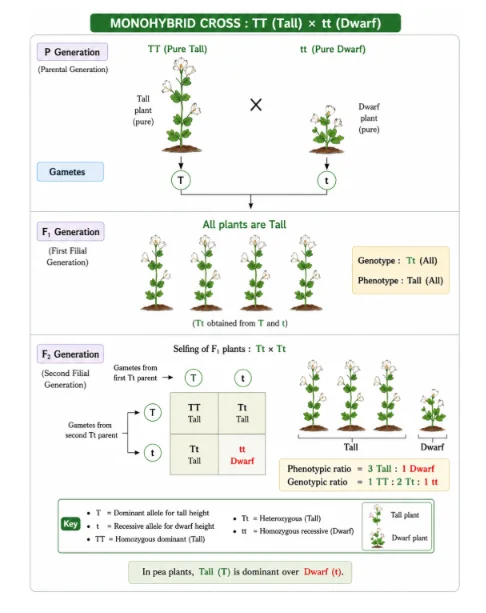
We see that all the offspring plants are tall but the question is why we didn't get any dwarf plants?
To get an answer to this let's look at what the first law says,
It says that when we take two contrasting alleles
An allele is simply one of the different versions of the same gene.
Like here for height we have two alleles that is
T for tall
t for short
Let's assume that T is a big person and t is a shorter one so when they stand in the same queue/line we will see T first because it's bigger than t
And this what exactly happens with genes too
When we have two Contrasting alleles together , one appears while the other one hides but it doesn't disappear
So the allele which appears when both the Contrasting alleles are together are said to dominant allele
And which hides is what recessive allele is .
This law explains why every plant in the first generation — also called the F₁ generation — was tall.
Now, when both alleles for a trait are the same — like TT or tt — we call this homozygous.
When the two alleles are different — like Tt — we call this heterozygous.
That's why in our cross, TT and tt are homozygous, while Tt is heterozygous.
But Mendel wasn't satisfied with just one question.
He had another puzzle:
If the dwarf trait was hidden in the first generation, had it disappeared forever—or was it still there?
To find the answer, he allowed the tall F₁ plants to reproduce.
When he observed the next generation, something remarkable happened.
The hidden dwarf trait reappeared in about one out of every four plants in the F2 generation
This observation led Mendel to propose the Law of segregation
Law of segregation
To understand this law, let's see what happens during the formation of gametes and their fusion.
Either the green ball or the yellow ball—but never both at the same time. That's exactly what happens during gamete formation. For the trait plant height, a heterozygous plant has two alleles: T (tall) and t (dwarf). When gametes are formed, these two alleles separate, so each gamete receives only one allele—either T or t, never both.
Now comes fertilization. When two gametes fuse, each brings its own allele.
he alleles pair up again. Depending on which gametes unite, the offspring may have TT, Tt, or tt.
This is the Law of Segregation: the two alleles of a gene separate during gamete formation, and reunite during fertilization, restoring the pair in the offspring.
Look back at the F2 generation in the diagram above — you'll see exactly this happening.
Some gametes carrying T paired with other T gametes to make TT.
some paired with t to make Tt, and some t gametes paired with t to make tt.
That's the Law of Segregation in action, right there in the Punnett square
Before we look at the ratios, let's understand two important words: genotype and phenotype.
Think of it this way — your genotype is like the recipe hidden inside a cookbook. It's the actual genetic combination, like TT, Tt, or tt.
Your phenotype is the cookie that comes out of the oven — what you can actually see and taste. In our pea plants, that's whether the plant is Tall or Dwarf.
So two plants can have different genotypes (TT or Tt) but show the same phenotype (both Tall) — because Tall is dominant over dwarf.
Ratios for monohybrid cross (F2 generation):-
Phenotype:- 3:1 (3 tall and 1 dwarf)
Genotype:- 1:2:1 {1 pure tall(TT) , 2 Tt , 1 dwarf (tt)}
But Mendel wasn't done yet.
He wondered, "What if I study two traits at the same time? Will they always be inherited together, or will each trait behave independently?"
To answer this question, he performed a dihybrid cross, studying two traits simultaneously.
His observations led to another remarkable discovery—the Law of Independent Assortment.
Law of independent assortment
Imagine you're getting ready in the morning. You have two shirts to choose from — blue or red. You also have two pairs of shoes — sneakers or sandals.
Does picking a blue shirt force you to also pick sneakers? Not at all. You could wear a blue shirt with sandals, or a red shirt with sneakers. Your shirt choice and your shoe choice don't depend on each other — they're made independently.
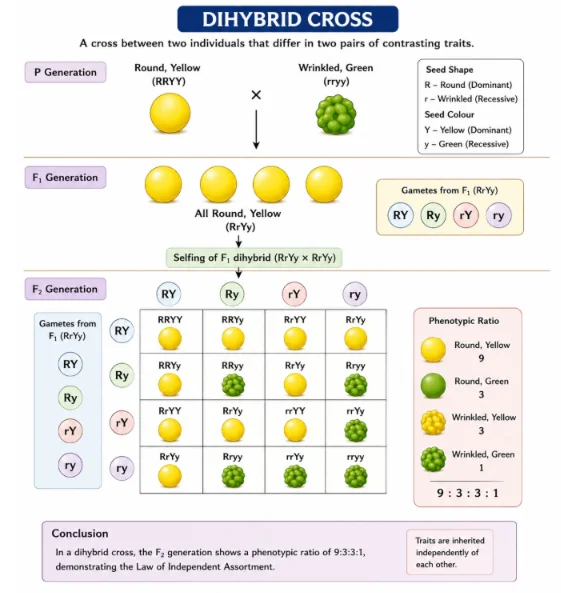
Mendel found something similar happening inside pea plants. When he studied two traits at once — say, seed color (yellow or green) and seed shape (round or wrinkled) — he discovered that inheriting one trait didn't affect which version of the other trait got passed down.
A plant could end up with yellow-round seeds, yellow-wrinkled seeds, green-round seeds, or green-wrinkled seeds — all four combinations appeared, in a predictable ratio.
This became known as the Law of Independent Assortment: different traits are inherited independently of one another, because the alleles for one gene separate and combine without being influenced by the alleles of a different gene.
Let's look at the ratios
Phenotype :- 9:3:3:1 {see diagram for expanded info}
genotype :- 1:2:1:2:4:2:1:2:1
Why this still matters?
These laws didn't just explain pea plants — they explained us. Here's why that still matters today.
from eye color to certain inherited health conditions
The monk in his quiet garden had unknowingly uncovered rules that would one day help us understand our own bodies.
So... why do you look more like your mom or dad—but not exactly like either?
Well, think of your parents as each bringing half the recipe. Your mom doesn't send a complete copy of herself, and neither does your dad. They each pass on one allele for every gene, and when those alleles come together, they create you.
But here's where nature gets creative.
Before those alleles are passed on, they shuffle, separate, and mix independently, almost like shuffling a deck of cards. So every baby receives a brand-new genetic combination—one that has never existed before.
That's why you might have your mother's eyes, your father's smile, your grandmother's hair, and your grandfather's height. You're not a photocopy of either parent—you're nature's own remix.
And that's exactly what Gregor Mendel's humble pea plants helped us understand over 150 years ago.
So, why does Mendelian genetics still matter today?
Because those simple experiments with pea plants unlocked the basic rules of inheritance.
Mendel showed us how traits are passed from one generation to the next
why siblings can look different despite having the same parents, and
why children resemble their parents without being identical copies.
His three laws became the foundation of modern genetics.
Today,
they help scientists understand genetic disorders
improve crop varieties
breed healthier plants and animals
solve forensic and paternity cases, and even advance personalized medicine.
Not bad for a few pea plants growing quietly in a monastery garden, right?



Discussion