
Introduction
When people think about medical research, they often imagine scientists studying humans or laboratory animals like mice. Very few would expect one of the most important research organisms to be a small fruit fly commonly seen around ripe fruit. However, for more than a hundred years, the fruit fly Drosophila melanogaster has played a major role in helping scientists understand how genes work, how bodies develop, how tissues heal, and how diseases arise (Jennings, 2011).
Although humans and fruit flies look very different, they share many basic biological mechanisms. Because of this, scientists use Drosophila as a model organism, a species that helps researchers study important biological processes that are difficult or impossible to examine directly in humans (Jennings, 2011).
What Is a Model Organism: Meet Drosophila melanogaster
A model organism is a living species that scientists study to understand biological processes such as development, growth, disease, and aging. These organisms are chosen because they are easy to grow and maintain in laboratories, develop quickly, and share important biological features with humans (Reiter et al., 2001).
Instead of experimenting directly on people, which raises obvious ethical and practical problems, scientists study model organisms to discover general rules of biology. These rules often apply across many species, including humans. Over time, research using model organisms has shaped nearly everything we know about genetics and development (Morgan, 1910; Jennings, 2011).
Drosophila melanogaster is a small flying insect known as the fruit fly. It feeds not on fruit itself, but on the yeast that grows on rotting fruit. Fruit flies are easy to raise in the laboratory and require minimal space, equipment, and cost (Jennings, 2011).
One of the most useful features of Drosophila is its short life cycle. At warm temperatures, a fertilized egg develops into a fully fertile adult fly in about ten days. Each female can lay up to 100 eggs per day, allowing scientists to study many generations in a short period of time (Jennings, 2011).
These advantages make fruit flies ideal for large-scale biological experiments that would take much longer in animals like mice.
Why Scientists Love the Fruit Fly
Fruit flies have been used in research since the early 1900s. One of the most important figures in early Drosophila research was Thomas Hunt Morgan, whose experiments helped establish the idea that genes are located on chromosomes (Morgan, 1910). This discovery laid the foundation for modern genetics.
Later, Hermann Muller used fruit flies to show that radiation can cause mutations in genes, helping scientists understand how environmental factors damage DNA (Muller, 1928). These discoveries were so important that both Morgan and Muller were awarded Nobel Prizes.
In 1995, scientists Christiane Nüsslein‑Volhard, Eric Wieschaus, and Edward Lewis won the Nobel Prize for discovering genes that control early development in fruit fly embryos. Many of these same genes were later found to be essential in human development (Nüsslein‑Volhard, Wieschaus, & Lewis, 1995).
Despite their obvious differences, fruit flies and humans share a surprising amount of genetic similarity. Scientists have found that approximately 75% of known human disease‑related genes have matching genes in Drosophila (Reiter et al., 2001).
These shared genes control critical processes such as cell division, cell death, communication between cells, and organ formation. For example, major signaling pathways like Notch, Wnt, and Hedgehog were first discovered and studied in fruit flies before being linked to human development and disease (Jennings, 2011).
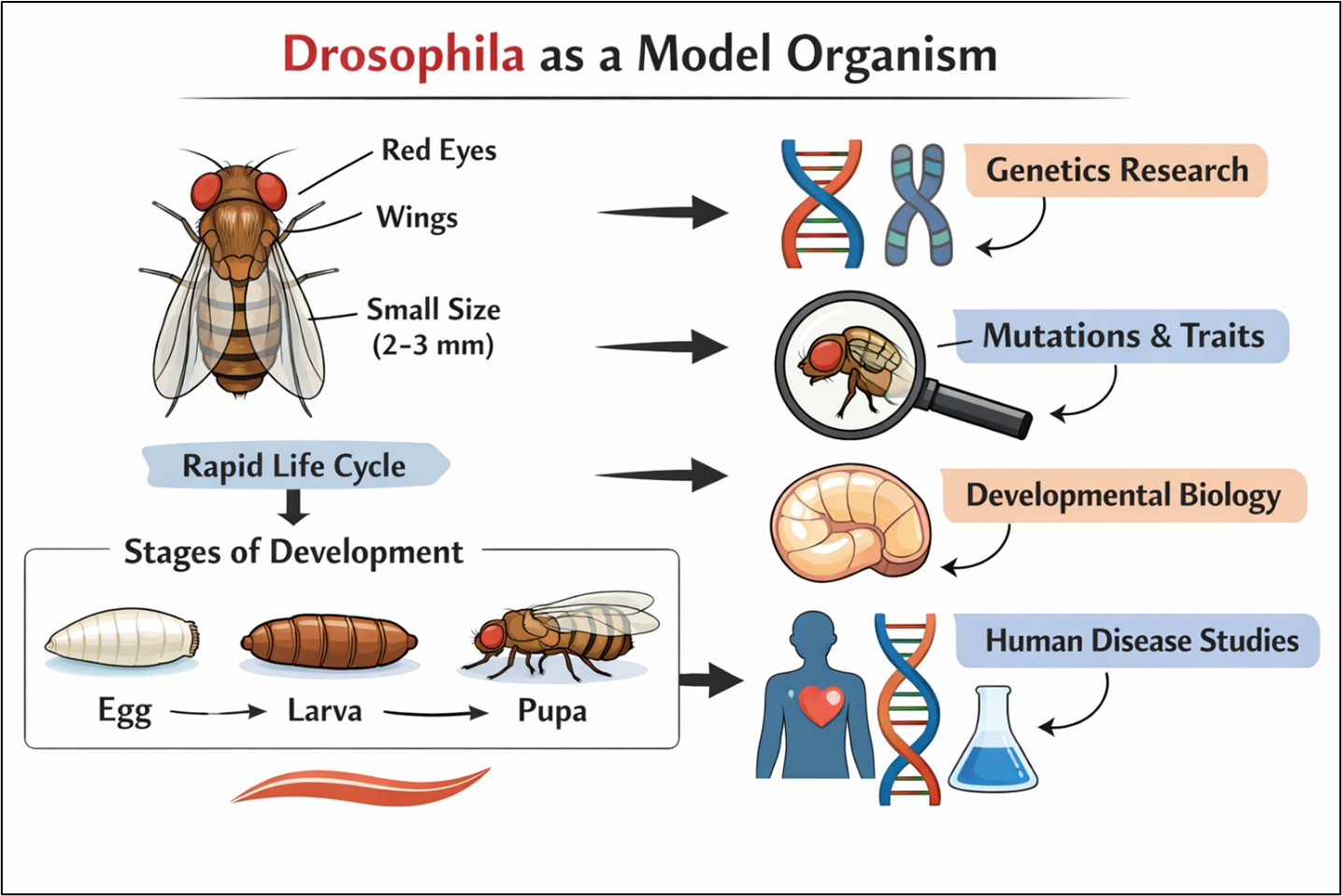
Because these pathways are conserved across evolution, studying them in flies provides valuable insight into how the same processes work in humans.
One reason Drosophila is so widely used is the large collection of genetic tools developed over decades of research. Scientists can manipulate fly genes in very precise ways, allowing them to study how individual genes affect development and health (Brand & Perrimon, 1993).
For example, researchers can:
Turn genes on or off in specific tissues
Reduce gene activity using RNA interference (RNAi)
Add fluorescent tags to genes to observe them in living tissue
Large genetic libraries now exist that allow scientists to reduce the activity of almost every gene in the Drosophila genome (Dietzl et al., 2007). These tools make it possible to study gene function quickly and efficiently.
Understanding Development Through Fruit Flies
Fruit flies have been especially valuable for studying development, the process by which a single fertilized egg becomes a complex organism. Early in development, fly embryos show clear patterns that are easy to observe and analyze.
By studying mutant flies, scientists identified genes that determine where different body parts form. These discoveries revealed that development follows strict genetic rules, many of which apply to humans as well.
Understanding development is critical for explaining birth defects, inherited disorders, and diseases that result from errors in early growth.
Regeneration and Wound Healing
While adult fruit flies cannot regenerate lost body parts, they contain tissues during development called imaginal discs that have strong regenerative abilities (Bergantinos et al., 2010). If damaged, these tissues can grow back under certain conditions.
Studies using Drosophila have shown that injured or dying cells release signals that trigger surrounding cells to divide and repair tissue (Bergmann & Steller, 2010). Similar signaling mechanisms play a role in wound healing in humans.
Fruit fly embryos have also been used to study how wounds close, revealing similarities between healing and normal developmental processes (Martin & Parkhurst, 2004).
Using Fruit Flies to Study Disease and Develop Therapies
Research in Drosophila has contributed greatly to our understanding of stem cells. These are the cells that can divide to produce both new stem cells and specialized cells. In fruit flies, stem cells are controlled by signals from nearby tissues, a system that closely resembles stem cell regulation in humans (Pearson et al., 2009).
At the same time, fruit fly research has helped scientists understand how uncontrolled cell division can lead to cancer. Many of the genes that regulate normal cell growth can cause tumors when they malfunction (Bergmann & Steller, 2010).
Because fruit flies share these growth control genes with humans, they are frequently used to study cancer-related processes.
In recent years, Drosophila has become an important tool in drug discovery (Bell et al., 2009). New drugs can be tested in fruit flies to see how they affect disease-related pathways in a living organism.
Using flies allows researchers to evaluate both positive effects and harmful side effects more quickly than in mammalian models. Scientists can also create fly models that mimic human diseases by altering specific genes, making it easier to test potential treatments.
Conclusion
Compared to vertebrate animals, fruit flies raise fewer ethical concerns and are not subject to strict animal research regulations in many countries (Jennings, 2011). This allows scientists to carry out large experiments, including long-term and multi-generation studies.
Because flies are inexpensive to maintain, they are accessible to laboratories worldwide, including teaching institutions and smaller research groups.
The tiny fruit fly Drosophila melanogaster has had an enormous impact on biology and medicine. Through studies of this small insect, scientists have uncovered fundamental principles of genetics, development, regeneration, stem cell biology, and disease (Jennings, 2011).
Even today, Drosophila remains a powerful and essential research tool. Its genetic similarity to humans, combined with practical and ethical advantages, makes it an ideal model organism for advancing knowledge and improving human health.




Discussion