
The Clinical Impasse of Disorders of Gut–Brain Interaction
Disorders of Gut–Brain Interaction (DGBIs), such as Functional Dyspepsia (FD) and Irritable Bowel Syndrome (IBS), present a formidable clinical impasse due to their profoundly heterogeneous and multifactorial nature. These conditions involve a complex intersection of motility dysfunctions, visceral hypersensitivity, and subclinical inflammation, rendering them notoriously resistant to conventional monomolecular therapies. Current pharmacological interventions often fail because they rely on "one-size-fits-all" drugs that target isolated pathways, providing only limited relief for what is inherently a systemic dysfunction. There is a strategic imperative to transition toward sophisticated alternatives that engage the full breadth of the gut–brain axis. The phytotherapeutic formulation STW 5-II represents a calculated pivot in this field, integrating diverse botanical extracts to address the intricate biological drivers of DGBIs simultaneously. This shift toward complex, multi-component systems reflects an advanced understanding of the necessity for multi-target pharmacology.
The Strategic Superiority of Multi-Target Pharmacology
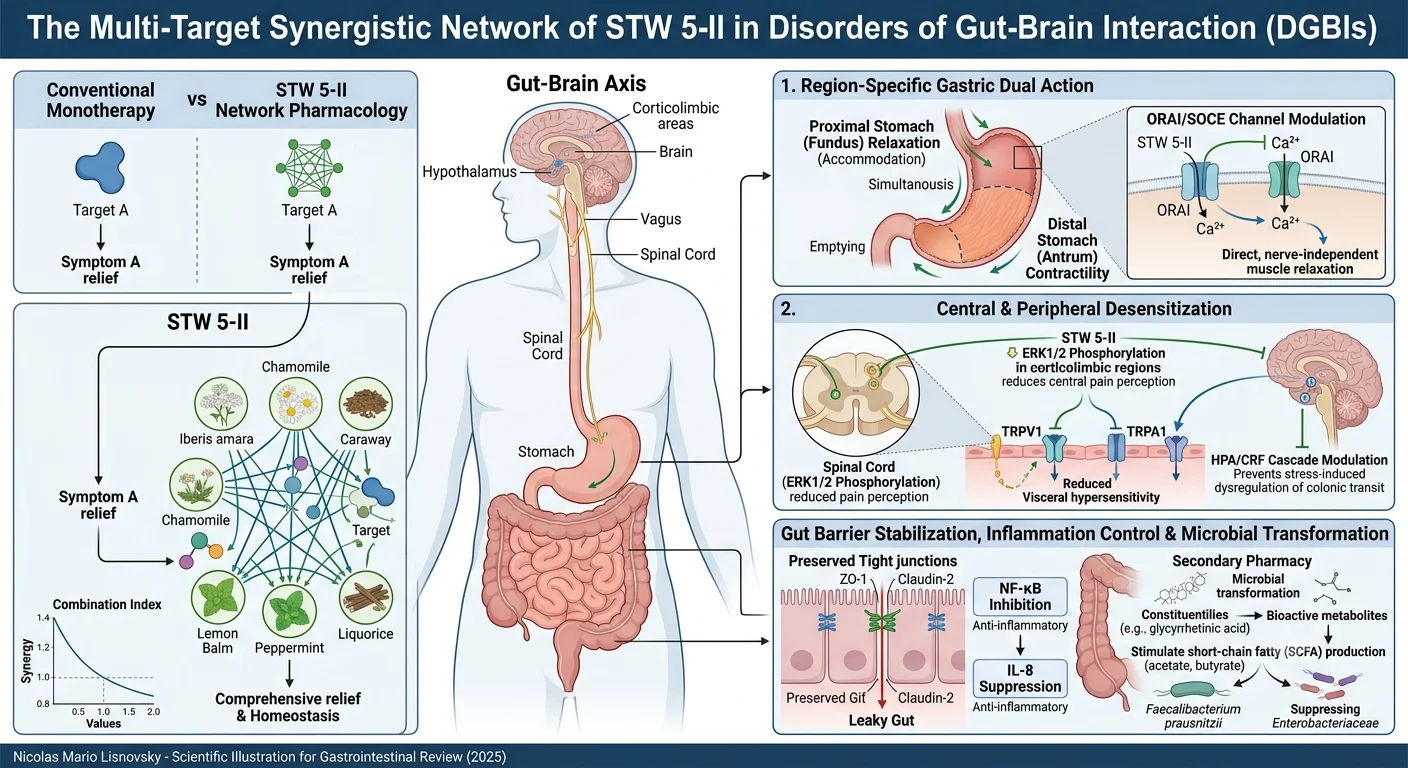
The strategic rationale for multi-target therapy is anchored in the recognition that complex diseases require solutions that mirror their own biological density. In DGBIs, where clinical presentations include simultaneous disruptions in motility, epithelial integrity, and secretion, a single molecular target is frequently insufficient to restore homeostasis. STW 5-II strategically integrates six extracts, Iberis amara, chamomile, caraway, lemon balm, peppermint, and liquorice root, into a unified poly-herbal system. This formulation leverages an array of secondary metabolites, such as flavonoids and terpenoids, to act as a resilient therapeutic network. By utilizing a multi-component approach, the treatment provides a more robust response to the multifactorial causes of DGBIs than narrow pharmacological agents. This orchestration of diverse botanical constituents ensures that the therapy provides comprehensive coverage across the gastrointestinal tract, leading directly to a restoration of disordered gastric mechanics.
The Dual-Action Mechanism
In the management of FD, restoring gastric accommodation and emptying is of paramount strategic importance. STW 5-II achieves a mechanical breakthrough through a region-specific, dual-action mechanism that is highly unusual in traditional pharmacology. The formulation simultaneously induces relaxation in the proximal stomach (fundus) to accommodate meal intake while increasing contractility in the antrum to facilitate emptying. This modulation represents a significant advancement because it is nerve-independent, acting directly on store-operated calcium entry (SOCE) through ORAI-type channels. By closing these channels, STW 5-II decreases intracellular calcium to induce relaxation where tone is excessive, while promoting the necessary contractile strength in distal regions. This physical restoration of mechanical function is essential, yet it remains vulnerable to the primary disruptor of gut homeostasis: the stress cascade.
Modulating the CRF Cascade
The hypothalamic–pituitary–adrenal (HPA) axis serves as the primary bridge through which psychological distress triggers physiological dysfunction in IBS. STW 5-II strategically intervenes in this process by modulating Corticotropin Releasing Factor (CRF) and serotonergic signaling. The formulation inhibits CRF-mediated neuroimmune cascades, which typically drive mast cell activation and barrier disruption. Crucially, in stress-based models where systemic growth is often stunted, STW 5-II has been shown to restore normal weight gain and physiological homeostasis. By stabilizing the signaling environment between the brain and the gut, the formulation prevents stress-induced disruptions of colonic transit and preserves the underlying tissue structure. This stabilization of the signaling milieu provides the necessary foundation for rewiring the patient’s physical perception of pain.
Reducing Visceral Hypersensitivity
Visceral pain remains the most defining and debilitating clinical challenge in DGBIs, necessitating a strategy that targets the nervous system's sensory baseline. STW 5-II demonstrates a unique ability to impact nociceptive pathways at both peripheral and central levels. By reducing the phosphorylation of extracellular signal-regulated kinase (ERK1/2) in the spinal cord and corticolimbic regions, the formulation effectively lowers the intensity of pain signals processed by the brain. Furthermore, the desensitization of key sensory receptors, specifically TRPA1 and TRPV1, represents a major milestone in treating chronic abdominal discomfort. This reduction in neuronal activation shifts the patient from a state of constant hypersensitivity toward sensory stability. These neural improvements are further bolstered by local cellular defenses that protect the structural integrity of the intestinal barrier.
Inflammation and Tight Junction Integrity
Subclinical inflammation and "leaky gut" are foundational drivers of DGBI symptoms, as a compromised barrier allows luminal antigens to sensitize local nerves and trigger immune responses. STW 5-II provides a robust defense by restoring paracellular permeability through the protection of essential tight junction proteins, including ZO-1 and claudin-2. Its anti-inflammatory profile is extensive; it inhibits pro-inflammatory markers such as IL-8 and suppresses the NF-κB pathway, a central regulator of immune activation. Unlike standard antacids that merely neutralize gastric acid, STW 5-II actively promotes mucosal restitution and strengthens the epithelial shield against irritants. This fortification of the physical barrier is deeply influenced by the external microbial environment, which serves as a critical partner in maintaining gut health.
Prebiotic Effects and Metabolic Transformation
In modern research strategy, the gut microbiome is viewed as both a therapeutic target and a bio-transformer that enhances the efficacy of herbal medicine. STW 5-II exerts prebiotic-like effects, selectively promoting beneficial bacteria such as Faecalibacterium prausnitzii while suppressing pathogenic families like Enterobacteriaceae. This shift is strategically vital because beneficial species produce Short-Chain Fatty Acids (SCFAs) that serve as a primary energy source for colonocytes. Furthermore, because many constituents remain stable during upper GI transit, the colon acts as a "secondary pharmacy" where microbial metabolic capacity transforms compounds like glycyrrhetinic acid into new metabolites with enhanced bioavailability. This synergy between the host's microbiome and the botanical formulation creates a dynamic environment where the collective medicinal output exceeds the sum of the individual parts.
Why the Whole Exceeds the Parts
The clinical potency of STW 5-II is a direct result of synergy, where interactions between botanical extracts produce results unattainable by single components. Using the Combination Index, researchers identified significant synergistic effects when Menthae piperitae and Matricariae flos are combined with Iberis amara, resulting in the lowest IC50 and IC75 levels for anti-inflammatory and motility-related readouts. The refinement of the original nine-herb blend involved the strategic omission of milk thistle, greater celandine, and angelica root. This decision was a calculated move to focus the formulation's impact specifically on the stomach and intestine. This concentration of ingredients ensures that the system remains highly effective across a range of DGBI symptoms, providing a sophisticated synthesis of traditional knowledge and modern pharmacological validation.
Future Horizons for Multi-Target Therapeutics
The strategic outlook for phytotherapy in gastroenterology is increasingly promising as research moves beyond the limitations of monotherapy. STW 5-II has demonstrated clear clinical efficacy in symptom relief for FD and IBS, validated by rigorous meta-analyses and mechanistic studies. However, the future trajectory of this research must address the challenges of systemic bioavailability and the performance of complex mixtures in larger, multi-center trials. While the formulation shows a high degree of safety and minimal drug–drug interactions, a deeper understanding of how these metabolites are absorbed in humans is essential. Continued investigation into personalized expression profiles will be the next step in integrating these multi-target therapies into the standard of care.
Global Research Landscape
The validation of STW 5-II is the outcome of an international, multi-disciplinary research effort that bridges traditional medicine and rigorous clinical science. The evidence is the result of cooperation between global institutions, combining expertise in zoology, pharmaceutical biology, and clinical medicine from Germany (Bonn, Munich, Mainz), Austria (Graz), Egypt (Cairo), and Australia (Adelaide). This international cooperation underscores the strategic importance of cross-disciplinary inquiry in substantiating complex medicines. Continued global collaboration and larger-scale randomized controlled trials are necessary to ensure the broad translation of these findings into standard evidence-based clinical protocols worldwide.

Discussion