
Introduction
A small tube of blood can reveal a surprising amount about what is happening inside the body. One of the most commonly requested laboratory investigations is the Full Blood Count (FBC), also known as a Complete Blood Count (CBC).
It provides information about the major cellular components of blood, including red blood cells, white blood cells, and platelets, as well as important measurements such as haemoglobin and haematocrit.
Because blood cells are involved in oxygen transport, immune defence, and blood clotting, changes in their number, size, or characteristics can provide important clues about a person's health.
An FBC or CBC can help healthcare professionals investigate conditions such as anaemia, infection, inflammation, bleeding disorders, and some blood or bone marrow disorders.
However, an abnormal result does not automatically mean that someone has a particular disease. Results must be interpreted in the context of symptoms, medical history, examination findings, and other investigations.
So, what exactly does an FBC measure, and what can the numbers tell you?
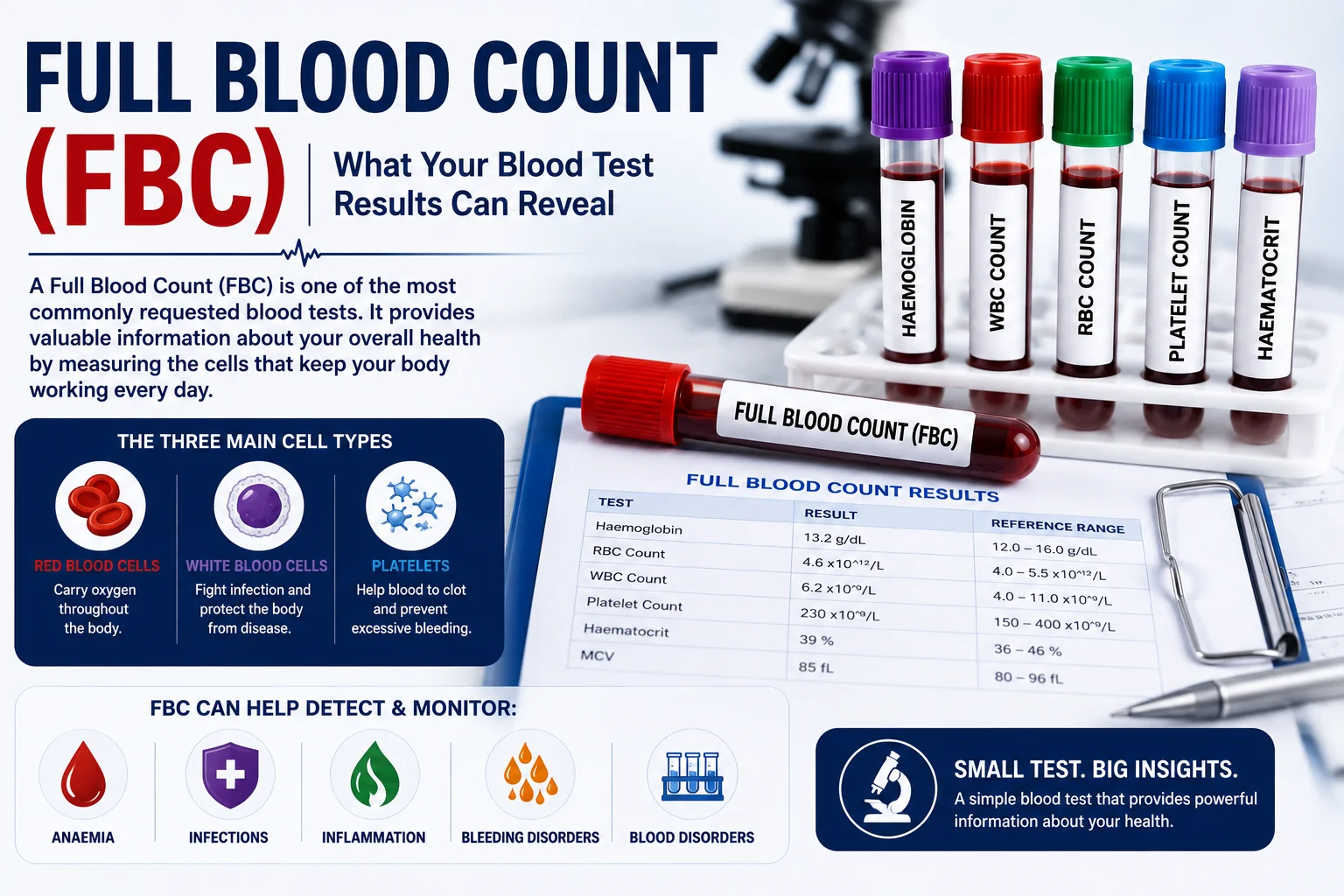
What Is a Full Blood Count?
A Full Blood Count (FBC) or Complete Blood Count (CBC) is a laboratory blood test that measures and provides information about different types of blood cells.
The test commonly includes measurements of:
Red blood cell count
White blood cell count
Platelet count
Haemoglobin concentration
Haematocrit
Mean corpuscular volume (MCV)
Other red blood cell indices
A standard FBC or CBC measures the total number of white blood cells, while an FBC or CBC with differentials provides additional information about the different types of white blood cells, including neutrophils, lymphocytes, monocytes, eosinophils, and basophils.
This makes the FBC or CBC a broad screening and diagnostic tool rather than a test for one specific disease.
Why Is a Full Blood Count Test Requested?
Healthcare professionals may request an FBC or CBC as part of a routine health assessment or when a person develops symptoms that could be associated with abnormalities in the blood.
Common reasons include investigating:
Persistent fatigue or weakness
Fever or suspected infection
Unexplained bruising
Abnormal bleeding
Pale skin
Shortness of breath
Recurrent infections
Unexplained weight loss
Monitoring certain chronic conditions
Monitoring treatments that can affect blood-cell production
An FBC may also be used to monitor a previously diagnosed condition or assess changes during treatment.
What Does the Red Blood Cell Count Tell You?
Red blood cells (RBCs) are responsible for transporting oxygen from the lungs to tissues throughout the body. The red blood cell count measures the number of red blood cells in a given volume of blood.
A low RBC count may occur with anaemia, blood loss, nutritional deficiencies, bone marrow disorders, or some chronic diseases. A high count may occur in situations such as dehydration, prolonged low oxygen exposure, or disorders that cause excessive red blood cell production.
However, the RBC count should not be interpreted alone. Haemoglobin, haematocrit, and red blood cell indices provide additional information that helps determine what may be happening.
Haemoglobin: The Oxygen-Carrying Protein
Haemoglobin is an iron-containing protein found inside red blood cells. Its primary role is to transport oxygen from the lungs to tissues throughout the body.
A low haemoglobin concentration is one of the key laboratory findings associated with anaemia. Anaemia can have many causes, including:
Iron deficiency
Vitamin B12 or folate deficiency
Blood loss
Chronic disease
Increased destruction of red blood cells
Bone marrow disorders
A high haemoglobin concentration may occur in conditions associated with reduced plasma volume, chronic low oxygen exposure, or increased red blood cell production.
The important point is that haemoglobin is a finding, not a diagnosis. The cause of an abnormal result needs further investigation.
What Is Haematocrit?
Haematocrit describes the proportion of blood volume occupied by red blood cells. For example, a haematocrit of 42% means that approximately 42% of the blood volume consists of red blood cells.
Haematocrit is closely related to haemoglobin and RBC measurements and is commonly included in an FBC.
A low haematocrit may occur with anaemia or blood loss, while a high result can be associated with dehydration or increased red blood cell production. However, factors such as pregnancy, altitude, smoking, and hydration status can influence the result.
Understanding Red Blood Cell Indices
One of the most useful features of an FBC or CBC is that it does more than simply count red blood cells. It also provides information about their characteristics.
Mean Corpuscular Volume (MCV)
MCV measures the average size of red blood cells. This measurement is particularly useful when investigating anaemia. For example, anaemia may be classified broadly as:
Microcytic: red blood cells are smaller than expected
Normocytic: red blood cells are within the expected size range
Macrocytic: red blood cells are larger than expected
This classification can help guide further laboratory investigations. Other red blood cell indices, including MCH and MCHC, provide information about the haemoglobin content and concentration within red blood cells.
Together, these measurements give laboratory professionals and clinicians a more detailed picture of red blood cell health.
White Blood Cells and the Immune System
White blood cells (WBCs), also known as leukocytes, are essential components of the immune system. They help the body respond to infections, inflammation, and other threats.
The five major types of white blood cells are:
Neutrophils
Lymphocytes
Monocytes
Eosinophils
Basophils
A standard FBC or CBC reports the total white blood cell count. When more detailed information is required, a white blood cell differential measures the proportions or numbers of these individual cell types.
A high WBC count can occur with infections, inflammation, certain medications, tissue injury, and some blood disorders. A low WBC count can occur with certain infections, autoimmune conditions, bone marrow disorders, medications, and other medical conditions.
The differential count can provide additional clues about why the total WBC count may be abnormal.
Platelets: Small Cells With a Big Job
Platelets are small blood components that play a central role in stopping bleeding. When a blood vessel is damaged, platelets become activated and help form a platelet plug as part of the body's clotting response. An FBC measures the number of platelets in the blood.
A low platelet count, known as thrombocytopenia, can increase the risk of abnormal bleeding in some circumstances. A high platelet count, known as thrombocytosis, can occur for several reasons, including inflammation, iron deficiency, infection, or certain bone marrow disorders.
As with other FBC parameters, an abnormal platelet count requires clinical context and, when necessary, additional investigations.
What Can an Abnormal FBC Result Mean?
An abnormal FBC result can have many possible explanations. For example:
FBC finding | Possible associations |
Low haemoglobin | Anaemia, blood loss, nutritional deficiency, chronic disease |
High haemoglobin | Dehydration, chronic low oxygen exposure, increased RBC production |
Low WBC count | Some infections, medications, autoimmune or bone marrow disorders |
High WBC count | Infection, inflammation, medication effects, some blood disorders |
Low platelet count | Reduced production, increased destruction, certain infections or medications |
High platelet count | Inflammation, infection, iron deficiency, some marrow disorders |
Low MCV | Iron deficiency and some haemoglobin disorders |
High MCV | Vitamin B12/folate deficiency, alcohol use, liver disease, medications and other causes |
These associations are not diagnoses. Many factors can influence blood counts, and an abnormal result may be temporary or clinically insignificant.
This is why laboratory results should be interpreted by a qualified healthcare professional rather than in isolation.
Do You Need to Fast Before an FBC?
Usually, no special preparation is required for an FBC. A blood sample is typically collected from a vein in the arm, and the procedure usually takes only a few minutes.
However, if an FBC is being performed alongside other blood tests, such as a fasting glucose or lipid profile, you may be given different preparation instructions.
Always follow the instructions provided by your healthcare provider or laboratory.
The Role of the Medical Laboratory
The usefulness of an FBC depends not only on the test itself but also on the quality of the laboratory process behind it. Blood samples must be correctly identified, collected, transported, processed, and analysed.
Modern automated haematology analysers can rapidly measure numerous blood parameters, but laboratory professionals remain essential for quality control, result validation, investigation of unusual findings, and further testing when abnormalities require clarification.
When results are unexpected or inconsistent with a patient's clinical picture, additional investigations may include a blood film, reticulocyte count, iron studies, vitamin assays, or other specialised haematology tests.
This highlights an important principle of laboratory medicine: a laboratory result is most valuable when it is accurate, appropriately interpreted, and connected to the patient's clinical context.
FBC vs CBC: Are They the Same Test?
In most contexts, Full Blood Count (FBC) and Complete Blood Count (CBC) refer to essentially the same group of blood measurements.
"FBC" is commonly used in the United Kingdom and several other countries, while "CBC" is more common in the United States and some international medical resources.
Regardless of the terminology, the purpose is broadly the same, which is to assess the cellular components of blood and identify abnormalities that may require further investigation.
Conclusion
The Full Blood Count (FBC) or Complete Blood Count (CBC) is one of the most useful routine investigations in laboratory medicine because it provides information about three major cellular components of blood: red blood cells, white blood cells, and platelets.
Measurements such as haemoglobin, haematocrit, MCV, and white blood cell counts can provide important clues about anaemia, infection, inflammation, bleeding problems, and other conditions.
However, an abnormal FBC is not a diagnosis by itself. Results must be interpreted alongside symptoms, medical history, physical findings, laboratory reference ranges, and, when necessary, additional investigations.
Understanding what an FBC measures helps patients appreciate how much information can be obtained from a simple blood sample, and why accurate laboratory testing remains central to modern healthcare.


Discussion