
Introduction
Few laboratory tests carry as much emotional weight as an HIV test. Yet scientifically, HIV testing is a carefully designed diagnostic process that uses different types of tests to detect evidence of infection as early and accurately as possible.
Today, HIV testing can be performed using rapid diagnostic tests, laboratory-based antigen/antibody assays, antibody tests, and nucleic acid tests.
Some tests can produce results within minutes, while laboratory investigations may require more time. The choice of test and the timing of testing both matter because no HIV test can detect an infection immediately after exposure.
Understanding how HIV testing works is important not only for people who are getting tested but also for anyone interested in laboratory medicine and public health. A reliable testing process can facilitate earlier diagnosis, connection to treatment, and appropriate prevention services.
So, what exactly happens when someone takes an HIV test, and what do the results really mean?
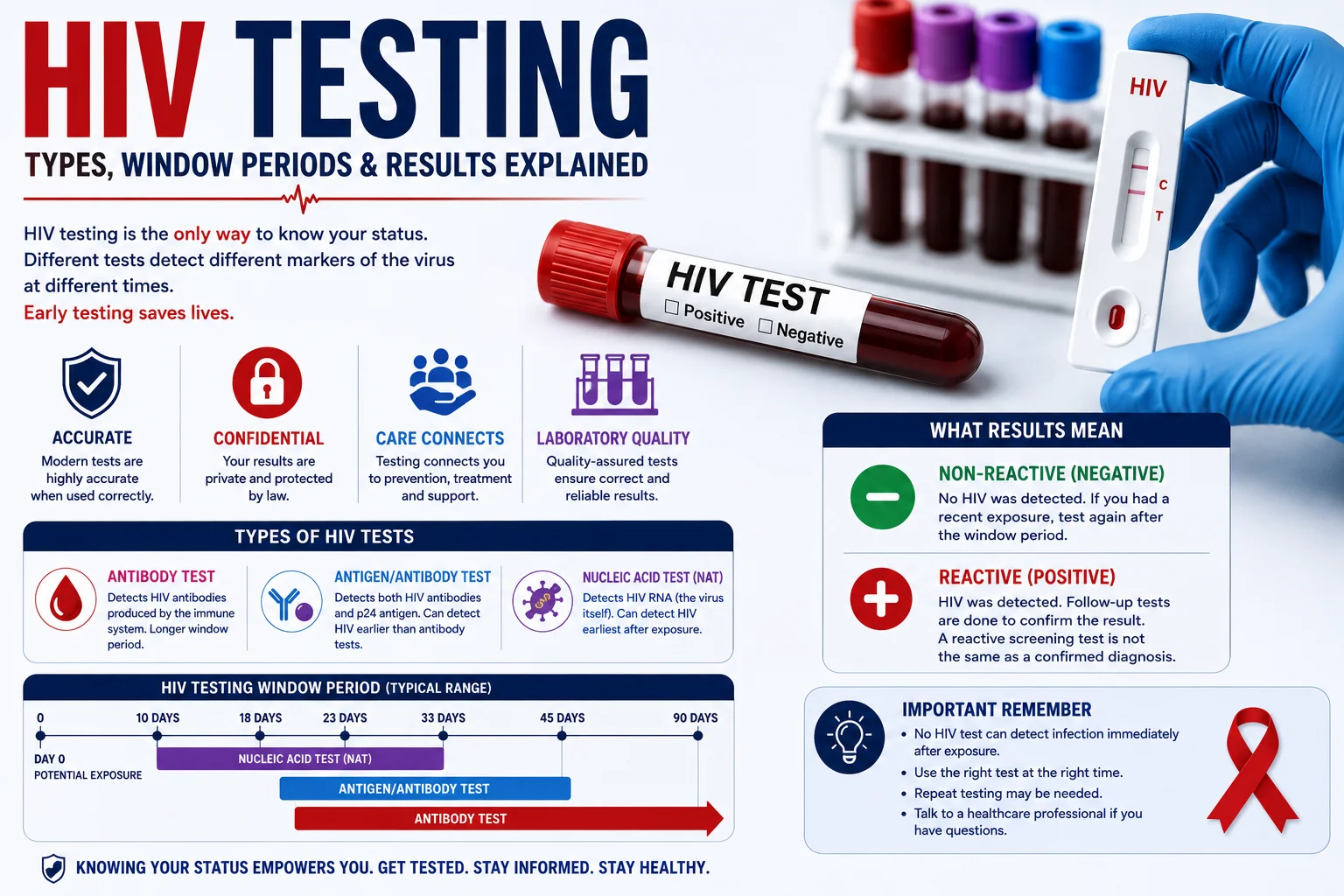
What Is HIV Testing?
HIV testing refers to the laboratory or point-of-care process used to determine whether a person has been infected with the human immunodeficiency virus (HIV).
Depending on the test, the investigation may look for:
HIV antibodies produced by the immune system
HIV p24 antigen, a component of the virus that can appear before antibodies develop
HIV RNA, the genetic material of the virus
The three broad categories of HIV tests are antibody tests, antigen/antibody tests, and nucleic acid tests (NATs).
Importantly, an initial reactive HIV screening test is not necessarily the same thing as a confirmed HIV diagnosis. Testing algorithms use additional testing to establish a diagnosis and minimize the possibility of misdiagnosis.
WHO's current guidance emphasizes quality-assured testing strategies and recommends a three-test strategy in national programmes to achieve high positive predictive value.
Why Is HIV Testing Important?
HIV infection can initially produce few or nonspecific symptoms, meaning that a person cannot reliably determine their HIV status from how they feel.
Testing is the only way to know a person's HIV status.
Early diagnosis matters because people who know they have HIV can be connected to antiretroviral therapy and appropriate healthcare.
Effective treatment can suppress HIV to very low levels, helping people remain healthy and preventing sexual transmission when viral suppression is maintained.
Testing also has an important prevention role. Someone who receives a negative result can discuss appropriate prevention strategies with a healthcare professional, while people with ongoing risk may benefit from repeated testing and prevention interventions.
WHO therefore considers HIV testing an essential gateway to prevention, treatment, and care.
Types of HIV Tests
Antibody Tests
Antibody tests detect antibodies produced by the immune system in response to HIV infection. They may use blood or oral fluid, and many rapid HIV tests and self-tests rely primarily on antibody detection.
Because the body needs time to produce detectable antibodies, these tests generally have a longer window period than tests that detect the virus or its antigen directly.
Antibody tests can be useful because they are relatively simple and can be performed in community and home settings, depending on the approved testing programme and product.
However, a negative result obtained too soon after exposure may not exclude infection.
Antigen/Antibody Tests
Antigen/antibody tests, sometimes called combination or fourth-generation tests, look for both HIV antibodies and the p24 antigen.
The advantage is that p24 antigen can become detectable before antibodies are fully developed, allowing some infections to be detected earlier than with antibody-only testing.
Laboratory-based antigen/antibody tests using blood from a vein are widely used for HIV screening. This type of testing is particularly important in laboratory medicine because it combines two biological markers to improve early detection.
Nucleic Acid Tests
Nucleic acid tests (NATs) detect HIV RNA directly.
Because they look for the virus's genetic material rather than waiting for an antibody response, NATs can detect infection earlier than antibody or antigen/antibody tests.
They may be considered when there has been a recent potential exposure, particularly when early HIV infection is suspected and an initial screening test is non-reactive.
NATs are also central to viral load testing, which is used to monitor HIV after diagnosis. However, a diagnostic NAT and a viral-load test serve different clinical purposes and should not simply be treated as interchangeable tests.
Understanding the HIV Window Period
One of the most misunderstood concepts in HIV testing is the window period.
The window period is the period between infection and the point at which a particular HIV test can reliably detect the infection. During this period, a person may have HIV even though their test result is negative.
The length of the window period depends on the type of test.
According to current CDC guidance:
HIV test | Typical Detection Window |
Antibody test | 23–90 days after exposure |
Rapid antigen/antibody test using finger-stick blood | 18–90 days |
Laboratory antigen/antibody test using blood from a vein | 18–45 days |
NAT | 10–33 days |
These are typical ranges rather than guarantees for every individual.
This is why the timing of an HIV test matters. Someone who tests negative shortly after a potential exposure may need repeat testing after the appropriate window period.
Medications such as PrEP or PEP can also affect the timing of HIV detection, so anyone who has used antiretroviral medicines around the time of a possible exposure should discuss their testing schedule with a healthcare professional.
What Does a Negative HIV Test Result Mean?
A non-reactive or negative HIV test result means that the test did not detect the marker it was designed to detect. But the result must be interpreted in relation to when testing occurred.
If testing takes place during the window period, a negative result may not rule out a recent infection. CDC guidance recommends repeat testing after the relevant window period when there has been a potential exposure.
For someone with no new potential exposure during that period, a negative result obtained after the appropriate window period provides much stronger evidence that HIV infection was not acquired from the earlier exposure.
The exact interpretation should always take into account the type of test used and the testing algorithm followed.
What Does a Reactive HIV Test Result Mean?
A reactive screening result does not automatically mean that a person has HIV. This distinction is extremely important.
Screening tests are designed to identify people who may have HIV, but a reactive result requires follow-up testing according to the applicable national testing algorithm.
For example, someone who receives a reactive result from a rapid test or self-test should seek follow-up testing from a qualified testing service. If a laboratory-based screening test is reactive, follow-up testing may be performed using the same specimen, depending on the testing algorithm.
WHO emphasizes the importance of accurate testing strategies because an incorrect HIV diagnosis can have serious consequences. Its 2024 implementation guidance recommends national programmes use a standardized three-test strategy and appropriate quality-assurance measures to minimize misdiagnosis.
Therefore, the appropriate response to a reactive screening result is follow-up testing. Not panic. Not self-diagnosis.
HIV Self-Testing
HIV testing is no longer limited to hospitals and conventional laboratories. HIV self-testing allows an individual to collect and test their own specimen, depending on the approved product.
Self-tests may use oral fluid or blood obtained through a finger prick, and some can produce results within minutes.
WHO recommends HIV self-testing as an additional approach to HIV testing services. The approach can improve privacy and convenience and may help reach people who are reluctant or unable to access conventional testing services.
However, a self-test is not a substitute for confirmatory testing after a reactive result. Anyone with a reactive self-test should seek professional follow-up testing.
The Role of Medical Laboratories in HIV Testing
Behind every reliable HIV result is a testing process that depends on quality at multiple stages. Medical laboratory professionals and testing services must consider:
Appropriate specimen collection
Correct patient identification
Proper storage and handling
Validated testing procedures
Quality-control processes
Accurate interpretation and reporting
Appropriate follow-up testing
These safeguards are particularly important for HIV because both false-positive and false-negative results can have significant consequences.
WHO's HIV testing framework emphasizes five essential principles, commonly known as the 5 Cs:
Consent
Confidentiality
Counselling
Correct test results
Connection to prevention, treatment, and care
These principles place laboratory accuracy within a broader healthcare system rather than treating testing as simply the act of producing a number or result.
HIV Testing Is Not the Same as Viral Load Testing
Another common source of confusion is the difference between an HIV diagnostic test and an HIV viral load test.
Diagnostic HIV tests determine whether infection is present using antibodies, antigen/antibody detection, or nucleic acid testing.
A viral load test, on the other hand, measures the amount of HIV RNA in the blood and is primarily used after diagnosis to monitor treatment and viral suppression.
Similarly, a CD4 count measures the number of CD4 immune cells and provides important information about immune function. It is not itself an HIV screening test.
Understanding these distinctions prevents different laboratory investigations from being incorrectly treated as interchangeable.
When Should Someone Get an HIV Test?
The appropriate timing depends on the reason for testing and the type of exposure or risk involved.
People may seek HIV testing as part of routine healthcare, after a potential exposure, during pregnancy, when being evaluated for certain sexually transmitted infections, or when a healthcare professional recommends testing based on symptoms or clinical circumstances.
WHO recommends HIV testing services be integrated into appropriate healthcare and community settings, with particular attention to populations and situations where testing can have substantial public-health benefits.
If someone has had a very recent potential exposure, waiting for a routine test may not be the only consideration. They should seek prompt professional medical advice because prevention options such as post-exposure prophylaxis (PEP) are time-sensitive.
Current CDC guidance addresses PEP following potential sexual, injection-drug-use, and other nonoccupational exposures.
Conclusion
HIV testing is more than a single blood test. It is a diagnostic process that combines appropriate testing technologies, timing, quality assurance, and follow-up procedures to determine HIV status as accurately as possible.
Antibody tests, antigen/antibody tests, and nucleic acid tests each have different advantages and window periods. A negative result obtained too early may require repeat testing, while a reactive screening result requires appropriate confirmatory testing before an HIV diagnosis is established.
For medical laboratory professionals, HIV testing also demonstrates why laboratory medicine is central to modern healthcare. Accurate testing can open the door to timely treatment, prevention services, counselling, and long-term care.
Most importantly, HIV testing should be approached as a routine component of evidence-based healthcare—not as a source of stigma. Knowing one's HIV status gives people information they can use to make informed decisions about their health and access appropriate care.


Discussion