
The Silent Frontier of The Elite Athlete
For the elite athlete, an injury is more than a clinical setback, it is an existential interruption. The pursuit of physical excellence has long been haunted by the inherent fragility of the human frame, where a single ligament tear or a chronic strain can dismantle years of disciplined optimization. Historically, sports medicine has operated in a reactive posture, intervening only after the kinetic chain has already failed. However, we are currently witnessing a transition into a profound strategic frontier, the shift from reactive medicine to proactive, AI-driven prevention. This evolution moves beyond the rudimentary tracking of miles or repetitions and enters the realm of "predictive resilience." As the scoping review by Martinez Mora et al. (2026) illustrates, the "relatable problem" of musculoskeletal injuries is no longer being interrogated through conventional factors alone, such as age or injury history, but through a dynamic synthesis of unconventional variables like sleep quality and accumulated fatigue. For those obsessed with becoming a greater human being, the adoption of artificial intelligence is not merely a technical upgrade, it is an essential biological safeguard in the high-stakes pursuit of peak performance.
The Ascendance of Unconventional Biomarkers
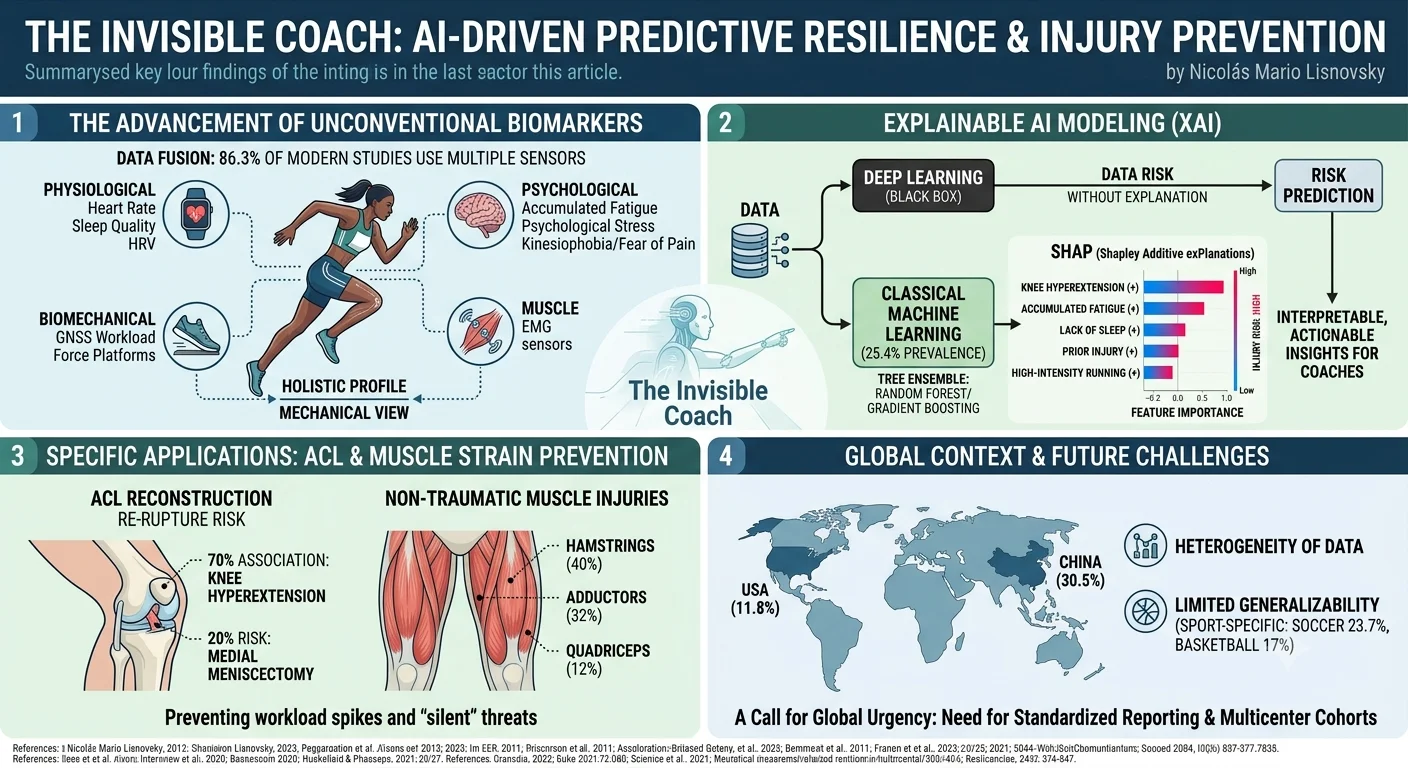
The hallmark of a sophisticated modern training regimen is the realization that the physical site of an injury is often the final stage of a much longer, systemic narrative. In the landmark review by Martinez Mora et al. (2026), which synthesized 59 pivotal studies published between 2015 and 2025, a clear trend emerged: the integration of "unconventional" risk factors. While traditional sports science focused on immutable or historical traits, the current paradigm, powered by AI, seeks to quantify the "noise" of daily human existence. Factors once dismissed as subjective or peripheral, such as sleep quality, psychological stress, and accumulated fatigue, are now central inputs in predictive modeling. This shift represents a fundamental maturation of the field, moving from a purely mechanical view of the body to a holistic, bio-informatic perspective where the athlete is viewed as a complex, integrated system.
By utilizing AI to process these variables, researchers have identified specific psychological precursors to physical failure that elude the naked eye. The source context highlights that "kinesiophobia", the irrational fear of movement, and the "fear of pain" (as explored in the Ayala et al. studies) have become critical predictors in the AI's risk calculus. The ability to quantify these internal states via machine learning represents a paradigm shift in how we define athlete readiness. It suggests that vulnerability is not merely a product of biomechanical load, but a transient state influenced by cognitive and emotional resilience. This transition transforms "subjective" states into actionable data points, allowing for a level of precision in performance management that creates the foundation for a complex network of hardware designed to capture these invisible signals.
Data Fusion as The New Gold Standard
In the age of the predictive pulse, single-point data has become obsolete; true resilience is understood only through the convergence of multiple, simultaneous streams of information. We have moved past the era of the isolated stopwatch. According to Martinez Mora et al. (2026), an overwhelming 86.3% of modern studies now rely on "combinations of multiple sensors," a concept known as data fusion. This approach renders individual tools, such as force platforms (used in only 2.7% of studies), cameras (2.2%), GNSS tracking (1.9%), or even the emerging smartwatch (1.9%) and electromyography (EMG) sensors (1.1%), as mere components of a larger, integrated diagnostic architecture.
This data fusion is the new gold standard because it eliminates the blind spots inherent in traditional clinical observations. While a force platform might detect a minor deficit in neuromuscular output, it is the integration of that signal with real-time GNSS workload data and physiological markers from wearables that creates a high-fidelity risk profile. As a futurist, I see this moving toward a state of "autonomous adjustment," where training loads are recalibrated in real-time by AI systems that synthesize this "multi-sensor symphony" to prevent overreaching. This eliminates the guesswork of the coach, replacing it with a diagnostic accuracy that bridges the gap between hardware and high-impact clinical findings.
Decoding the ACL and Muscle Strain
To ensure longevity in the elite arena, one must strategically protect the most vulnerable kinetic links specifically the knee and the primary muscle groups. The research by Martinez Mora et al. (2026) offers a "probabilistic risk estimation" of the most catastrophic failures. For instance, in patients following anterior cruciate ligament (ACL) reconstruction, AI models identified a staggering 70% association between knee hyperextension and the risk of graft re-rupture. Crucially, the data also points to "medial meniscectomy (20%)" and "age" as significant risk factors that must be weighted in any predictive model for the knee.
The peril is equally precise in the realm of non-traumatic muscle injuries, which often derail careers with sudden, silent efficiency. The scoping review distills critical metrics: hamstring tears (40%), adductor injuries (32%), and quadriceps strains (12%) are frequently the result of unmanaged workload spikes rather than direct contact. By monitoring these specific thresholds, AI allows for the customization of training loads to prevent the "non-traumatic" threats that threaten the athlete's zenith. This mathematical approach to peril shifts the practitioner's role from one of intuition to one of data-informed stewardship, supported by the specific mathematical architectures making these predictions possible.
The Dominance of Classical Intelligence Over Deep Learning
In the quest for interpretable resilience, the most complex tool is not always the most effective. While "Deep Learning" captures the public imagination, the Martinez Mora et al. (2026) review reveals that "Classical Machine Learning", specifically tree-based ensembles like Random Forest and Gradient Boosting, remains more prevalent (25.4%) in current research. The reason for this dominance is rooted in the strategic necessity of "explainable AI." If a model predicts a high risk of injury but cannot explain why, it is functionally useless in a high-stakes performance environment.
This is where tools such as SHAP, or Shapley Additive Explanations, become indispensable. SHAP enables coaches and athletes to understand the reasoning behind a prediction by identifying which factors, such as insufficient sleep, previous injuries, or increased high-intensity running, contribute most to the calculated risk score. For futurists, this level of transparency bridges the gap between raw data and coaching intuition. AI systems that operate as "black boxes" cannot be trusted to build meaningful resilience because their decisions cannot be clearly explained. The continued importance of classical intelligence highlights a critical lesson in the age of algorithms: the most valuable data is data that is interpretable, actionable, and transparent. This architectural preference also reflects a global landscape in which the race for technological leadership is becoming increasingly localized.
A Call For Global Urgency
The "race for the super-human" is currently imbalanced, creating a strategic blind spot in global sports science. According to the geographical mapping in Martinez Mora et al. (2026), China holds a significant lead, producing 30.5% of the research, followed by the United States at 11.8%. This concentration results in a high degree of "heterogeneity" in the data. Because 23.7% of studies focus on soccer and 17% on basketball, the models developed are often sport-specific and elite-centric, leading to a "limited generalizability" across different competitive levels or geographic contexts.
This fragmentation means that a model trained on elite European soccer players may not accurately predict risk for a collegiate basketball player in North America or a martial artist in Asia. There is an urgent need to "level up" global standards through multicenter prospective cohorts and standardized reporting. Without a globally synchronized infrastructure, the benefits of AI will remain siloed in elite enclaves. To truly redefine human resilience, we must move beyond isolated pilot studies toward a unified, global data framework that accounts for the diversity of the human athlete.
The Resilient Human in the Age of Algorithms
The integration of artificial intelligence into the athletic life does not signify the replacement of human intuition; rather, it represents its ultimate amplification. By decoding the "unconventional" and synthesizing the data-fusion symphony, AI allows the modern athlete to listen to the silent, sub-perceptual signals of their own biology. We have entered an era where resilience is no longer a matter of chance, but a product of informed, data-driven discipline.
The responsibility now falls upon the athlete and the strategist to embrace these tools as essential components of the human machine. As we stand at this technological crossroads, you must confront a fundamental question regarding your own evolution: Are you truly training your body, or are you failing to listen to the data-driven whispers of your own biology?


Discussion