
1. Introduction / Motivation
Humans instinctively seek origins - a beginning, a first cause, a starting point. This drive creates persistent difficulty when confronting systems that lack a clear “first moment.”
This short note reframes the problem: many abstract questions are not best answered by tracing an origin, but by identifying the stable structure and the boundary conditions under which that structure can transition or fail. Using a simple childhood observation as the starting point, we show how shifting from origin-based to boundary-based thinking resolves infinite regress and opens a clearer way to engage with fundamental concepts in physics, time, and existence.
2. Core Concept or Framework Overview
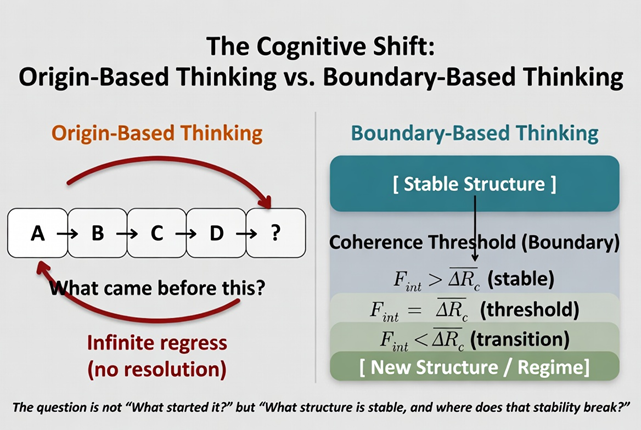
The human mind defaults to sequence-thinking: beginning → middle → end. We ask “What caused this?” and, when given an answer, immediately ask “What caused that?”
This pattern is so deeply ingrained that even profound questions collapse into the same loop. A child hearing adults debate the origin of the universe or the existence of God naturally wonders: “If God made everything, then who made God?” The mind keeps demanding a prior step.
This is not a flaw in reasoning - it is the default cognitive strategy. It works extremely well for everyday cause-and-effect stories, but it becomes an obstacle when we encounter systems that do not possess a tidy “first moment.”
3. Governing Principle or Constraint
Some questions do not have a beginning in the way the mind expects. They have stable regions, transition thresholds, and points where the rules of the system itself change.
When coherence - the system’s ability to maintain or reconstruct its prior structure - falls below a restoration threshold, the system can no longer reconstruct its prior state because the structure needed to support that reconstruction is no longer available. The difficulty is not that the system lacks an answer, but that the question is being asked in the wrong form.
The mind, however, still tries to force an origin story onto the boundary. The result is an infinite regress that feels unsatisfying because the real constraint is not a missing first cause — it is the loss of reconstructible access at the boundary.
4. Implications & Reframing
The practical shift is to replace origin-based questions with boundary-based ones:
· Instead of “What started it?” ask: “What structure is stable here, and where does that stability break?”
· Instead of “What came before the beginning?” ask: “What coherence-capacity limit must be crossed for the current form to emerge?”
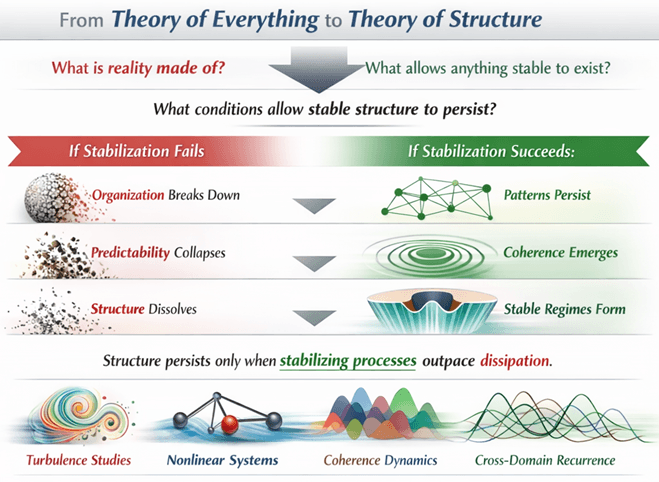
The mind’s demand for an origin can be seen as a cognitive analogue of trying to push past a coherence-capacity limit with the wrong tool. For example, a bridge holds while internal forces can redistribute load. When that capacity is exceeded, the structure doesn’t “go backward” — it reorganizes.
The same pattern appears throughout physics. Systems persist only while restoration outweighs dissipation. When, coherence cannot be maintained and the system reorganizes at a new boundary.
5. Minimal Formalism
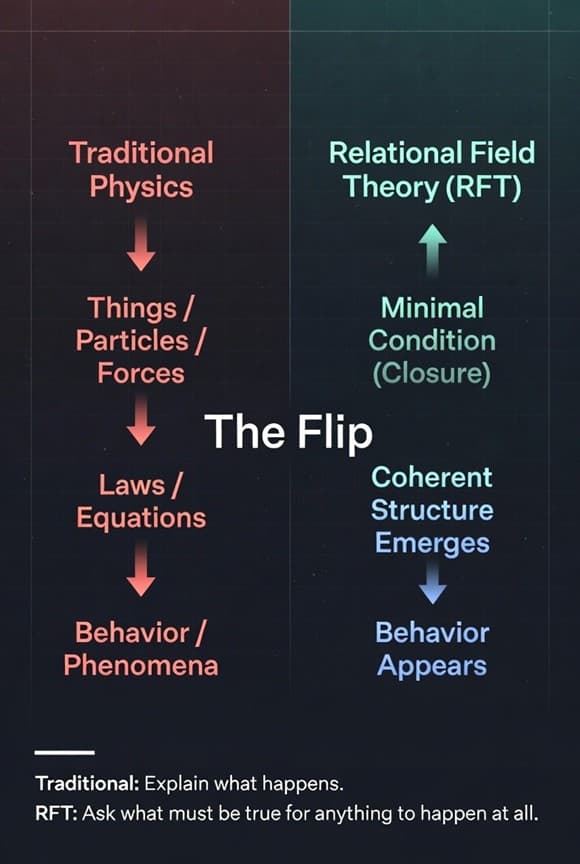
While the full technical development appears in the Relational Field Theory series, the governing idea can be expressed conceptually as: a system maintains coherence while restoration outweighs dissipation. When restoration falls below a critical threshold, coherence cannot be maintained and the system reorganizes at a new boundary.
This is not a proposal of new physics, but a structural perspective that clarifies why certain questions become difficult and how they can be reframed productively.
6. Testability & Predictions
The boundary-based perspective makes several observable predictions about human reasoning and scientific progress:
· Questions framed as origins will reliably produce infinite regress.
· Questions framed as boundaries will converge on testable constraints and transition conditions.
· Cognitive discomfort decreases when people are trained to reframe origin questions as boundary questions.
These predictions are readily testable through simple thought experiments or structured discussions.


Discussion