
1. Introduction / Motivation
Most scientific thinking follows a familiar path.
We begin with things - particles, fields, forces - and then build laws and equations to explain how those things behave. This approach has been extraordinarily successful. It is how we arrived at quantum mechanics, general relativity, and the Standard Model.
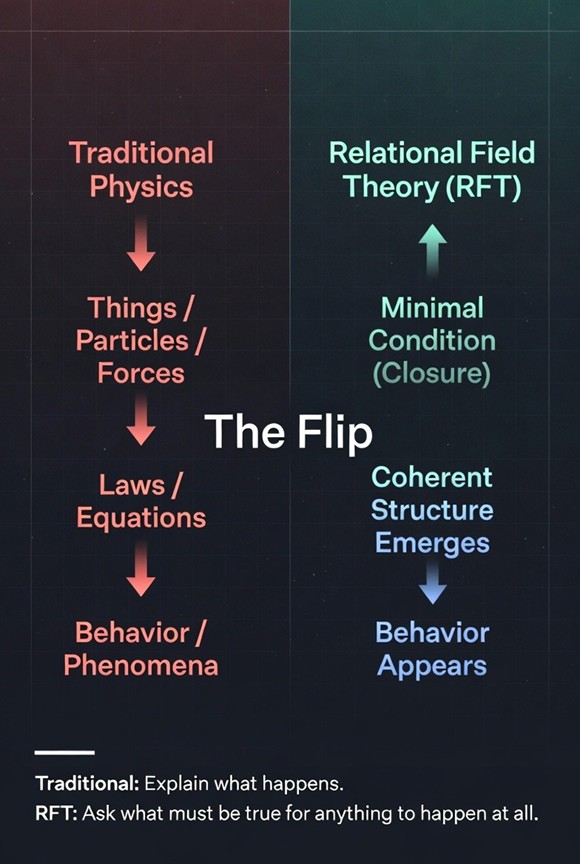
Relational Field Theory (RFT) takes a different starting point.
Instead of beginning with objects or laws, RFT begins with a single minimal condition: closure. It asks a deceptively simple question:
What must be true for anything to hold together at all?
A conceptual summary of this inversion is shown in Figure 1.
2. Core Concept or Framework Overview
From that single condition - expressed in the terminal axiom
coherent domains form, structure emerges, and behavior appears.
All other elements of the framework — including competitive stabilization, resolution constraints, measurable quantities, and empirical signatures — arise strictly downstream.
This is the “flip.”
Traditional physics: start with things → define laws → explain behavior
RFT: start with the minimal condition for persistence → allow structure and behavior to emerge
3. Governing Principle or Constraint
The governing principle of RFT is closure.
Closure defines the condition under which a domain can maintain internal relational consistency. Only when sufficient closure is achieved can a system persist, differentiate, and support multiple candidate configurations.
From this condition, resolution occurs. Competing configurations stabilize into a single realized trajectory - a process formalized as competitive stabilization in the downstream framework.
Importantly, closure is not a dynamical rule or optimization principle. It is a minimal constraint that determines whether coherent structure can exist at all.
4. Implications & Reframing
This inversion leads to a significant reframing of how systems are understood.
In standard approaches, causation is treated as fundamental. In RFT, causation appears only after a domain has achieved sufficient closure to support ordered transitions.
In this sense:
Closure enables persistence
Persistence enables resolution
resolution produces the appearance of causation and ordered behavior
The implication is not that existing physics is replaced, but that many systems — physical, artificial, and potentially biological — may share a common structural pattern:
resolution under constraint
This pattern is already familiar at an intuitive level. Human decision-making, for example, exhibits competing possibilities that resolve into a single action once sufficient coherence is reached. Similar threshold-driven behavior appears in physical and computational systems.
RFT provides a structural language for describing this pattern without introducing additional primitives at the base layer.
5. Minimal Formalism
The base framework is defined by the terminal axiom:
All formal quantities introduced in later work — such as stability margin () and resolution time () — are strictly downstream and apply only within already-coherent domains.
No assumptions of space, time, energy, probability, or dynamics are introduced at the base level.
6. Testability & Initial Empirical Signal
An initial empirical test of this structure was carried out in transformer-based language models (Papers VIII and IX).
Using a simple proxy experiment, we measured:
stability margin ()
resolution time ()
across controlled prompt regimes.
The results showed clear regime-dependent ordering, consistent with the predicted downstream constraints. High-coherence prompts resolved quickly with strong dominance, while low-coherence prompts exhibited prolonged instability and failure modes.
These results do not establish RFT as a validated physical theory. They demonstrate that at least one real system exhibits behavior consistent with the proposed resolution structure.
Closing Note
RFT does not aim to explain what happens.
It asks what must be true for anything to happen at all.
The “flip” is simple once seen — but it requires letting go of the assumption that deeper causal primitives must exist at the base layer. That shift is not trivial, but it may be necessary for understanding what makes coherent structure possible in the first place.


Discussion