
Introduction
Few words carry the weight that “Cancer” does—one of the most serious, feared, and emotionally devastating diseases globally, affecting not just the body but every aspect of a person’s life. It is a single word that reshapes life in an instant. It remains the second leading cause of death worldwide. Cancer is termed life-threatening not because treatment is impossible, but rather because diagnosis often comes too late. It is feared not only for what it does to the body, but for how silently it begins, growing and spreading slowly before the onset of any notable symptoms. Traditional methods are way too expensive, slow, and require specialists. Some of the standard gold methods include next generation sequencing and polymerase chain reactions. For decades, medicine has struggled to take it away.
With the global upsurge in cancer incidences and mortality, technological advancements are emerging across laboratories worldwide. Computational biology and nano-bioelectronics are quietly unfolding in research laboratories. Devices smaller than fingernails are being engineered that could help in better and faster diagnosis. These devices are biosensing chips that do not wait for cancer to announce itself; they hunt for it at the molecular level.
This article explains the working mechanism of biosensing chips, what factors make them so powerful for early detection of cancer, and why they are called next-generation point-of-care devices that can detect cancer-specific biomarkers at extremely low concentrations.
“What if a single drop of blood —or even a breath— could reveal the cancer growing inside you years before a single symptom appears. This is no longer a stuff of science fiction. A new generation of biosensing chips redefines what early cancer detection can look like.”
What a Biosensor Actually Does?
Biosensors are like molecular detectives that are preciously engineered to detect biological signals. They consist of a biological recognition element paired with a signal transducer, and together they do magic.
The biological recognition element acts as the first responder. This could be a strand of DNA, an antibody, or an aptamer. The moment binding occurs, the transducer takes over the charge of sensing the molecular interaction and translates it into electrical impulses. These signals are further amplified, processed, and delivered as digital readouts. This article clearly explains all the steps involved:
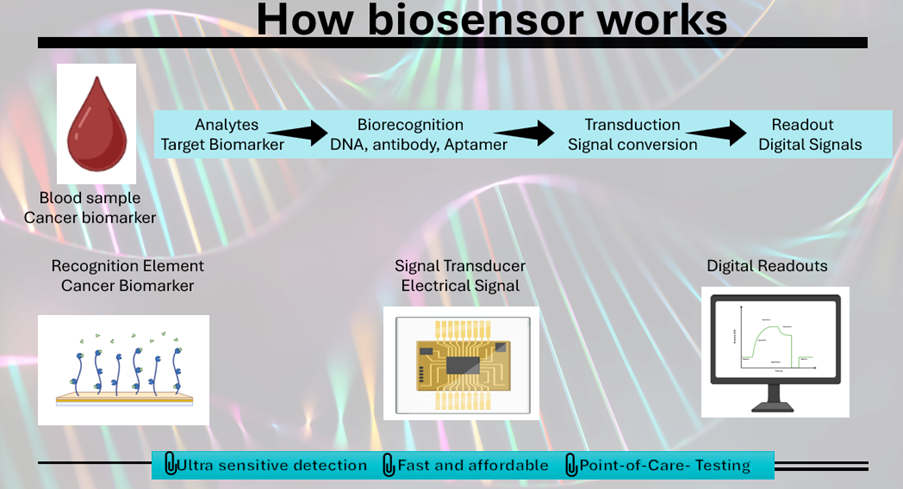
For example, an immuno-biochip was developed for detecting EGFR2, a protein responsible for aggressive breast cancer. Antibodies specific to EGFR2 are immobilized on an electrode surface. When a blood sample passes over it, EFGR2 molecules bind to the waiting antibodies. The moment binding occurs, transducers capture the signals and register the event. Within seconds, clinicians receive measurements without involvement of laboratory infrastructure, advance tests or tools, and without waiting for days.
This is exactly how the biosensor works—and this is only the beginning of the revolution.
Technologies Leading the Revolution
Of all the biosensors, Electrochemical biosensors stand out. They are supernatural sensitive and detect biomarkers at femtomolar concentrations which is equal to a single grain of salt dissolved across a pool to detect cancer-associated miRNAs. At this resolution, cancer can be detected when molecular evidence of malignancy is so low that no conventional test can detect.
Microfluidic point-of-care chips compress the full analytical power of a specialist oncology laboratory into a device as small as a credit card. This transforms not just how cancer is detected but where and for whom. It helps to separate circulating tumors from a few milliliters of blood. For circulating tumor cells, this delivers remarkable clinical performances. These have changed the definition of cancer detection, as these portable bedside devices can detect early stages of cancer and become closer to a universal clinical standard.
Quantum dot biosensors are among the most visually spectacular performers. They not only detect cancer but also illuminate it by offering oncologists a path into tumor biology that was previously impossible to explore. This unlocks multiplexity by tracking down nearly dozens of tumor biomarkers in a single pass. In case of HER2-positive breast cancer, these dots have simultaneously mapped expression of receptor, hormone receptor status, and proliferation indices with clarity in a single run.
Together, these technological advancements are changing the landscape of cancer diagnostics.
Future of Tiny Chips
The global burden of cancer has risen at a faster rate, and the most dangerous advantage has always been time. The time it takes to grow undetected, spread silently, and become resistant to treatment.
The healthcare systems in both high- and low-income countries are under pressure to deliver faster, cheaper, and more accurate diagnostics.
Biosensing chips represent a rare convergence of all these needs. A technology that simultaneously addresses sensitivity, cost, speed, and portability into a single platform.
Electrochemical biosensor detects cancer cells at a level that was previously unimaginable. Quantum dot reveals tumor biology in multi-layered light. Microfluids brings laboratory grade detection to any clinical setting present globally.
Together, these are not just enhancing cancer detection; they are fundamentally reimagining when and where cancer detection happens and its reach.
Conclusion
We spend decades learning to treat cancer. With scientific advancement, we have entered an era where cancer doesn’t get to hide. Biosensor technology has changed that rhythm entirely.
Who would have imagined that a chip, small enough to hold between two fingers, could detect the earliest signals of cancer before it finds its voice?


Discussion