
1. Introduction
What if we could treat cancer and only hurt the cancer cells, not the good cells in the body? This is a question, and it is what makes smart nanoparticles so exciting.
We have been using chemotherapy and radiation to treat cancer for some time, and they do work. They can also hurt the good cells in our body, which can make us feel very tired, lose our hair, and get sick easily. To make things better, scientists are now making particles that can find the bad cells and give them the medicine they need.
In this article, we will talk about nanoparticles and how they work. We will also talk about how they help in cancer treatment, and why they are a big deal in the medical world. This is important because it means we can treat cancer more safely and more effectively for each person. Cancer treatment is what smart nanoparticles are all about. They are changing the way cancer is treated.
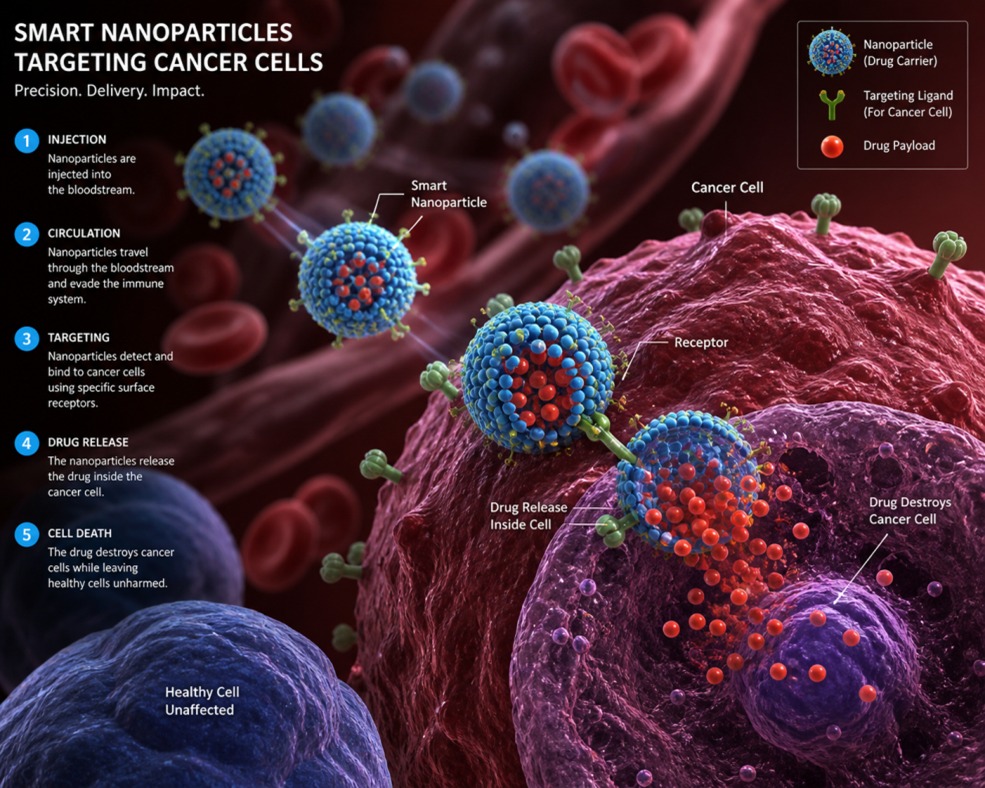
2. What Are Smart Nanoparticles?
Smart nanoparticles are tiny particles that scientists make in a lab. They are usually between 1 and 100 nanometers in size. At this size, the materials in smart nanoparticles work differently, and they can even touch cells and tiny parts of our body.
What makes nanoparticles so special is that they can tell when something is wrong, and they can do something about it. What makes them “smart” is their ability to recognize and respond to specific biological signals. Scientists design these particles with special surface properties that allow them to identify cancer cells based on unique molecular markers found on their surface. Imagine, Scientists make these particles so that they can find bad cells like cancer cells. Because they have special signs on them that say "I am a cancer cell".
Smart nanoparticles can go into our bloodstream. Float around until they find the bad cells. When they find the cells, they stick to them and give them medicine that can make them die. This is a lot better than the way of giving medicine because the old way hurts both the bad cells and the good cells.
Some smart nanoparticles are even smarter because they only give the medicine when they are in a place or when something specific happens, like when it is hot or when there are certain helpers around. This means that the medicine only works on the bad cells and not on the good cells, so we do not get as sick from the medicine.
Smart nanoparticles work at a small level, so they can help us make medicine that is just right for each person and each sickness. This means that smart nanoparticles can help us move away from using the medicine for everyone and instead use medicine that is just right for each individual.
3. How They Improve Cancer Treatment
Targeted Drug Delivery is a key benefit. Old drug therapies affect whole parts of the body, but these smart nanoparticles are designed to deliver specific drugs to tumor sites only, which increases the effectiveness while reducing toxicity.
Another benefit is drug protection. Some of the drugs used for chemotherapy tend to break down and are not delivered to the tumors at the required dosage. Nanoparticles act as a barrier and keep drugs safe from damage until they reach their designated targets (cancerous cells).
Due to the small size of these nanoparticles, they can also penetrate tumors, which often have a high density that drugs cannot always penetrate.
Another new development is Theranostic nanoparticles that carry both a therapy and an imaging component, which not only treat the tumor but can detect it using the imaging aspect. These could drastically improve cancer detection and treatment management.
Journals such as Nature Nanotechnology have published papers on the advantages of nanoparticle-based therapies, demonstrating a significant increase in drug concentration in tumors while not delivering higher dosages to healthy tissue.
Despite these benefits, there are issues. A main problem is the potential for these nanoparticles to be recognized and targeted by the immune system before they reach tumors. As a result, researchers have started coating the surface of the nanoparticles, making them less recognizable and more friendly to the body's defenses.
Despite these issues, nanoparticle-based therapy is extremely promising for cancer treatment.
4. Scientific Evidence
Scientific research shows that nanoparticle-based drug delivery really works. Studies in Nature Nanotechnology found that nanoparticles can deliver up to 10 times more medicine to tumor tissues than traditional chemotherapy.
The National Cancer Institute says that nanoparticle-based treatments have less toxicity in preclinical studies. Furthermore, Liposomal nanomedicines, which are already approved for some cancers help patients feel better and have fewer side effects.
These findings prove that nanotechnology is not an experiment. It is already being used in real cancer treatments and research. Nanotechnology and nanomedicine are helping to make cancer treatments better. It is being used now to help patients.
5. Real-World Implications
Nanoparticles are really good for people who are sick, for doctors, and for the healthcare system as a whole. For people who are sick, nanoparticles are a big deal because they can make treatment work better and have fewer bad side effects. This means that more people can get better, and they can feel okay while they are getting treatment, with nanoparticles. Nanoparticles can really help improve how long people live and how well they feel when they are getting therapy with nanoparticles.
For doctors, this technology makes it possible to give people the medicine that's just right for them based on the kind of tumor they have and their biological profile. This means that the treatment is more precise and it works better.
For hospitals and people who take care of us when we are sick, this technology can help get people better, which can save money in the long run by getting people out of the hospital sooner and helping them feel better when they have bad reactions to medicine.
The thing about these tiny particles is that they are part of a bigger change in the way we think about medicine, where we try to make treatment that is just right for each person instead of just using the same treatment for everyone. This way of doing things brings us closer to being able to know what is going to happen when someone gets sick and being able to give them the right treatment just for them, and that is a really good thing, for doctors, patients, and everyone.
6. Conclusion
Cancer treatment is getting better with the help of particles called nanoparticles. These nanoparticles are making treatment more precise and efficient. They are also reducing the harm to tissues. There are still some problems, like how the immune system reacts to them and how hard they are to make. People are still working on making them better.
This new way of treating cancer is a change in medicine. We used to treat the whole body with strong medicines. Now we can use nanoparticles to deliver drugs in a way. As we learn more about nanoparticles, cancer treatment will get safer and more effective. It will also be tailored to each person’s needs.


Discussion