
Introduction
A simple blood test can reveal important clues about a man's prostate health long before symptoms appear. Known as the Prostate Specific Antigen (PSA) test, it has become one of the most widely used laboratory tools for evaluating prostate conditions and supporting the early detection of prostate cancer.
Despite its widespread use, the PSA test is often misunderstood. Many people assume that a high PSA result automatically means cancer, while others are unsure why doctors recommend the test at all. In reality, PSA levels can rise for several reasons, and interpreting the result requires careful clinical evaluation.
Understanding what PSA is, how it is measured, and what the results may indicate can help individuals make informed decisions about their health and screening options.
What Is Prostate Specific Antigen (PSA)?
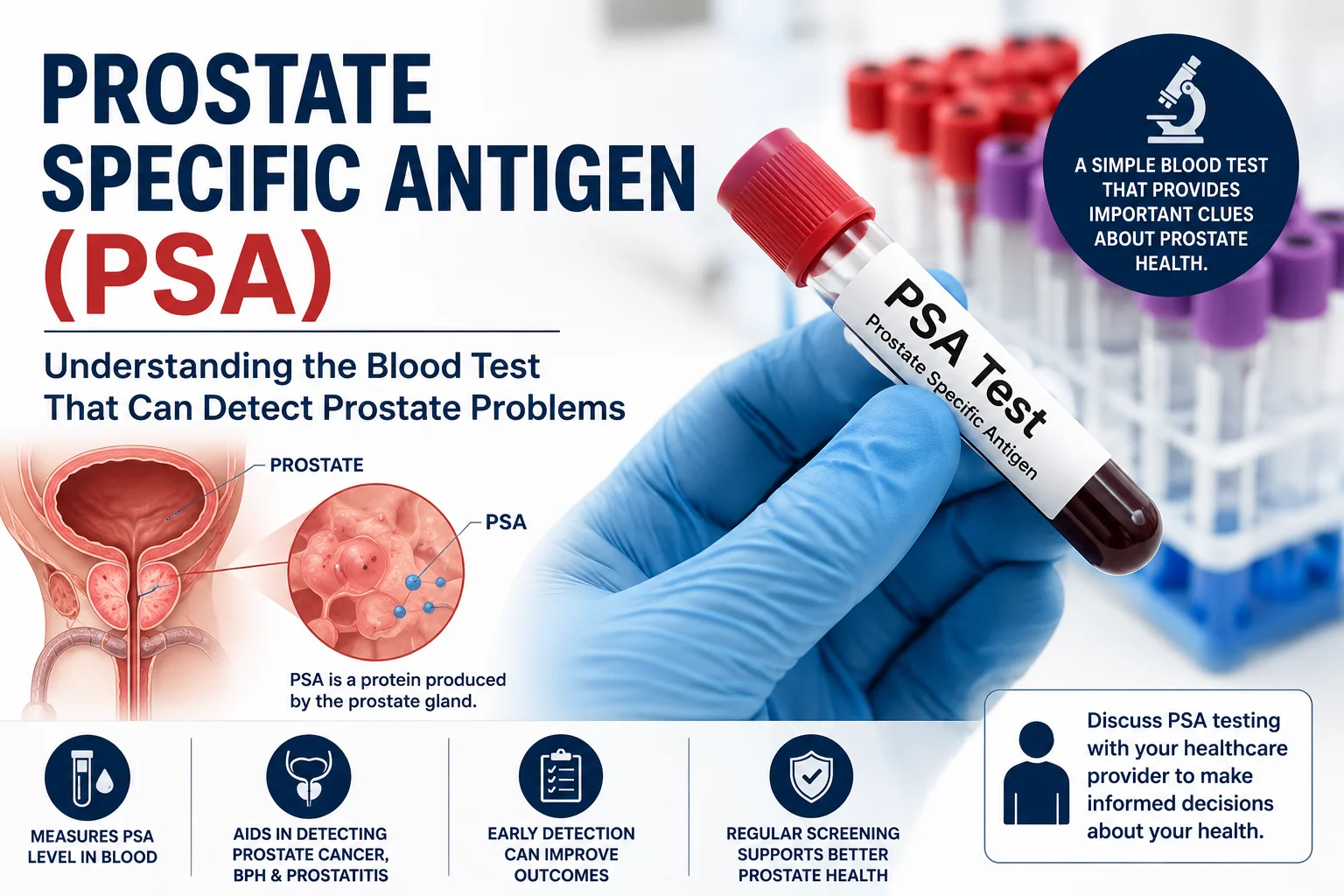
Prostate Specific Antigen (PSA) is a protein produced primarily by the cells of the prostate gland, a small organ located below the bladder in men. The prostate helps produce seminal fluid, which nourishes and transports sperm.
Normally, only a small amount of PSA enters the bloodstream. However, when the prostate becomes enlarged, inflamed, infected, or affected by disease, more PSA may leak into the blood, leading to an elevated PSA level.
Because PSA is produced almost exclusively by the prostate, it serves as a useful biomarker for monitoring prostate health.
How Does the PSA Test Work?
The PSA test is a straightforward laboratory investigation performed using a blood sample collected from a vein, usually in the arm. The sample is analyzed to measure the concentration of Prostate Specific Antigen in the bloodstream, typically reported in nanograms per milliliter (ng/mL).
The test itself does not diagnose prostate cancer. Instead, it acts as a screening and monitoring tool that helps healthcare professionals determine whether additional investigations may be necessary.
Doctors may recommend a PSA test for several reasons:
Routine prostate cancer screening for individuals at increased risk.
Investigation of urinary symptoms such as frequent urination or difficulty passing urine.
Monitoring patients who have been treated for prostate cancer.
Assessing the progression of known prostate disease.
In many cases, the PSA test may be combined with a digital rectal examination (DRE) and other clinical assessments to provide a more complete picture of prostate health.
What Can Cause PSA Levels to Rise?
A common misconception is that an elevated PSA level always indicates prostate cancer. In reality, several conditions can increase PSA levels.
Benign Prostatic Hyperplasia (BPH)
As men age, the prostate gland often enlarges naturally. This non-cancerous condition, known as benign prostatic hyperplasia, can increase PSA production and raise blood levels.
Prostatitis
Inflammation or infection of the prostate gland, called prostatitis, can significantly elevate PSA levels. In some cases, treating the underlying infection may cause PSA values to return to normal.
Prostate Cancer
Cancerous changes in prostate tissue can increase the amount of PSA released into the bloodstream. However, PSA levels alone cannot confirm the presence or severity of cancer.
Other Factors
Certain activities and medical procedures may temporarily affect PSA levels, including:
Recent ejaculation.
Vigorous cycling or activities that place pressure on the prostate.
Urinary tract infections.
Recent prostate examination or biopsy.
For this reason, healthcare providers often consider medical history, symptoms, and repeat testing before drawing conclusions from a single PSA result.
Understanding PSA Test Results
There is no universal "normal" PSA value because PSA levels naturally change with age and individual variation. Traditionally, PSA levels below 4.0 ng/mL have often been considered within the normal range, but some men with lower levels may still have prostate cancer, while others with higher levels may have completely benign conditions.
Rather than relying on a single number, healthcare professionals may evaluate additional factors, including:
Age-specific PSA ranges.
The rate at which PSA levels change over time (PSA velocity).
The ratio of free PSA to total PSA.
Family history of prostate cancer.
Findings from physical examination and imaging studies.
If PSA levels are persistently elevated or increasing rapidly, further investigations such as magnetic resonance imaging (MRI) or a prostate biopsy may be recommended.
Why Early Detection of PSA Testing Matters
Prostate cancer is one of the most common cancers affecting men worldwide. In many cases, the disease develops slowly and causes few or no symptoms during its early stages. This is where the PSA test can play an important role.
Early identification of potential prostate abnormalities may allow for earlier diagnosis and treatment, improving the chances of successful management. At the same time, experts recognize that PSA screening also has limitations, including the possibility of false-positive results and the detection of slow-growing cancers that may never become life-threatening.
Because of these considerations, many healthcare organizations recommend that men discuss the potential benefits and risks of PSA screening with their healthcare provider, particularly if they are over the age of 50 or have a family history of prostate cancer.
The Role of Medical Laboratories in PSA Testing
Medical laboratories play a critical role in ensuring the accuracy and reliability of PSA testing. Proper specimen collection, handling, quality control procedures, and standardized analytical methods help produce dependable results that clinicians can trust.
Laboratory professionals also contribute to patient care by ensuring test quality, validating analytical systems, and supporting clinicians with accurate diagnostic information. While the PSA value itself is just one piece of the puzzle, the quality of laboratory testing directly influences the decisions that follow.
Conclusion
The Prostate Specific Antigen (PSA) test is a valuable laboratory tool that helps assess prostate health and supports the early detection of prostate disorders, including prostate cancer. However, PSA is not a cancer diagnosis on its own. Elevated levels may result from several non-cancerous conditions, making proper interpretation essential.
By understanding what PSA is, what influences its levels, and how the test is used alongside other clinical assessments, individuals can have more informed conversations with their healthcare providers. As research continues to improve screening and diagnostic methods, the PSA test remains an important part of modern laboratory medicine and preventive healthcare.



Discussion