
Abstract
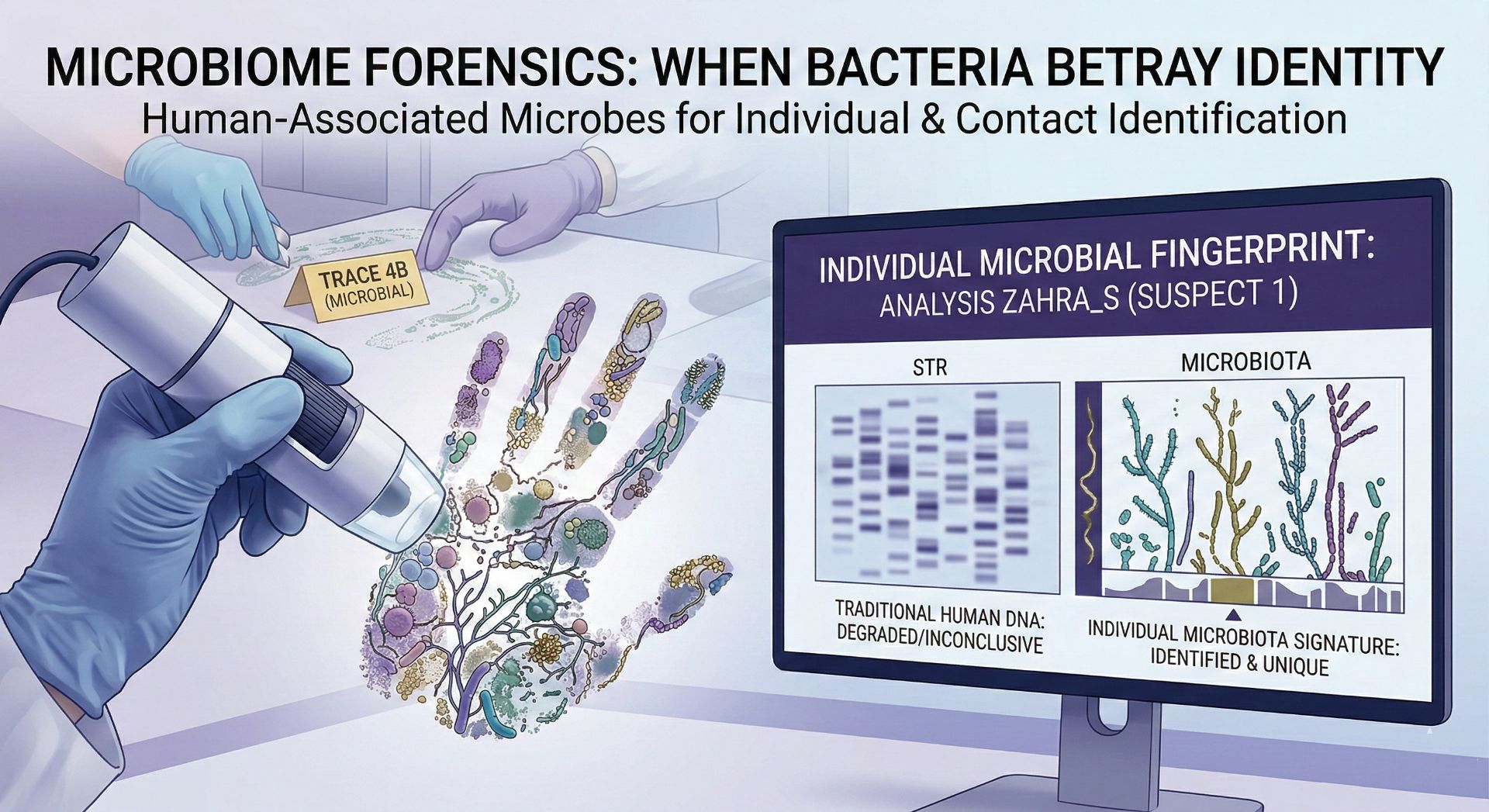
Traditionally, Forensic Science relies on Human DNA for contact evidence and individual identification, but limitations arise when the blood cells obtained from the crime scene are degraded or absent. Recent advances in microbiome analysis highlight its potential as a novel source of forensic evidence, including studies of the community of microbiomes associated with the human body. This review ponders current research on microbiome-mediated identification, with a major focus on interpersonal contact and pointing out criminals. Williams and Gibson's seminal study on the pubic microbiome posited that microbes remain stable over time and are distinctive between individuals, and that, under specific conditions, microbial transfer occurs between sexual partners. A thorough literature review suggests the specificity and uniqueness of human microbiota across personal items and skin, making it a potential forensic signature for post-contact linkages and individual identification. However, there are still issues associated with temporal variability, environmental factors, and standardization of methods. This review integrates the evidence on microbial individuality, transfer, and analysis (including next-generation sequencing and machine learning classifiers), and the limitations of using microbiome data in forensic analysis. By placing microbiome forensics in the context of forensic applications such as contact tracing and individual identification, this review examines the promise and pitfalls, as well as future directions, such as enhanced bioinformatic models based on existing systematic reviews. Microbiome forensics is an emerging, scientifically based technology that has the potential to complement traditional DNA analysis, especially in cases where standard markers are not available.
1. Introduction
1.1 Background
The world of Forensic Science is historically dependent on the use of DNA profiling or genotyping to link the biological evidence with the suspect. Genotyping done through STR (Short Tandem Repeats) markers has revolutionized the area of criminal investigation because of its power to be reliable and discriminatory. Forouzesh et al.
However, the traditional techniques are limited in cases where the biological material is limited or absent and degraded for STR analysis. As the world progresses, forensic applications are being diversified, hinting focus towards sourcing microbial evidence. The microbial evidence, including the Human Microbiome, serves as an alternative source for contact inference and identification. (Sciences and Studies)
1.2 Human Microbiota
Trillions of microbial cells, inhabiting different body sites including the oral cavity, skin, gut, and pubic regions, are all comprised in the Human Microbiome. The composition of microbiomes is affected by personal interactions, lifestyle, genetics, and environment. As far as Forensic Science is concerned, inter-individual variation is observed in microbial communities that can surpass intra-individual variation with respect to time, shaping them to be the potential markers of identity and contact history. (“The Human Microbiome: An Emerging Tool in Forensics | National Institute of Justice”)
Various research projects, including the National Institutes of Health Microbiome Project, have unveiled the fact that various microbial profiles can be generated from different body sites of the same individual and from other individuals, opening doors to innovative forensic applications.
1.3 Objective
The core idea of using Microbes as a major source of evidence stems from the observation that every organism sheds microbial assemblages onto various objects, surfaces, and places that they are in contact with. In items like a keyboard, microbial communities can be retained, hinting towards a specific user, thus highlighting the potential of using microbial signatures as trace evidence. (Jarrad T. Hampton-Marcell et al., 2020.) One of the noteworthy applications is the examination of the pubic microbiome for the potential sexual contact between individuals, a scenario where the potential DNA evidence may be ambiguous or unreliable (e.g., sperm or Epithelial Cells). As shown by William and Gibson that pubic microbiome remains stable even after a long time and after sexual contact, the proportion of shared microbiome increases with respect to it. (Diana W. Williams, Greg Gibson et al., 2019)
Beyond this pubic microbiome data analysis, a systematic Human Microbiome assessment has suggested that there are multiple perspectives that can come in hand, in terms of investigation, i.e., person identification, postmortem interval estimation, and association of personal items, along with contact identification in the context of sexual assault. (García et al., “Impact of the Human Microbiome in Forensic Sciences: A Systematic Review”)
1.4 Expected Outcome and Scope of the Study
Microbiome forensic research is promising, but it faces obstacles such as fluctuating transfer kinetics, environmental effects on microbial communities, and analytical complexity. With an emphasis on microbiota individuality, transfer detection, analytical techniques, and forensic relevance, this study summarizes the available data. In doing so, it considers both advancements in science and practical constraints when using microbial forensics in criminal investigations.
2. Methodology
Just because the microbial evidence is dynamic, sensitive to the environment, and can be influenced by the host, its analysis workflow would be different from the traditional ways of dealing with other forms of evidence. This section highlights the proposed framework, from evidence collection to microbial profiling and then interpretation of the data.
2.1. Evidence Collection from the Crime Scene
The possible things that have been in contact with the human body, surfaces, objects, and biohazard material are typically collected as microbial forensic evidence. The usual sample sites would be the items that the victim or suspect personally have (smart phones, clothes, bedsheets), the places they must have touched (handles of the doors, keyboards, kitchen utensils), and private areas such as pubic region, skin, hair, sweat, which can vary based on the investigation. Nylon flocked swabs or sterile cotton are the most usual tools for sample collection; it's because of their ability to efficiently catch microbial evidence with a minimum chance of contamination. As for the dry surfaces, the swabs are mostly wet with sterile saline or buffer solution for maximum microbial recovery. In case of sensitive cases like sexual contact and intimate personal interaction, swabs are taken from pubic regions, skin folds, and fabrics to seize microbial communities. When collecting, strict inter- and intrapersonal hygiene should be ensured while keeping in check contamination control measures. The crime scene investigators must wear masks, gloves, protective full-body suits, and account for microbial contamination; a negative control swab is collected. Samples should be labeled, photographed, and documented while updating the chain of custody, to maintain the forensic integrity and authenticity.
2.2. Preservation and Transport of Microbial Evidence
As compared to Human-DNA, the Microbial DNA can degrade quickly, and environmental exposure can alter its composition. Therefore, proper packaging is crucial. Swabs are placed in a sterile tube immediately, which contains a DNA stabilization buffer that can stop microbes from dividing and from enzymatic degradation. Samples must be stored at 4 degrees for short-term storage and -20°C to -80°C for long-term storage to stabilize the structure of the microbial community. Because microbiological evidence is sensitive to humidity, temperature changes, and time delays, maintaining these conditions is very crucial.
2.3. DNA Extraction from Microbial Samples
Once the sample is collected, the next important step is to extract DNA from the microbial sample. For investigations involving microbial samples, vigorous extraction methods are needed to obtain DNA of high quality, a mixture of microbial community and low-biomass, including areas like skin, pubic region, and other body surfaces. Usually, scientists must deal with analysis involving human STR markers, but as far as microbial samples are concerned, the focus would shift towards yielding the maximum number of bacterial cell types, while having little to no chance of contamination.
2.3.1 Kit and Swab Selection
The type of extraction kit used and the swabs directly deal with the representation of the community and the yield of DNA. The isolation of maximum microbial DNA is shown by Nylon-flocked swabs because they can release a larger number of cells into the extraction buffer tube from their tip during the processing. Yu et al.
The choice of swabs is limited by the materials suggested by Forensic protocols.
· The materials that minimize bacterial cell compliance.
· Microbial diversity is conserved.
· Are suitable for downstream molecular workflows and are reproducible.
2.3.2 Extraction Method
The typical microbiome forensic analysis is done by following these steps:
1. Cell Lysis
Gram-positive and Gram-negative organisms will be present in the sample, with differences in their cell wall structure. To open the tough cell wall structure, mechanical disruption is done through a chemical lysis buffer, which must be added to the effective lysis protocol. The biofilms and refractory cells are physically disrupted by that mechanical component, while to ensure comprehensive lysis, detergent and enzymatic reagents are used to do the job.
2. Protocols and Commercial Kits
Various commercial kits are used in the forensic laboratories with authentic performance. If taken as an example, Automated Kits like Maxwell® FSC DNA IQ™ Casework Kit, can provide consistent results and high yield especial in cases where contamination control is the first concern. Manual Kits like QIAamp DNA Mini Kit or QIAamp DNA Micro Kit, for cases that need precise optimization. Yu et al. When compared, the results showed that higher concentrations of DNA were observed in automated kits, while manual methods can only be affected if dealt with care.
3. Yield Optimization and Quality Control
Using spectrometric or fluorometric methods, the DNA is then quantified after extraction to further evaluate the purity and concentration of the isolated DNA. If the quality is low and there are traces of inhibitors that are present, there may be a need to repeat the extraction step and purify again for a successful sequencing step.
4. Consideration for low biomass
For the Forensic Microbiome specimens that contain low biomass, for the improvement of recovery of the DNA addition of carrier DNA is done, or bead beating is increased, to oppose the risk of contamination. Positive or Blank controls are always processed side by side for clear results and interpretation.
2.3.3 Preparation for Sequencing Microbial
DNA is treated for amplification and sequencing once it has been isolated. PCR is used to amplify specific marker genes, like the bacterial 16S rRNA gene, before sequencing. Even in situations when microbial DNA is present at low levels or host (human) DNA is abundant, forensic experts may profile community makeup using this focused technique. Zhang et al.
Forensic microbiome practitioners can guarantee that recovered DNA appropriately reflects the in-situ microbial community by optimizing both extraction kits and sampling instruments. This is crucial for trustworthy individuals or contact inference.
2.4. Microbial Profiling and Sequencing Technique
The common method used in forensic microbiome analysis is 16S rRNA gene sequencing, which focuses on the conserved regions of the bacterial ribosomal RNA genes but allows for taxonomic distinction at the genus or species level. This method is cost-effective and can be used for the analysis of low-biomass forensic samples. In more advanced applications, shotgun metagenomic sequencing can be used to provide higher taxonomic resolution and functional information on microbial communities. While more resource-intensive, metagenomics allows for the assessment of strain-level variation, which is essential for individual identification in forensic microbiome analysis. Polymerase chain reaction (PCR) amplification is used before sequencing to increase the amount of detectable microbial DNA. However, primer selection must be done carefully to prevent bias towards microbial targets. Sequencing is done using high-throughput sequencing platforms, which provide a large amount of data that represents the microbial composition of the sample obtained.
2.5. Bioinformatics and Data Analysis
The raw sequencing data that contains low-quality reads, contaminants, and sequencing artifacts must undergo quality control to remove them all. Reference databases can be used to classify microbial sequences, thus producing taxonomic profiles following a specific bioinformatics working pipeline, giving us the relative abundance of a particular microbial taxon. Forensic interpretations are done using machine learning and statistical approaches. Across samples, different techniques are used to generate microbial profiles, such as Random Forest Classification, hierarchical clustering, and Principal Component Analysis (PCA). These approaches allow researchers to compare microbial evidence generated profiles between individuals, spot sharing of microbial signatures, and deduce intra-individual contact. If the similarity score is high and there is no other evidence found, i.e., Blood, semen, fingerprints, or saliva...these similarity profiles can suggest a common microbial origin or transfer, while well-defined microbial patterns can spare an innocent individual if associated with a crime or crime scene. Bansal et al.
2.6. Forensic Application and Interpretative Framework
Active reconstruction, tracing of contact, and differentiation of individuals for all these multiple purposes of forensics can be done through microbiome analysis. For example, in the case of close physical contact, similarity reports of microbial samples should be enough to prove the presence of specific individuals and their contact at the crime scene. Moreover, if one wants to know about the geographic location or habitat, environmental microbial samples would be enough. Weiping Li et al.
However, one should be cautious when giving interpretations. Environmental exposure, hygiene practice, and health status all influence the microbial community. Therefore, microbial evidence could be used as supportive or associative evidence rather than replacing traditional forensic DNA. To increase the dependency of forensic microbiome studies should focus on the reproducibility of the experiments, comparisons on the population level, and stability analysis.
2.7. Ethical and Quality Assurance Considerations
Because of the sensitivity of microbiome data, the techniques used in forensics must consider ethics. The generated microbial profiles might provide personal health, lifestyle, or intimate behavior information. Strict data processing, anonymization, and consent procedures are therefore required. To establish scientific credibility, quality assurance procedures are necessary, such as laboratory accreditation, verified methods, and public reporting standards. These steps bring microbial forensics into compliance with accepted standards of forensic science. Dr. Arora et al.
3. Results and Discussion
The unique nature of the human microbiome is supported by the collection of evidence. Under controlled conditions, certain machine learning models are used to achieve high classification accuracy. Attributed and statistically classified, inter-individual microbiomes of skin and pubic areas have proven to be different on a larger scale. (“Forensic Human Identification Using Skin Microbiomes | Office of Justice Programs”) The persistent nature of microbial signatures for months proposes that microbiome patterns are efficient enough to be able to act as forensic markers, equivalent but not identical to human DNA. However, unlike Human DNA, the microbiome can easily be influenced by lifestyle, environment, and hygiene, thus complicating interpretation. A novel forensics dimension is presented by the ability of microbial transfer through interpersonal contact. The pubic microbiome study is the baseline: it recommends that the intensity of microbial pattern similarity increases with contact between partners. Diana W. Williams et al.
Nonetheless, the detection threshold shows limitations (e.g.,>10% microbial contribution). If the contact is minimal or sporadic, the contact may not generate a signal that is detectable. Further suggesting that while microbial transfer can be a supporting marker, it is very improbable to replace the traditional techniques without notable methodological advances. The progress in research shows that even after days of intercourse, the genital microbial signatures may still be present, opening an extended window in Forensics which cannot be done with the usual sperm detection alone. Lu et al.
However, false positives, environmental contamination, and changes in the microbiome over time remain a significant concern. Thus, robust statistical modeling, validation, and interpretation will be required to integrate microbiome analysis into the forensic process. Ethical issues of consent, privacy, and potential abuse are raised by microbiome forensics. The microbiome, unlike human DNA, is a combination of both environmental and inherited components, sometimes yielding data on lifestyle or health status that is not merely identity-related.
Reproducibility and established soundness are the criteria of legal admissibility (Daubert or Frye tests in some jurisdictions) that are still evolving for microbiological evidence. Another factor that prevents widespread use is the lack of standardization in sampling, storage, sequencing, and analysis of results. Before the acceptance of microbial evidence in courtrooms, comparisons and quality control tests among laboratories are necessary.
4. Conclusion
In regions where conventional DNA analysis may be limited or non-existent, microbiome forensics represents an exciting new area of forensic science, as it provides new approaches to contact analysis and individualization. Using advanced sequencing and analysis tools, research such as the classification of pubic microbiome communities illustrates the potential for the detection of individual patterns over time and the detection of inter-individual microbial transfer. In general, research indicates that human microbiomes can provide forensic information on touched objects or biological samples and are sufficiently individualized. Temporal dynamics, environmental influences, the risk of contamination, and ethical issues represent significant challenges in this area. Before microbiome analysis can be incorporated into forensic analysis on a routine basis, standardized protocols and validation research are necessary. Despite these challenges, the growing amount of data available suggests that microbiome sequencing could be a valuable tool to add to traditional forensic markers in complex cases. The ability to correctly interpret microbial markers for forensic analysis will evolve with technology.



Discussion