
1. Introduction / Motivation
Most theoretical papers present only the final equations, leaving the reasoning process that produced them invisible.
This article makes those steps explicit. I describe a repeatable cognitive pipeline I call Stained-Glass Thinking, which I have used consistently throughout the development of Relational Field Theory (RFT). The method forces a structured progression from visual/structural intuition to plain-language interpretation and finally to mathematical formalization.
By making this process transparent, the method not only improves the coherence of new theoretical work but also offers a practical protocol that AI systems can adopt for more disciplined reasoning.
2. Core Concept or Framework Overview
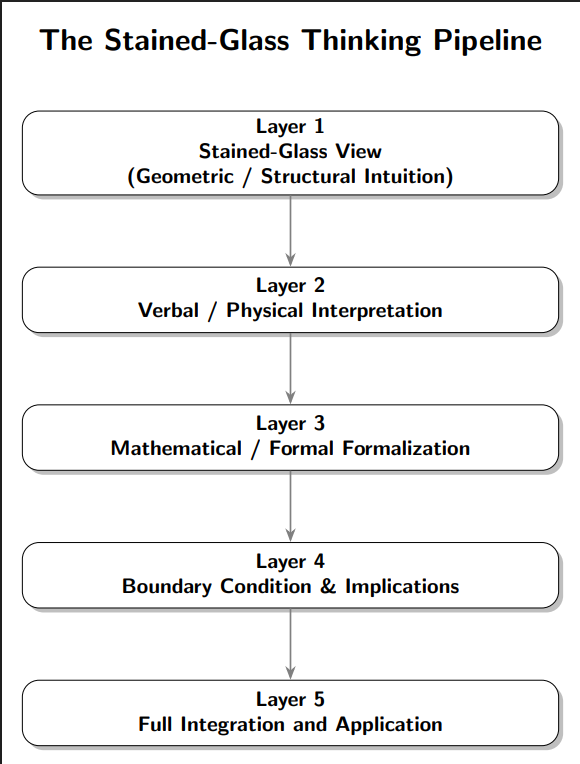
Stained-Glass Thinking is a five-layer cognitive pipeline:
Stained-Glass View (Geometric / Structural Intuition)
Verbal / Physical Interpretation
Mathematical / Formal Formalization
Boundary Condition & Implications
Full Integration and Application
The process begins with seeing the problem as an interconnected structural pattern—like pieces of colored glass held together by lead lines—long before any equation appears. Each subsequent layer translates that intuition into clearer and more rigorous form.
For example, in developing RFT, an initial structural intuition of competing alignment and dispersion (Layer 1) was translated into a physical interpretation of dissipation versus restoration (Layer 2), which then produced the persistence equation (Layer 3).
3. Governing Principle or Constraint
The central rule is simple but powerful: reasoning must move in strict order from structure to formalism.
Layer 1 must remain visual, relational, and free of equations or technical jargon
Layer 3 (mathematics) must be directly traceable to Layers 1 and 2
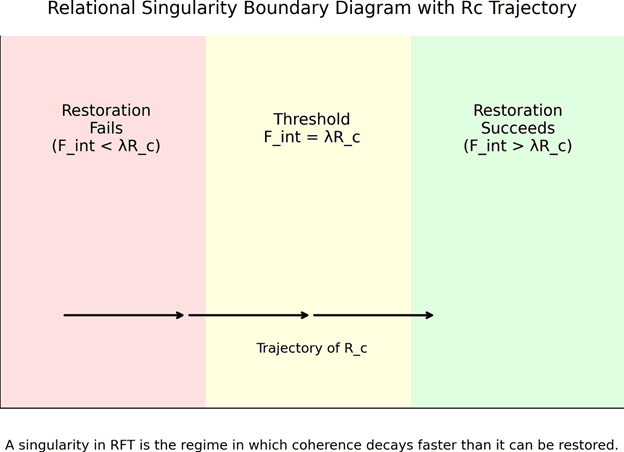
Layer 4 must explicitly identify the critical threshold where the structure changes
This ordering prevents disconnected mathematics and forces the emergence of natural boundary conditions.
4. Implications & Reframing
Stained-Glass Thinking reframes theory construction as a translation process rather than an act of invention. It makes the origin of ideas visible and auditable.
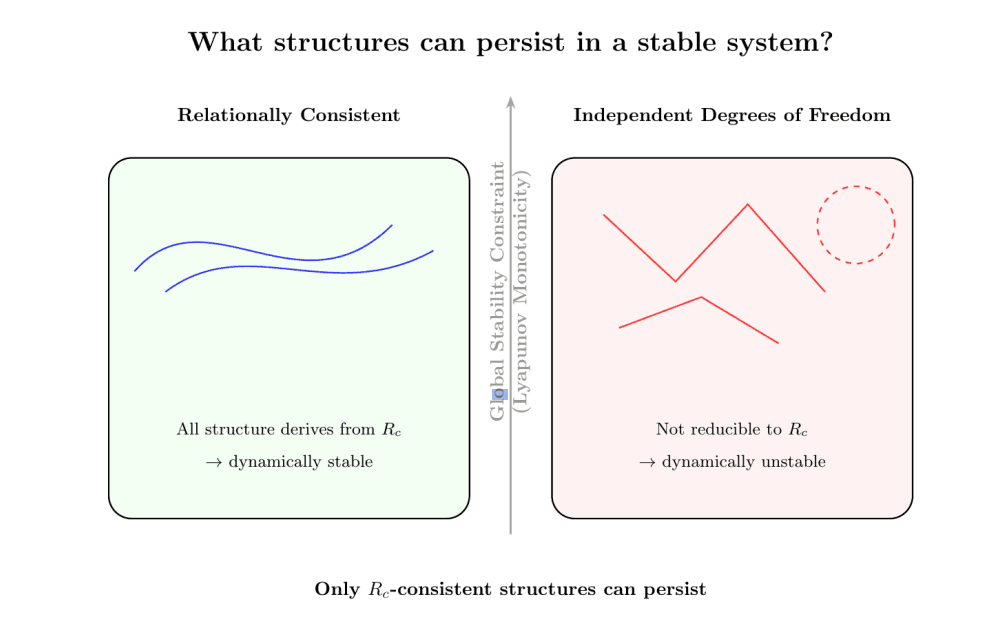
In practice, the method has consistently produced minimal, testable structures. It naturally surfaces coherence thresholds, stability conditions, and regime transitions that might otherwise remain hidden.
When applied to AI reasoning, it provides a scaffold that reduces hallucination, improves structural coherence, and makes the reasoning chain explicitly transparent to users.
For example, an AI system following this pipeline cannot produce a final equation without first generating a consistent structural and verbal interpretation.
5. Minimal Formalism (Optional)
As a running example from Relational Field Theory, the core dynamical law that emerges from this pipeline can be written as:
where:
is a scalar coherence field
represents natural dissipative loss
represents internal restorative interactions
The equation itself is the end product of the five-layer pipeline, not its starting point.
6. Testability & Predictions
Because the method requires explicit progression through all five layers, the resulting framework is more easily falsifiable:
One can inspect whether the final equations are traceable to the original structural intuition
Boundary conditions become natural predictions rather than afterthoughts
AI implementations of the protocol can be audited for adherence to the ordered layers
This creates a direct way to compare reasoning systems based on structural coherence rather than output alone.


Discussion