
What if one of the most powerful models for understanding the human brain were less than an inch long, transparent, and living in a small tank? Meet Danio rerio, the zebrafish. Despite their modest appearance, these small striped fish have become one of neuroscience’s most valuable model organisms. Recent research shows that the way their brains respond to hormones closely parallels mechanisms found in humans. From regulating stress responses to shaping social interactions and behavioral traits, zebrafish provide an unexpected window into human biology. By studying these tiny vertebrates, scientists are uncovering insights into brain function, revealing how hormonal signaling influences behavior across species.
The Stress System: Tiny Fish, Big Hormones
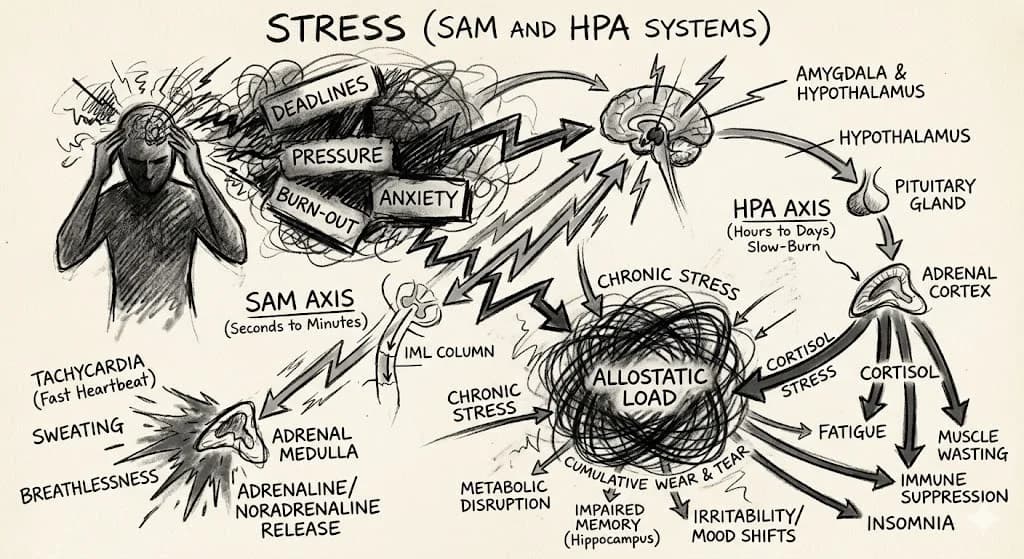
When humans experience stress, the brain activates a hormonal cascade known as the hypothalamic–pituitary–adrenal (HPA) axis, which ultimately releases cortisol into the bloodstream. Zebrafish possess a closely related system, the hypothalamic–pituitary–interrenal (HPI) axis, that performs an equivalent regulatory role. Despite the evolutionary distance between fish and humans, the structure and function of these pathways are strikingly conserved.
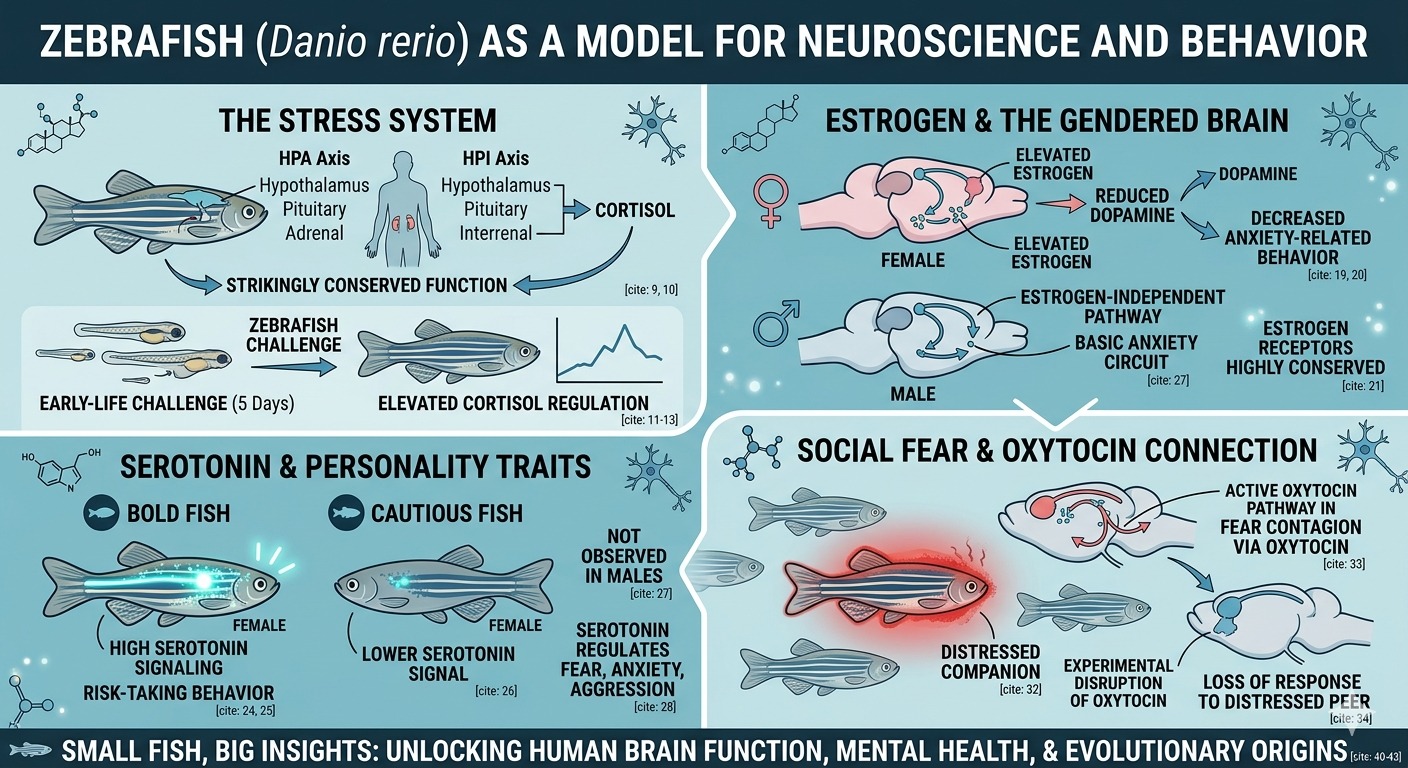
Scientists (Castillo-Ramírez et al., 2024) explored how early-life stress shapes this system by exposing zebrafish larvae to a controlled physical challenge only five days after hatching—an extremely early developmental stage. The findings were remarkable. Fish that experienced this early challenge showed long-lasting alterations in their stress physiology. Their cortisol regulation shifted, their capacity to synthesize stress hormones increased, and key molecular regulators of the stress response remained elevated well after the initial event.
In simple terms, early-life experiences can recalibrate the biological machinery that governs stress responses. Zebrafish provide a powerful model for understanding how such early influences may shape long-term health and behavior across vertebrates.
Estrogen and the Gendered Brain
One finding that often surprises people is that estrogen does far more than regulate reproduction, it also plays a central role in shaping the brain. Research using Danio rerio is helping clarify this relationship. Recent studies (Tao et al., 2025) showed that endogenous estradiol, the primary form of estrogen, modulates anxiety-related behavior differently in male and female zebrafish. In females, elevated estrogen levels were associated with changes in dopamine signaling, reducing concentrations in brain regions linked to motivation and reward. These circuits are also involved in human mood disorders. Complementing this, a review (Akinrinade et al., 2023) emphasized that estrogen receptors are highly conserved across vertebrates, reinforcing the value of zebrafish as a model for understanding how hormonal signals influence brain development and long-term behavior.
Serotonin, Dopamine, and the Science of Personality
Do fish have personalities? Increasingly, evidence suggests they do. In zebrafish (Danio rerio), consistent behavioral differences among individuals, such as boldness or caution, appear to be linked to underlying neurochemical variation. A study (Beigloo et al., 2024) examined “boldness,” defined as the tendency to explore unfamiliar environments and take risks, and then investigated the brain chemistry associated with this trait. The researchers found that in female zebrafish, boldness correlated with differences in serotonin signaling. Individuals displaying bolder behavior exhibited distinct serotonergic profiles compared with more cautious counterparts. Interestingly, this relationship was not observed in males, highlighting notable sex-specific patterns in how neurotransmitters influence behavior.
Beyond individual personality traits, the broader implication is striking. Serotonin in zebrafish plays a central role in regulating fear, anxiety, and aggression, functions that closely parallel its role in mammals, including humans. The same neurochemical pathways targeted by many antidepressant treatments operate in the zebrafish brain, reflecting deep evolutionary conservation across vertebrate species.
Can Fish Feel Empathy? The Oxytocin Connection
In 2023, a landmark study published in Science (Akinrinade et al., 2023) explored a provocative question: how ancient are the biological mechanisms underlying social fear—the capacity to respond to another individual’s distress? Experiments using zebrafish (Danio rerio) provided compelling evidence that these mechanisms are deeply rooted in vertebrate evolution. The researchers demonstrated that zebrafish exhibit fear contagion: individuals become stressed after observing a distressed companion.
Crucially, this response depended on oxytocin signaling. Oxytocin, often described as a “bonding hormone” in mammals, is well known for its role in human empathy, trust, and social attachment. When oxytocin pathways were experimentally disrupted, zebrafish lost their ability to respond to the fear of nearby fish. Neural regions involved in this response also displayed structural parallels to circuits associated with social processing in mammals.
These findings do not imply that fish experience empathy in the human sense. However, they suggest that the biological foundations of social-emotional responses in vertebrates may share a remarkably ancient evolutionary origin.
Small Fish, Big Insights
Zebrafish (Danio rerio) were not originally intended to become central figures in neuroscience. For decades, they were primarily valued in developmental biology because of their transparent embryos and rapid reproduction. Yet scientific discovery often follows unexpected paths. Today, these small fish are helping illuminate fundamental questions about how brains function, how hormones shape behavior, and how emotional responses arise.
Recent studies exploring stress physiology, sex hormones, neurotransmitters, and social behavior have strengthened the role of zebrafish as a powerful model for understanding the biological foundations of mental health. Although the story is far from complete, the emerging picture is compelling. Research on these tiny vertebrates may ultimately help clarify, and perhaps address, some of the most complex challenges surrounding human brain function and psychological well-being.


Discussion