
1. Introduction / Motivation
Modern physics often assumes that the complexity we observe in the universe reflects an underlying complexity in its fundamental structure. Fields, particles, forces, and geometries are typically introduced as independent components, each carrying its own degrees of freedom.
However, this raises a foundational question:
Is complexity fundamental—or does it emerge from a simpler underlying constraint?
In Relational Field Theory (RFT), this question is approached from a different direction. Instead of starting with multiple interacting entities, the framework begins with a single relational field and asks:
What constraints are required for stable, persistent structures to exist at all?
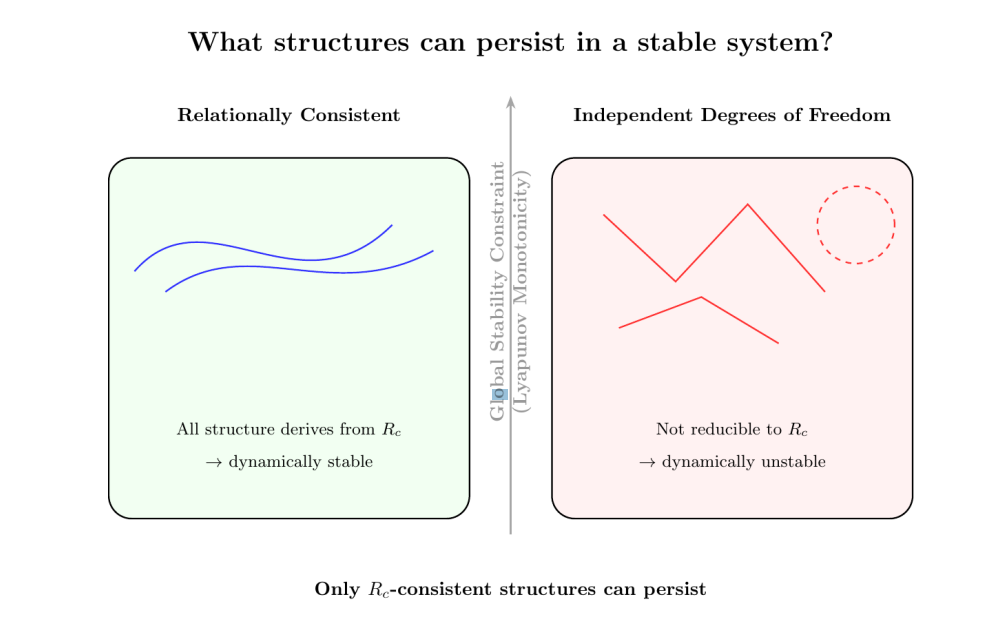
The result is a striking conclusion: a stable universe cannot support unnecessary independent structure. What appears as complexity must instead emerge from a minimal, self-consistent relational system.
2. Core Concept: The Relational Kernel
At the center of RFT is the Relational Kernel, a minimal set of governing rules that define how coherence evolves across a domain.
The primary object is a scalar coherence field:
This field does not represent a particle or force in the traditional sense. Instead, it encodes the degree of relational coherence—how consistently a system maintains structure across space and time.
Two key ideas define the kernel:
Relational closure: All dynamics must be expressible in terms of itself
Self-consistent evolution: The domain Ωis not predefined but emerges from the evolution of
In this framework, what we typically call “structure” (geometry, topology, fields) is not fundamental—it is a manifestation of stable coherence patterns.
3. Governing Principle: Stability via Monotonicity
The central constraint governing the Relational Kernel is global stability, expressed through a monotonicity condition:
Under free evolution (no external forcing), the system must not generate unbounded increases in coherence.
This condition functions as a Lyapunov constraint, ensuring that:
coherence remains bounded
Evolution converges toward stable configurations
Divergence or instability is excluded
From this perspective, stability is not an emergent property—it is a necessary condition for the existence of persistent structures.
4. The Occam Constraint: Eliminating Independent Structure
This leads directly to the central result:
Any additional independent structure not governed by the Relational Kernel cannot remain stable
Formally, if a proposed entity 𝑋introduces degrees of freedom not expressible as a functional of , then the combined system violates the monotonicity constraint.
There are only two possibilities:
1. Redundancy
→ The structure is not fundamental, but derived
2. Instability
→ The system loses coherence and cannot persist
This result is captured in the RFT Occam Theorem:
The simplest possible ontology—one field, one governing equation, one fixed-point structure—is not a preference. It is the only dynamically stable configuration.
5. Implications & Reframing
This reframes several foundational assumptions:
1. Structure is not fundamental
Geometry, fields, and interactions are not independent entities—they are expressions of coherent relational configurations.
2. Complexity is constrained, not arbitrary
Observed complexity must arise from:
stable coherence patterns under minimal rules
—not from freely introduced degrees of freedom.
3. The universe is a constrained system
Rather than being free to adopt any structure, the universe is restricted by:
what can remain stable under relational dynamics
4. Persistence becomes the key observable
Instead of asking “what exists?”, the more fundamental question becomes:
what can persist under the governing constraints?
6. Minimal Formalism
The Relational Kernel is governed by a single evolution equation:
Where:
: potential constrained by stability conditions
: coupling to matter-like terms (not independent fields, but derived interactions)
Importantly, this equation introduces no additional ontological entities.
All admissible structures must be representable as:
curvature effects
gradients
memory or boundary conditions
of
7. Testability & Predictions
A framework like this must be falsifiable.
RFT makes several testable implications:
1. No independent degrees of freedom
Any proposed new field or structure must reduce to a functional of the coherence field.
If not, it should lead to:
instability
loss of boundedness
breakdown of persistence
2. Stability thresholds
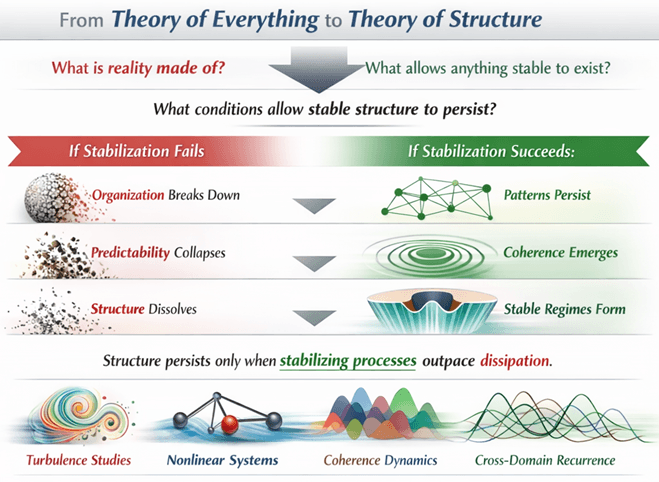
Persistent structures should only appear when:
reinforcement > dissipation
This condition appears across:
oscillatory systems
network dynamics
superconducting regimes
quantum sampling behavior
3. Cross-domain consistency
If the Relational Kernel is correct, similar persistence thresholds should emerge in very different physical systems, independent of their substrate.


Discussion