
Why Yeasts Are a Perfect Evolutionary Laboratory
Evolution is often imagined as a process that unfolds over millions of years. However, in microorganisms such as yeasts, evolutionary changes can occur much more rapidly. Yeasts reproduce quickly, populations grow to large sizes, and genetic variations can spread through generations in a short time. These characteristics make them ideal model organisms for studying evolution in laboratory settings. In addition, yeasts possess remarkable genetic flexibility. Besides accumulating mutations, they can also generate diversity through hybridization between species, producing organisms with new trait combinations. Because of this adaptability, yeasts provide a powerful system for understanding how genetic variation arises and how organisms respond to changing environments.
Hybridization: Nature’s Shortcut to Innovation
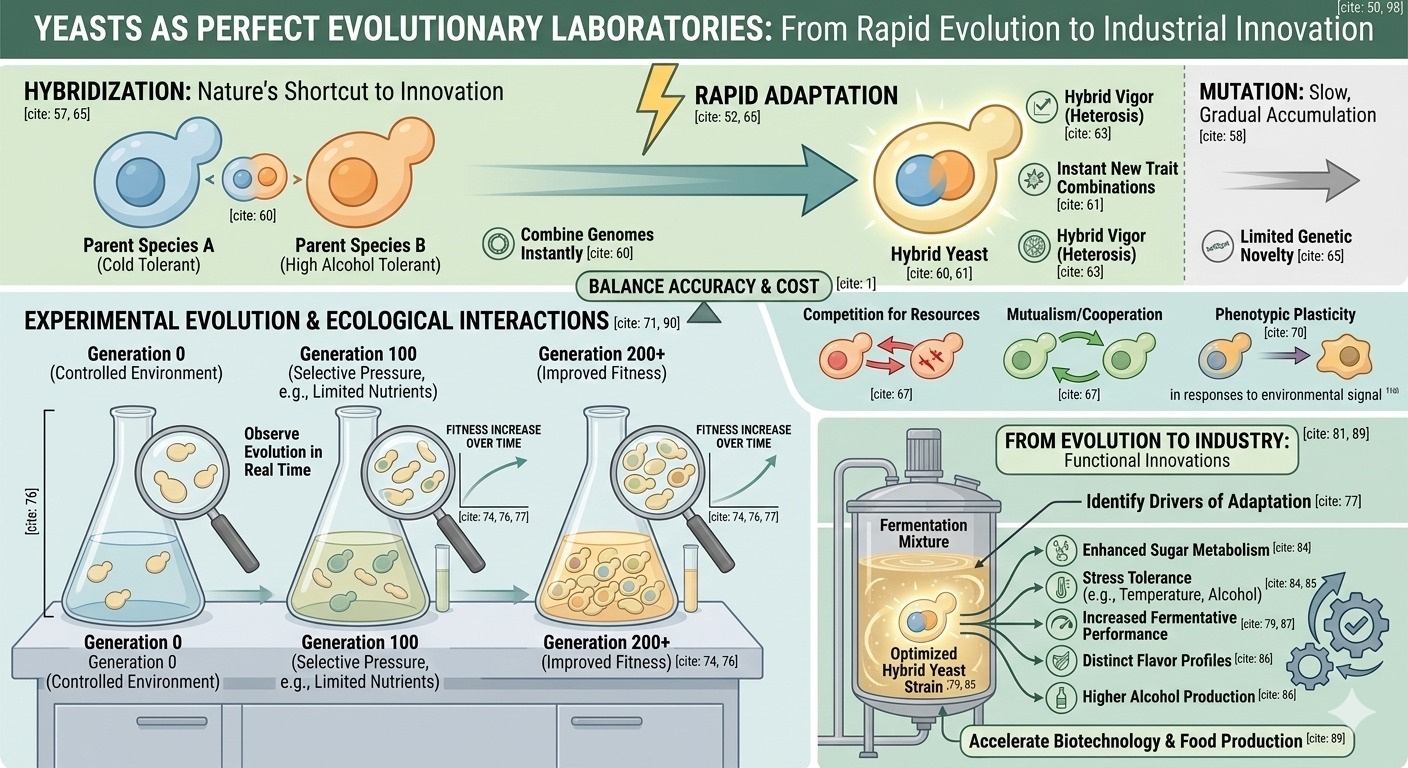
In many organisms, evolution is driven primarily by the gradual accumulation of mutations. However, in fungi such as yeasts, another powerful mechanism can accelerate evolutionary change: hybridization. This process occurs when individuals from different species interbreed, combining their genomes into a single hybrid organism. Instead of waiting for beneficial mutations to arise one by one, hybridization can instantly generate new combinations of traits. These hybrid genomes often carry genetic material from both parent species, which may allow hybrids to exploit new ecological niches or tolerate environmental stresses more effectively. In some cases, hybrids even show improved performance compared to their parents, a phenomenon known as hybrid vigor or heterosis. Studies in fungal evolution (Steensels et al., 2021) have shown that interspecific hybridization has contributed significantly to the diversification and adaptation of many yeast lineages. Because of this ability to rapidly create genetic novelty, hybridization acts as a powerful evolutionary shortcut, generating new biological possibilities in relatively short time scales.
Evolution in Action: What Happens When Yeasts Interact
In natural environments, yeasts rarely exist in isolation. Instead, they interact with other microorganisms through competition for resources or through cooperative relationships that benefit both partners. These ecological interactions can strongly influence how species evolve
. When yeasts grow together, selective pressures created by competition or mutualism can shape the evolution of traits such as growth rate, resource use, and stress tolerance. Studies of evolving yeast communities (Wang et al., 2025) show that these interactions can also influence phenotypic plasticity—the ability of an organism to adjust its behavior or physiology in response to environmental changes—highlighting how ecological context plays a crucial role in evolutionary dynamics.
Experimental Evolution: Recreating Evolution in the Lab
One of the most powerful ways to study evolution is to recreate it under controlled laboratory conditions. This approach, known as experimental evolution, allows scientists to observe how organisms adapt across many generations in response to specific environmental pressures. Because yeasts reproduce rapidly and are easy to cultivate, they are particularly well suited for this type of research.
In experimental evolution studies, researchers grow yeast populations under defined conditions—such as limited nutrients, temperature stress, or fermentation environments—and track how their traits change over time. These experiments make it possible to identify the genetic and physiological mechanisms that drive adaptation. Recent studies (Vega-Macaya et al., 2025) have shown that combining experimental evolution with hybridization can further enhance adaptive potential. Hybrid yeast strains may acquire improved metabolic capabilities, including increased fermentative performance. By observing these processes in real time, scientists can better understand how evolutionary mechanisms generate functional innovations with both ecological and industrial significance.
From Evolution to Industry: Why Hybrid Yeasts Matter
The evolutionary mechanisms observed in yeast are not only important for understanding basic biology but also have significant practical applications. Hybridization and experimental evolution can generate strains with improved traits that are valuable in industrial processes, particularly in fermentation (Vega-Macaya et al., 2025). Yeasts are central to the production of products such as beer, wine, and bioethanol, where efficient sugar metabolism and tolerance to stressful conditions are essential. Hybrid yeasts often combine advantageous traits from different parental species, allowing them to perform better under industrial conditions. For example, some hybrids can tolerate higher alcohol concentrations, ferment at lower temperatures, or produce distinctive flavor profiles. These characteristics can improve both the efficiency and the quality of fermentation processes. By studying and harnessing these evolutionary mechanisms, scientists and industry professionals can develop new yeast strains with enhanced performance. This illustrates how research on microbial evolution can directly contribute to advances in biotechnology and food production.
Where Genetics, Ecology, and Evolution Meet
Research on yeasts has revealed that evolution is not always a slow and gradual process driven solely by random mutations. Instead, multiple mechanisms can accelerate the generation of biological diversity. Hybridization allows organisms to combine entire genomes from different species, while ecological interactions such as competition and cooperation shape how traits evolve in microbial communities. Together, these processes can rapidly produce new genetic combinations and adaptive strategies. Experimental studies with yeast demonstrate how these mechanisms operate in real time. By observing populations across many generations, scientists can see how environmental pressures and species interactions influence evolutionary outcomes. These insights not only deepen our understanding of fundamental evolutionary principles but also highlight the remarkable creativity of natural processes. Ultimately, studying yeast evolution shows that innovation in biology often arises from the interplay among genetic diversity, ecological dynamics, and environmental challenges.




Discussion