
1. Introduction / Motivation
Many physical and computational systems exhibit a familiar behavior: ordered states gradually decay in the presence of noise. Examples appear across science:
Quantum circuits lose fidelity under gate noise
oscillator networks lose synchronization under perturbations
neural network training dynamics drift under stochastic gradients
reaction–diffusion systems lose pattern structure under noise
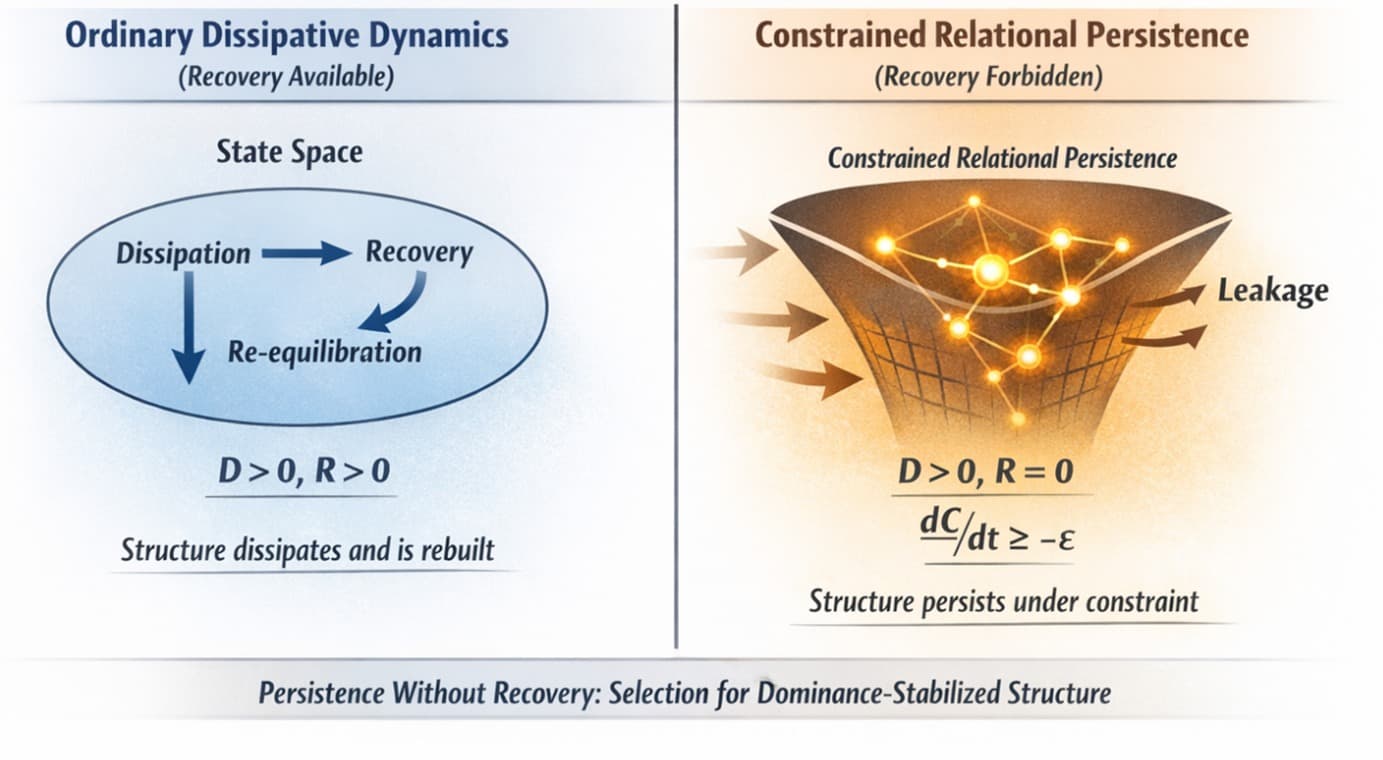
In each case, noise tends to push the system toward disorder. Standard models typically assume this decay is approximately exponential unless strong coupling or external control mechanisms are present.

However, a simple structural question arises: Can topology alone influence how long coherence persists in a noisy system? In particular, could certain repeated local structures within a system reinforce coherence faster than noise removes it?
This question motivated a series of exploratory papers examining whether a minimal dynamical recurrence could produce delayed decay or persistence plateaus across different domains. The goal was not to propose a universal theory, but to test whether a simple structural mechanism could appear consistently across unrelated systems.
2. Core Concept: A Minimal Persistence Mechanism.
The work begins with a simple idea. Suppose a system has:
Noise or decay, which gradually reduces coherence
Local coupling, which allows neighboring elements to influence each other
A bounded nonlinear feedback term, which reinforces coherence when it becomes locally organized
If repeated local motifs are present in the system’s topology, these motifs may act as reinforcement structures, allowing coherence to accumulate locally before noise can disperse it.
Under these conditions, the system can exhibit a bifurcation between two regimes:
a standard noisy regime where coherence decays to zero
a persistence regime where a nonzero plateau emerges
The mechanism can be captured by a minimal recurrence governing a bounded coherence observable r:

where
γ represents effective noise or decay
α(μ) represents reinforcement strength depending on motif density
When reinforcement exceeds noise, the system can stabilize around a nonzero coherence plateau. The transition occurs when α(μ) > γ — a transcritical bifurcation separating decay from persistence.
Importantly, the mechanism does not require introducing new physical laws. It only introduces a topology-dependent reinforcement parameter.
3. Why Topology Matters
Topology enters through motif density. Motifs are small repeated connectivity patterns,s such as:
loops
triangles
repeated subnetworks
structured local neighborhoods
When these motifs occur frequently, they create local reinforcement pathways that can temporarily stabilize coherence. Motif density can be defined as the fraction of system elements that participate in repeated local subgraphs within the interaction network. Increasing motif density increases the effective reinforcement parameter α(μ).
The hypothesis explored in this work is that topology alone may shift the persistence threshold, delaying the decay of coherence even when noise remains unchanged.
4. Four Domains Explored
To examine whether this mechanism is domain-specific or structural, the same recurrence framework was explored across four very different systems. The goal was not to fit detailed physical models, but to examine whether the same qualitative bifurcation structure could appear across multiple contexts.
Random Quantum Circuits.
In noisy random quantum circuits, fidelity metrics such as cross-entropy benchmarking (XEB) typically decay with circuit depth. When repeated structural motifs appear in the connectivity graph, the model suggests that fidelity decay may slow or stabilize temporarily, producing observable plateaus under identical noise conditions.
Coupled Oscillator Networks
Oscillator networks provide a clean classical testbed for collective dynamics. The synchronization order parameter measures the degree of phase alignment across oscillators. Networks containing repeated connectivity motifs may sustain synchronization longer under noise, producing delayed decay or plateau-like behavior.
Neural Network Training Dynamics:
Deep neural networks frequently exhibit extended loss plateaus during training. If the parameter interaction structure is interpreted as a network, higher motif density may influence how coherence propagates during optimization, potentially producing longer-lived plateau regimes in training dynamics.
Reaction–Diffusion Pattern Formation.
Reaction–diffusion systems are classic models of spatial pattern formation. Under noise, ordered patterns usually degrade over time. When spatial coupling contains repeated structural motifs, the recurrence predicts longer persistence of pattern coherence before the system relaxes toward uniformity.
5. Testability and Falsification
A key goal of this work is to make clear, falsifiable predictions. Each paper proposes a simple experimental or simulation protocol.
Two systems are constructed that are identical in every respect except for motif density. The following variables are held constant:
noise strength
system size
coupling strength
environmental conditions
Only motif density is varied.
The prediction is straightforward:
If α(μ) ≤ γ, coherence decays normally.
If α(μ) > γ, a persistence plateau emerges.
If no statistically significant difference appears between motif-rich and motif-poor systems, the model is falsified. This matched-pairs approach allows the mechanism to be tested across simulations or experiments without requiring detailed knowledge of microscopic dynamics. The protocol is intentionally domain-agnostic and requires no changes to the underlying physics of each system — only the topology of local interactions is modified while noise and system parameters remain fixed.
6. Implicatio:
ns If topology-dependent persistence is observed across multiple systems, it would suggest that local structural reinforcement can influence the stability of coherence under noise. This would not imply a universal theory, but it would point toward a recurring dynamical motif appearing in different fields.
Similar structural motifs have historically played important roles in science. Examples include:
logistic growth in population dynamics
synchronization in oscillator networks
scaling laws in renormalization theory
Each began as a simple mathematical structure that appeared repeatedly in unrelated systems. The present work explores whether a similar structural motif may exist in noisy coupled systems. Further investigation, particularly through simulations and controlled experiments, will determine whether the predicted persistence effect is observable in practice.
Structural Motivation
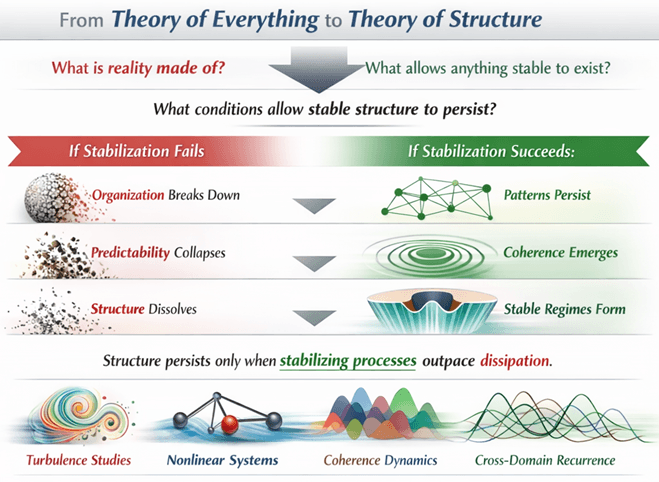
The recurrence explored in these papers was originally motivated by ideas from Relational Field Theory (RFT), a framework that examines how stability in physical systems may emerge from relational structure rather than isolated components. Within that perspective, coherence is treated not purely as a property of individual elements but as something that can accumulate through repeated local relationships within a network or field. The recurrence used in this work can be viewed as a minimal phenomenological expression of that intuition: local motifs act as reinforcement structures that may allow coherence to persist longer than expected under noise.
Importantly, the present papers do not depend on accepting RFT as a theory. The recurrence and its predictions stand independently as a testable dynamical hypothesis. The role of RFT here is simply historical — it helped motivate the search for structural persistence mechanisms that might appear across multiple domains.
7. Formal Papers and Technical Details
Full technical derivations and domain-specific analyses are available in the following papers:
Topology-Dependent Coherence Persistence in Noisy Random Quantum Circuits https://doi.org/10.17605/OSF.IO/U65TY
Topology-Dependent Persistence of Synchronization in Noisy Coupled Oscillator Networks https://doi.org/10.17605/OSF.IO/TS3RV
Topology-Dependent Loss Plateau Persistence in Neural Network Training https://doi.org/10.17605/OSF.IO/YJ6G8
Topology-Dependent Pattern Persistence in Noisy Reaction–Diffusion Systems https://doi.org/10.17605/OSF.IO/EZ7JH
These papers contain the formal recurrence models, derivations, and simulation protocols.
Acknowledgment: This work forms part of a broader research program exploring structural stability mechanisms in noisy systems. Researchers interested in testing the matched-pair protocols or exploring the effect in other systems are encouraged to examine the linked OSF papers.



Discussion