
1. Introduction / Motivation
Relational Field Theory (RFT) has matured into a predictive framework with operational definitions, numerical demonstrations, and practical inference tools. As the program moves toward empirical validation, it is essential to identify the conditions under which its core ideas — particularly the persistence law and coherence functional — may break down or produce misleading results.
Acknowledging these limits is not a weakness. It defines the boundaries within which the framework can be meaningfully tested.
2. Core Concept or Framework Overview
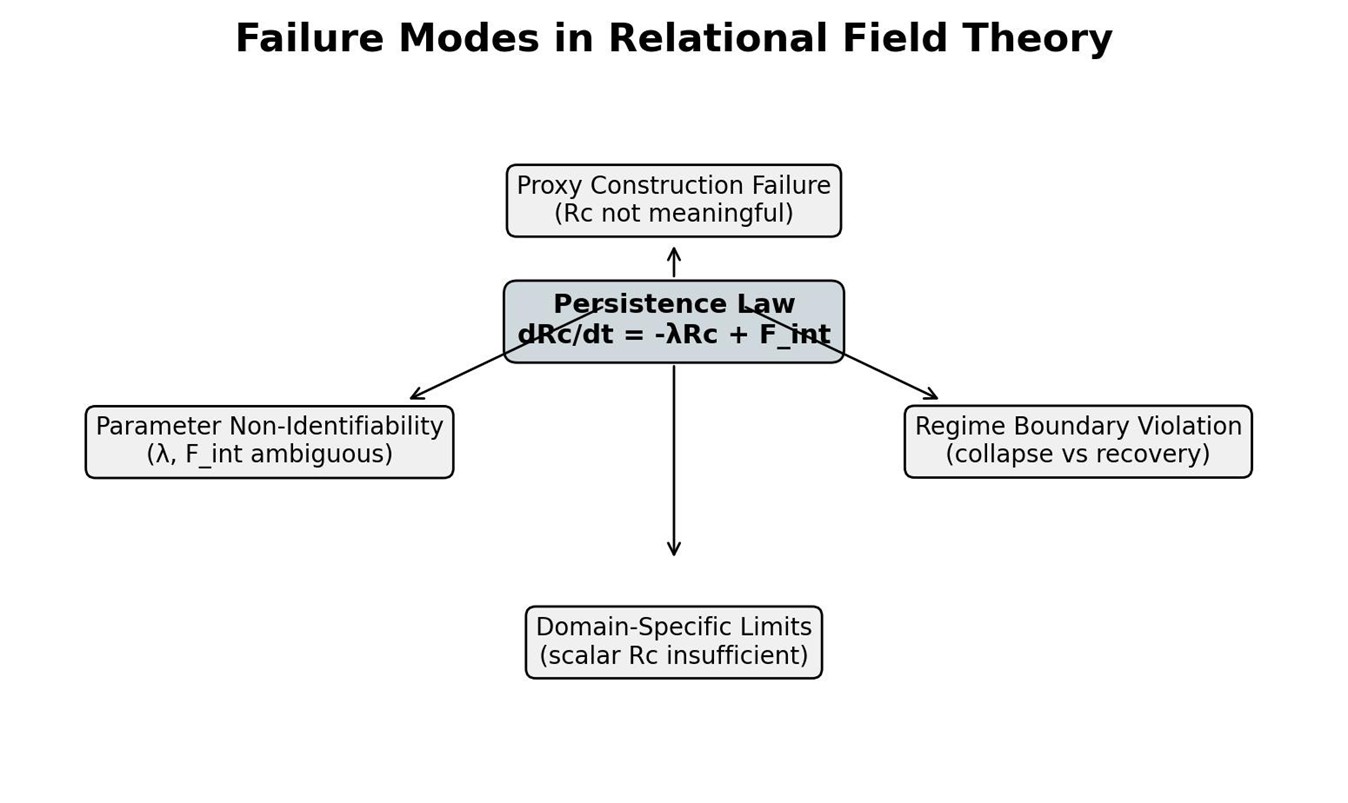
The central persistence law in RFT is expressed as
This reduced dynamical form defines the operational regime of the persistence law. Its validity depends on several assumptions: that R_c can be meaningfully extracted from data, that parameters λ and are identifiable, and that the system remains within the intended regime.
3. Governing Principle or Constraint
Four primary failure modes emerge from numerical exploration and theoretical analysis:
• Proxy Construction Failure: When the chosen observables do not faithfully reflect relational order (e.g., in highly chaotic or non-stationary systems), becomes noisy or meaningless.
• Parameter Non-Identifiability: When λ and produce similar time-scale effects, multiple parameter pairs yield indistinguishable recovery curves.
• Regime Boundary Violation: Outside the persistence regime (when restoration is too weak relative to dissipation), the system collapses rather than recovers.
• Domain-Specific Limitations: In systems with strong spatial structure or quantum entanglement, the scalar proxy may lose essential information.
These failure modes often co-occur, particularly in low-resolution or single-condition datasets.
4. Implications & Reframing
The underlying study provides diagnostic signatures for identifying these failure modes in practice. By making these limits explicit, RFT moves from an aspirational framework toward one that can be rigorously evaluated and improved.
5. Testability & Predictions
Future experimental designs should prioritize multi-condition experiments, higher-resolution data, and careful proxy validation to avoid known failure regimes. These limits help define the conditions under which RFT predictions can be meaningfully tested.
6. Conclusion:
Making these limits explicit allows RFT to be evaluated not only by where it succeeds, but by where it is expected to fail.



Discussion