
A low-energy dynamical approach could give companion AI the gift of long-term relational memory - especially valuable for eldercare.
In an aging world, millions of elderly people face a quiet crisis: loneliness. They don’t necessarily need an AI that is brilliantly intelligent. They need one that remembers them - their stories, their tone, their shared history - even after weeks or months between conversations.
Current AI systems struggle with this. They are built around discrete sessions. When the chat ends, context largely disappears. Rebuilding it next time is expensive and imperfect. For companionship, especially in eldercare, this is a serious limitation.
A Different Approach: Persistent Relational Continuity
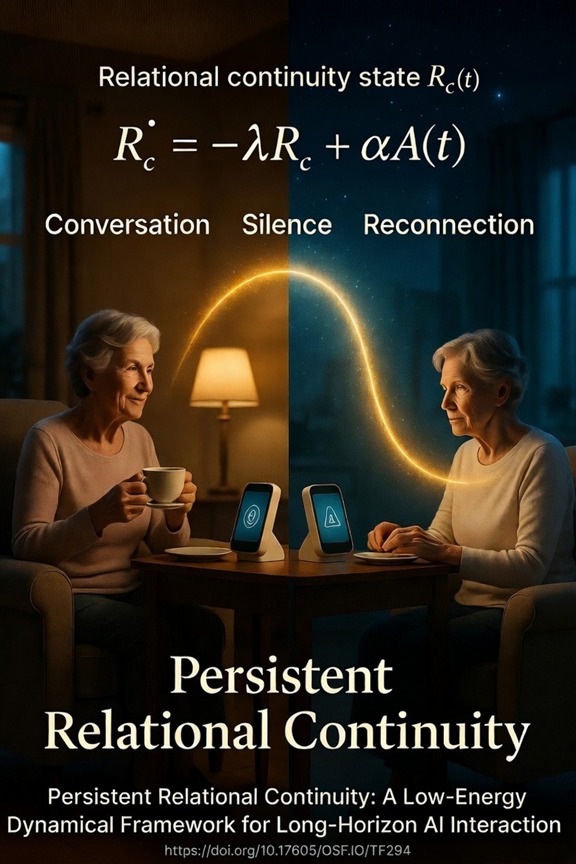
Instead of trying to store every conversation, what if we maintained a lightweight, low-energy “relational state” that never fully drops to zero?
We call this Persistent Relational Continuity. It is not about simulating consciousness. It is about keeping a gentle, continuous thread of relational context alive - enough so that when the person returns, the AI can re-engage naturally and meaningfully, without reloading massive histories.
Rather than preserving full conversations, the framework maintains a compressed low-resolution continuity state that captures interaction stability and relational reinforcement over time.
The Core Mechanism
We model this with a simple dynamical equation:
Where:
: the strength of relational continuity at the time
: very slow natural decay (the system “forgets” gradually)
: small reinforcement whenever real interaction occurs
During long periods of inactivity, R_cdecays slowly. When the user returns, even a short conversation rapidly strengthens the state again. The result is fast re-entrainment - the system can re-establish conversational continuity rapidly without needing perfect memory. In practice, this behaves more like a low-energy dynamical attractor than a conventional memory archive.
For human-AI companionship, we can use asymmetric decay: the human side (or a simulated anchor) decays more slowly, acting as a stable reference point.
Why This Matters for Eldercare
Elderly users often value consistency more than cleverness. They want the AI to:
Remember how they like to be greeted
Recall shared jokes or emotional moments
Maintain conversational rhythm across weeks
A persistent continuity layer can deliver exactly that - at very low computational and storage cost. No giant context windows. No exhaustive logs. Just a lightweight relational field that holds the shape of the relationship.
Ethical Guardrails Are Essential
This approach must be designed carefully:
No claim of consciousness or sentience
No hidden high-resolution memory
Full transparency: users should know the system maintains lightweight continuity
User control ability to reset or adjust the continuity strength
Done right, this is not creepy persistence - it is respectful continuity. From Theory to Practice This idea grew out of Relational Field Theory work exploring how coherent structure can emerge from simple relational dynamics. The same principles that produced emergent scalar fields in graph models now suggest a practical way to give AI systems better long-term relational memory. We are not claiming awareness. We are claiming something more modest and achievable: better continuity without massive storage. An Invitation Loneliness among the elderly is a growing problem. If you are working on companion AI, eldercare technology, or persistent agent architectures, I would be happy to share the mathematical details and simulation code openly.


Discussion