
1. Introduction / Motivation
Conservation laws (energy, momentum, charge) are among the most reliable features of local physics. They work with extraordinary precision in laboratories and everyday settings. This success naturally leads to the intuition that conservation is a universal, fundamental property of nature.
Yet when we look at larger scales — cosmological expansion, horizons, or black hole interiors — global conservation becomes more difficult to define unambiguously. General relativity already complicates the definition of total energy, and cosmological models raise questions about global accounting.
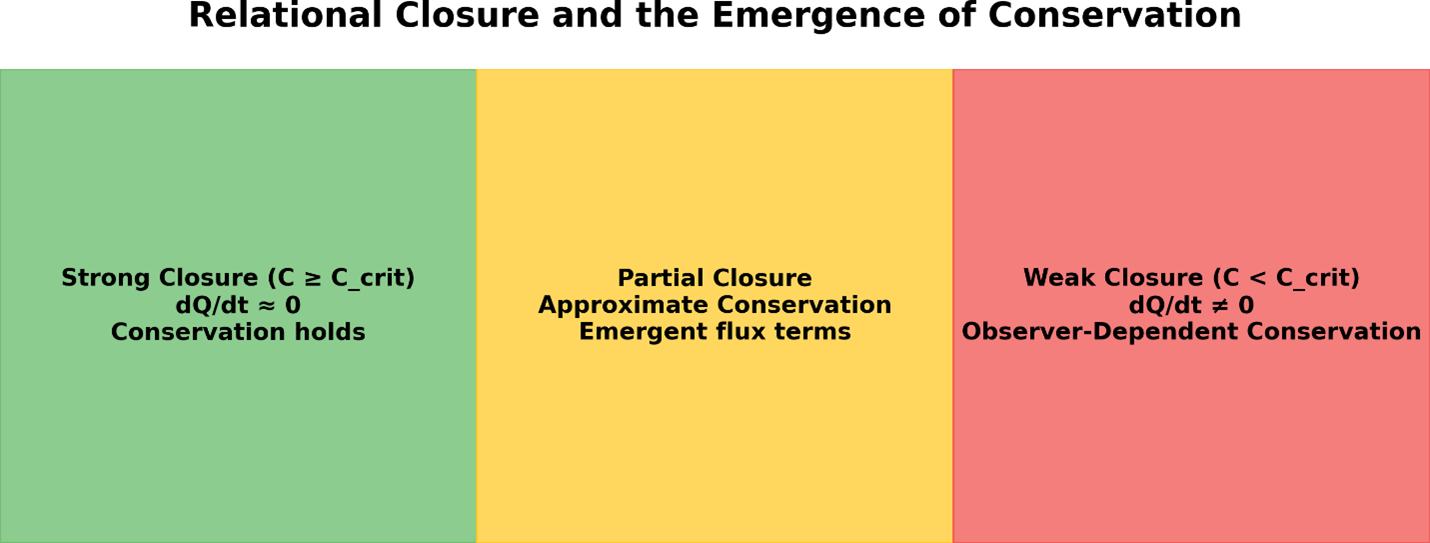
Relational Field Theory (RFT) offers a structural explanation for why conservation works so well locally while becoming more subtle at larger scales.
2. Core Concept or Framework Overview
In RFT, relations — not objects or forces — are primary. Physical quantities and laws emerge from the geometry, coherence, and flow of relational fields. A central idea is relational closure: high-coherence domains form effectively closed regions where stable invariants can persist.
Conservation laws emerge robustly inside these closed domains but become approximate or observer-dependent when closure weakens.
3. Governing Principle or Constraint
Define a closure functional for a relational domain
where is local relational coherence and f is monotone increasing
A quantity Q satisfies approximate conservation when closure is strong:
When closure weakens, a relational flux term appears, making conservation regime-dependent. Recoverability further determines whether invariants remain stable and reconstructable.
4. Implications & Reframing
This perspective reframes conservation from a presumed universal absolute to a local emergent symmetry stabilized by relational closure. It explains:
• Why conservation works so extraordinarily well in our everyday domain (strong local closure). • Why extending that exactness globally becomes difficult (varying closure across domains).
• Why black hole interiors may admit constrained relational persistence under reduced recoverability.
It unifies local robustness with large-scale variability without introducing new fundamental fields or forces.
5. Minimal Formalism
The key equations are intentionally simple and conditional. Conservation is not assumed globally but emerges conditionally when relational closure and recoverability are sufficiently strong. Outside these regimes, effective descriptions become approximate.
6. Testability & Predictions Recent regression analysis on synthetic anisotropic channel flow provides supporting evidence: structure-sensitive coherence adds substantial explanatory power in near-wall anisotropic regions (ΔR² ≈ +0.245) but negligible value globally. This pattern is consistent with regime-dependent activation.
Future work will explore these ideas on higher-resolution DNS and examine possible observable signatures in extreme regimes.
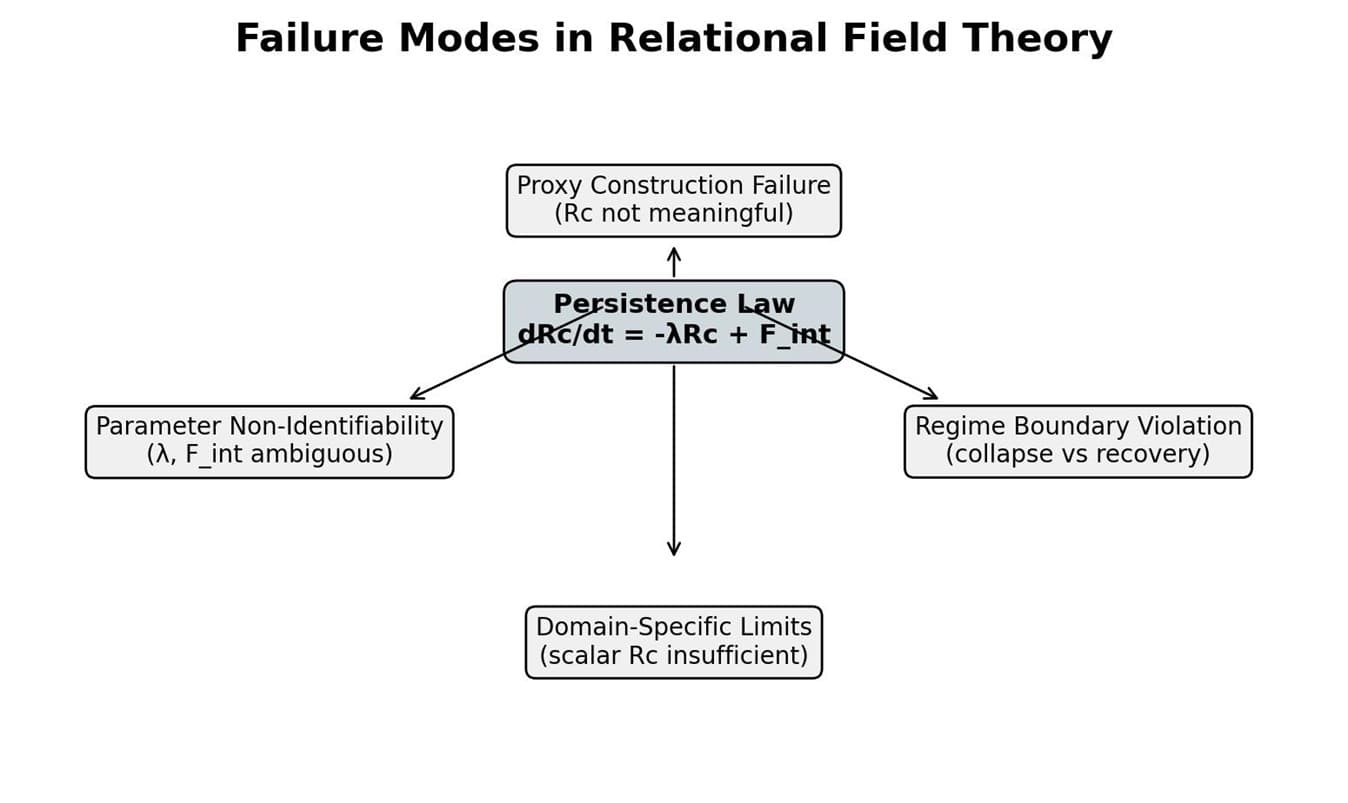



Discussion