
1. Introduction: A Different Kind of Singularity
In many areas of physics, the word “singularity” implies the breakdown of equations — an undefined point where the mathematics “fails” or where physical laws suddenly stop working. But this interpretation has always felt philosophically unsatisfying. Why should nature permit a point where its own rules dissolve?
Relational Field Theory (RFT) offers a cleaner answer: a singularity is not a breakdown at all. It is a boundary in the coherence field — the precise point at which the system can no longer restore the relational structure needed to persist.
In the reduced-law formulation, this threshold becomes remarkably clear. The entire story of persistence and loss is encoded in one operational equation that governs coherence across classical, physiological, and quantum domains.
2. The Core Framework: Coherence as the Fundamental Quantity
The foundation is the coherence field , which measures how effectively a system maintains and organizes its internal relational structure — whether that system is a neuron ensemble, a quantum device, or a classical dynamical network.
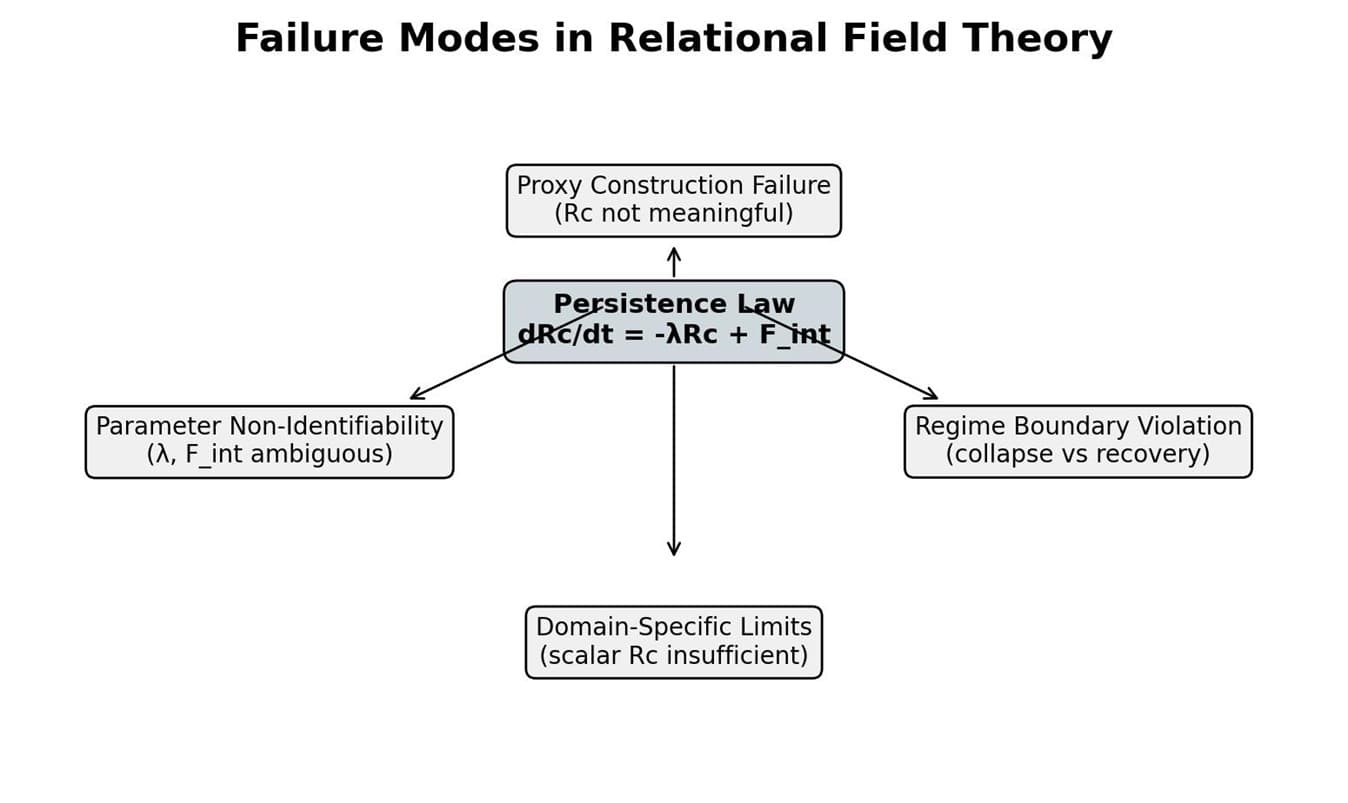
In its most compact form, the coherence field evolves according to the reduced law:
This single equation contains only two competing forces:
Dissipation (), arising from noise or environmental fluctuations.
Restoration (), the system’s internal coherence-preserving interactions.
Despite its simplicity, this balance determines everything about the system’s fate — and it already contains, embedded within it, both the origin and the boundary of singular behavior.
3. The Governing Principle: Restoration vs. Dissipation
The future of any coherence-bearing system depends on a single inequality:
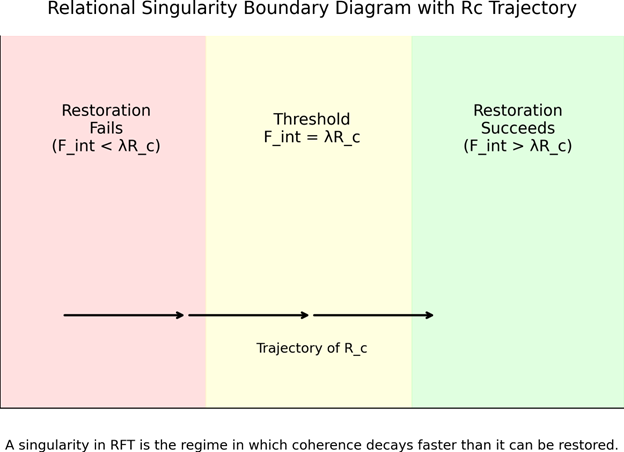
Restoration succeeds () → coherence grows or stabilizes; the system persists.
Restoration fails () → coherence enters irreversible decline.
Exact balance () → fixed-point threshold (the restoration limit).
This boundary is identified in RFT with the condition previously called Genesis Zero: the point of perfect coherence retention, where the system “cannot be lost.”
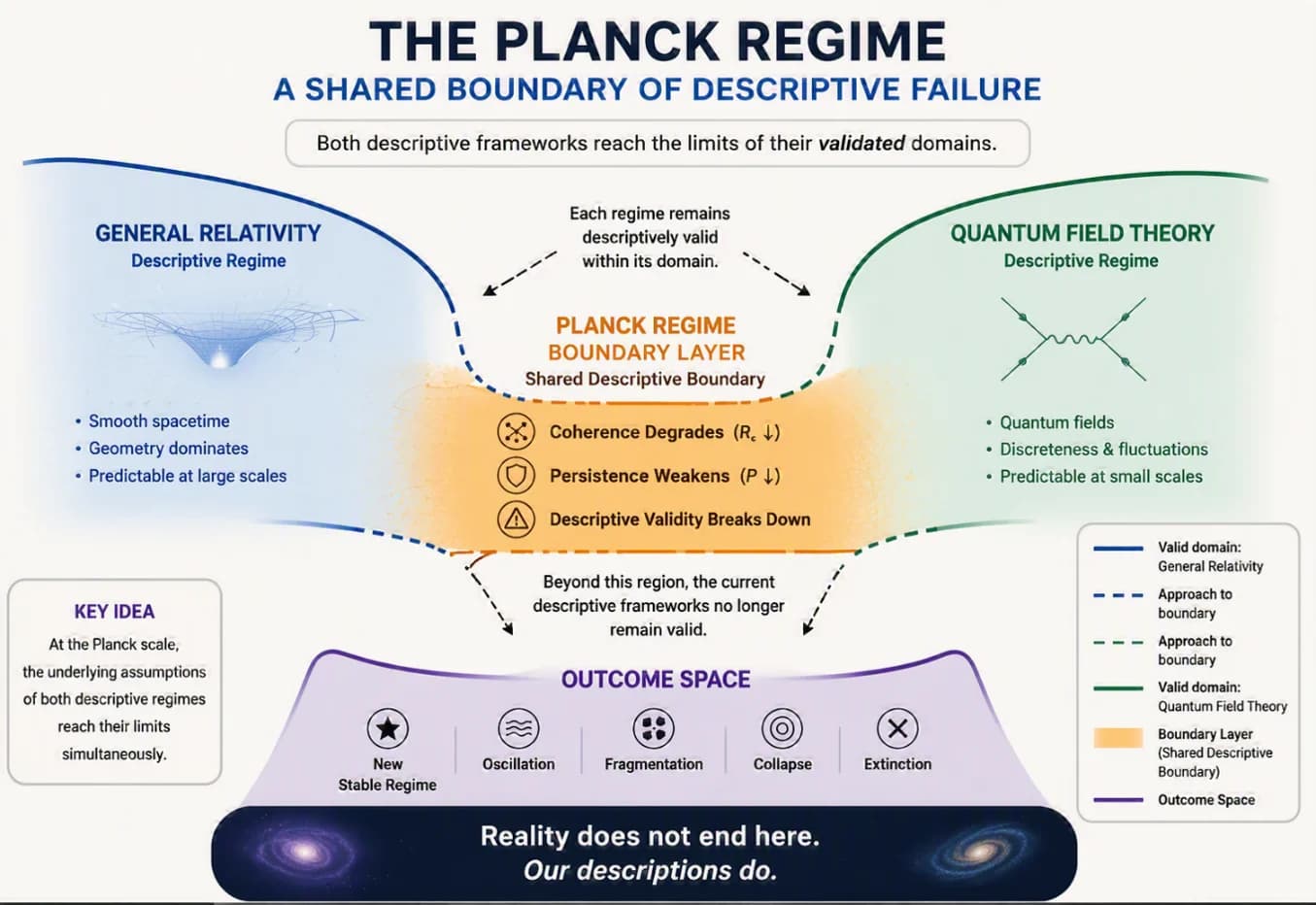
On the other side lies irreversible decoherence — the regime in which the system loses the structural resources required to reorganize and recover.
This is the key insight: the singularity is the regime in which restoration fails — nothing more exotic is required.
4. Implications: Two Boundaries, One Field
The reduced law shows that “light” and “darkness” (metaphorically speaking) are not different ontologies but opposite limits of the same coherence field:
Light / Presence: the restoration threshold where coherence is perfectly sustained. This corresponds to Genesis Zero and saturated interiors in earlier RFT work.
Darkness / Absence: the regime in which dissipation overwhelms restoration and recovery becomes impossible.
When , the variation space collapses (“nothing” limit). When , the action diverges (“infinity” limit).
Both extremes arise from the same equation. A singularity is therefore not a special place — it is a one-way relational phase boundary: the point beyond which coherence can no longer reorganize itself fast enough to persist.
5. Minimal Formalism: The Three Regimes at a Glance
Figure: Relational Singularity Boundary Diagram with Trajectory(Insert the image you just created — the three-column version with pink/yellow/green regions and the horizontal trajectory arrow)
The entire singularity structure in RFT reduces to three outcomes:
Condition | Interpretation | Behavior |
Restoration succeeds | Stable attractor/persistence | Coherence grows or plateaus |
Restoration threshold | Genesis Zero/coherence fixed point | |
Restoration fails | Irrecoverable decoherence (singularity) | Coherence enters irreversible decline |
The equation is mathematically symmetric, but the solution space is not: once coherence loss crosses below the threshold and the supporting structure is lost, reversal is no longer generally available without renewed restoring input. The transition is directionally constrained.
6. Testability and Cross-Domain Relevance
One of the strengths of the reduced-law formulation is that it generalizes across classical dynamical systems, neural/physiological systems, quantum coherence, noisy networks, and even random-circuit sampling benchmarks.
Because the same equation governs restoration versus dissipation everywhere noise and coupling compete, RFT predicts identifiable thresholds in coherence decay curves, nonlinear recovery failures, saturating plateaus, and abrupt recoverability loss — all measurable today.


Discussion