
1. Introduction
“Every star in the night sky could potentially host worlds we have never seen — and perhaps life we have never imagined.”
For centuries, humans have wondered whether life exists beyond Earth. Today, that question is no longer limited to science fiction or philosophy. With advanced telescopes, robotic missions, and artificial intelligence, scientists are actively searching for evidence of life elsewhere in the universe.
In the last two decades, researchers have discovered thousands of planets orbiting distant stars, found organic molecules in space, and gathered evidence that Mars once contained rivers and lakes. At the same time, missions studying icy moons in our solar system are revealing hidden oceans that may contain conditions suitable for life.
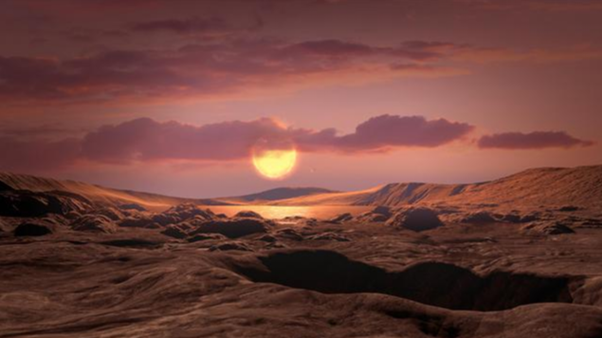
Even with these discoveries, scientists still have no confirmed evidence of extraterrestrial life. However, the search has become far more precise and scientifically grounded than ever before.
So, are we actually close to finding life beyond Earth? The universe may contain billions of potentially habitable worlds.
2. What Scientists Are Really Searching For
When scientists talk about finding life, they are usually searching for biosignatures — measurable signs that could indicate biological activity.
These biosignatures may include:
Oxygen and methane in a planet’s atmosphere
Organic carbon-based molecules
Chemical patterns difficult to explain through geology alone
The challenge is that many of these signals can also be produced naturally without life. Methane, for example, may come from microbes, but it can also result from volcanic or geological activity [6]. Because of this, scientists do not rely on a single clue. Instead, they look for multiple forms of evidence before suggesting the possibility of life.
This careful approach is important because extraordinary claims require extraordinary evidence.
3. Exoplanets and the Search Beyond Our Solar System
One of the biggest breakthroughs in astronomy has been the discovery of exoplanets, or planets orbiting stars outside our solar system.
Before the 1990s, scientists were unsure whether planets were common in the universe. Today, thousands of exoplanets have been confirmed through missions like NASA’s Kepler and TESS telescopes. As of 2026, astronomers have confirmed more than 5,800 exoplanets, according to NASA’s Exoplanet Archive [3].
Some of these planets exist in the habitable zone, where temperatures may allow liquid water to exist. Since water is essential for life on Earth, these planets became major targets in the search for alien life [1].
The launch of the James Webb Space Telescope marked another major step forward. Operated by NASA and international partners, the telescope can study the atmospheres of distant planets using spectroscopy, a method that analyses light to identify chemical elements [2].
Scientists can now detect gases such as:
Water vapor
Carbon dioxide
Methane
These observations do not prove life exists, but they help researchers identify planets that may have habitable environments. The search has shifted from asking whether planets exist to asking which planets could realistically support life.
4. Why Mars Still Matters
Although exoplanets attract enormous attention, Mars remains one of the most important locations in the search for life.
Today, Mars is cold and dry. However, evidence collected by rovers and orbiters suggests that billions of years ago, the planet had rivers, lakes, and possibly even oceans [4]. NASA’s Perseverance rover is currently studying rocks in Jezero Crater, an area believed to have once contained water [4].
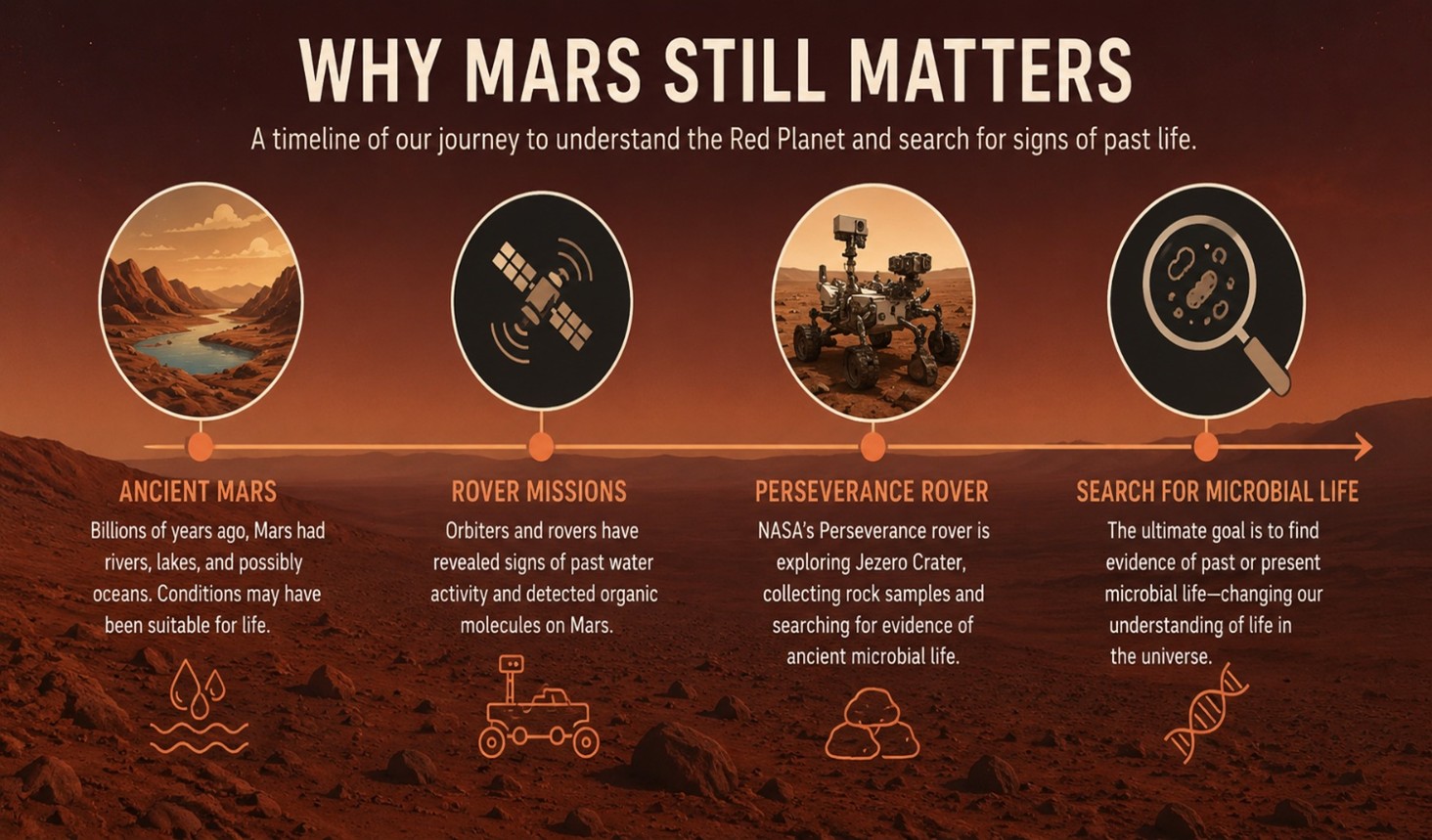
Scientists hope these rocks may preserve traces of ancient microbial life. Researchers are not expecting to find advanced organisms. Even evidence of microscopic life would be revolutionary because it would suggest that life can emerge independently on different planets.
Scientists estimate that ancient Mars may have contained stable liquid water nearly 3.5 billion years ago [4]. Mars is scientifically important because it allows researchers to study another potentially habitable world relatively close to Earth.
5. The Hidden Oceans of Icy Moons
Some of the most promising places for extraterrestrial life may actually be moons rather than planets.
Europa, a moon of Jupiter, and Enceladus, a moon of Saturn, both contain massive oceans beneath thick layers of ice. Scientists believe these oceans may hold more water than all of Earth’s oceans combined. Enceladus is particularly interesting because it releases plumes of water vapor and organic molecules into space.
Data from NASA’s Cassini mission detected organic molecules and molecular hydrogen in Enceladus’ plumes, suggesting possible hydrothermal activity beneath the moon’s icy surface — conditions similar to deep-sea environments on Earth where life exists without sunlight [5].
Future missions from European Space Agency and NASA aim to study these moons in greater detail [7]. If microbial life exists elsewhere in our solar system today, these hidden oceans are among the most likely places to find it.
6. How Artificial Intelligence Is Helping Astronomy
Modern astronomy generates enormous amounts of data, making artificial intelligence increasingly important in scientific research.
AI systems can:
Analyse telescope data quickly
Detect unusual atmospheric signals
Identify possible exoplanets
Reduce human error in data analysis
Machine learning tools are also helping astronomers process images and recognize patterns that might otherwise be missed. Modern observatories generate terabytes of astronomical data daily, making AI-driven analysis increasingly essential for identifying meaningful patterns.
As telescopes become more advanced, AI is expected to play an even larger role in the search for extraterrestrial life.
7. So, Are We Close?
The honest scientific answer is: not yet, but closer than ever before.
Scientists have not discovered confirmed evidence of alien organisms or civilizations. However, researchers now know that planets are extremely common, water exists in multiple places beyond Earth, and many worlds may contain environments suitable for life.
More importantly, humanity finally has the technology to investigate these possibilities seriously. The next major discovery may not involve intelligent aliens. Instead, it could be microbial life on Mars, chemical biosignatures in a distant atmosphere, or evidence hidden beneath the icy oceans of Europa or Enceladus.
Even that would completely change humanity’s understanding of life in the universe.
8. Conclusion
The search for life beyond Earth has entered a new scientific era. Advanced telescopes, planetary missions, and AI-driven research are transforming a centuries-old mystery into a measurable scientific investigation.
Although no definitive discovery has been made, scientists are now closer than ever to identifying worlds that may support life. Whether the first breakthrough comes from Mars, a distant exoplanet, or an icy moon, the search itself is already reshaping modern astronomy and biology.
Upcoming missions over the next decade may bring humanity closer than ever to answering one of science’s greatest questions. For the first time in history, humanity is not just imagining life beyond Earth — it is actively searching for it.




Discussion