
1. Introduction / Motivation
Turbulent flow does not dissipate energy uniformly, it does so through highly localized, intermittent events. The Navier–Stokes equations are among the most important and challenging equations in mathematical physics. Despite centuries of study, the question of whether smooth solutions exist globally in three dimensions for arbitrary smooth initial data remains open. Partial regularity results exist, and weak solutions are known, yet the fundamental mechanisms that could guarantee or prevent global smoothness are still not fully understood at the structural level.
Classical energy methods control integrated norms but do not guarantee pointwise coercive dissipation. Phenomena such as intermittency and the energy cascade suggest that energy transfer may evade uniform control. The difficulty appears to lie not merely in the strength of the nonlinearity, but in the absence of robust structural mechanisms that would enforce coercive dissipation everywhere.
2. Core Concept or Framework Overview
Relational Field Theory (RFT), developed through a detailed structural analysis of the simpler Burgers equation, offers a new lens. Burgers’ equation shares the same nonlinear advection term as Navier–Stokes but is one-dimensional and exactly solvable via the Cole–Hopf transformation. Recent RFT work has shown that coercive dissipation in Burgers flow is not automatic, it is conditional on the emergence of relational dominance.
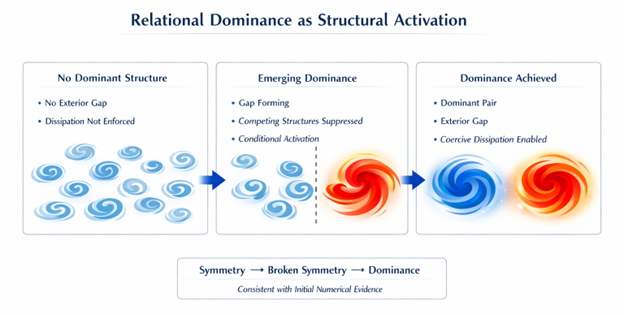
Relational dominance means that a small number of localized contributions become overwhelmingly stronger than all others, creating an “exterior gap” that suppresses competing terms. This structural collapse enables efficient dissipation. Without it, smoothing alone is insufficient. It is similar to how a few intense vortices can dominate an otherwise chaotic flow field.
3. Governing Principle or Constraint
In viscous Burgers flow, dissipation at gradient extrema reduces to a higher-order statistical quantity (a fourth cumulant of a tilted heat-kernel measure). Rigorous analysis shows that coercive dissipation occurs only when:
• The emergence of a dominant pair of localized contributions, • An exterior gap suppressing all other contributions, • The resulting two-peak Laplace approximation.
Under perfect symmetry, dominant-pair selection fails and the mechanism is unavailable. Small symmetry breaking restores dominance continuously, and dominance is open and dense in the natural class of multi-region data. Explicit scaling laws govern the transition: the dominance ratio scales linearly with perturbation strength, and the gap grows logarithmically.
Thus, smoothing alone does not guarantee coercivity; relational collapse to a finite dominant structure is the enabling condition. Failure is structural, not anomalous.
4. Implications & Reframing
This perspective reframes the Navier–Stokes problem. The difficulty may not be purely analytic or energetic, it may be structural.
If this mechanism extends beyond Burgers flow, it would imply that structural organization—not just energy magnitude—governs dissipation.
Key questions arise:
What is the analogue of a dominant pair in the vorticity or velocity field?
Can localized vortex structures achieve relational dominance under nonlinear advection and diffusion?
Is the absence of global regularity linked to failure of dominant-pair selection at certain scales?
Does the energy cascade correspond to a regime in which relational dominance is prevented?
These are not claims about Navier–Stokes behavior. They are precise, testable structural questions suggested by a mechanism that is now quantitatively understood in the simpler Burgers setting.
5. Minimal Formalism
Under the Cole–Hopf transformation, dissipation reduces to a fourth cumulant of a tilted heat-kernel measure. Coercivity arises only when relational dominance creates an exterior gap that suppresses all but a dominant pair of localized contributions.
6. Testability & Predictions
Rather than claiming the existence of relational dominance in Navier–Stokes, we propose concrete, measurable diagnostics that could be extracted from direct numerical simulations (DNS):
Dominance ratio at scale ℓ: Identify the top-k localized coherent vorticity structures at scale ℓ and compute the ratio of their combined enstrophy to the total enstrophy outside those structures.
Persistence time of top contributors: Track the lifetime over which the same set of k structures remains dominant, measured relative to the local turnover time.
Gap ratio: The logarithmic separation between the strength of the dominant structures and the maximum background vorticity/enstrophy outside them.
Failure signatures: Rapid turnover of dominant structures, lack of scale separation, or persistent multi-structure competition without a clear dominant pair.
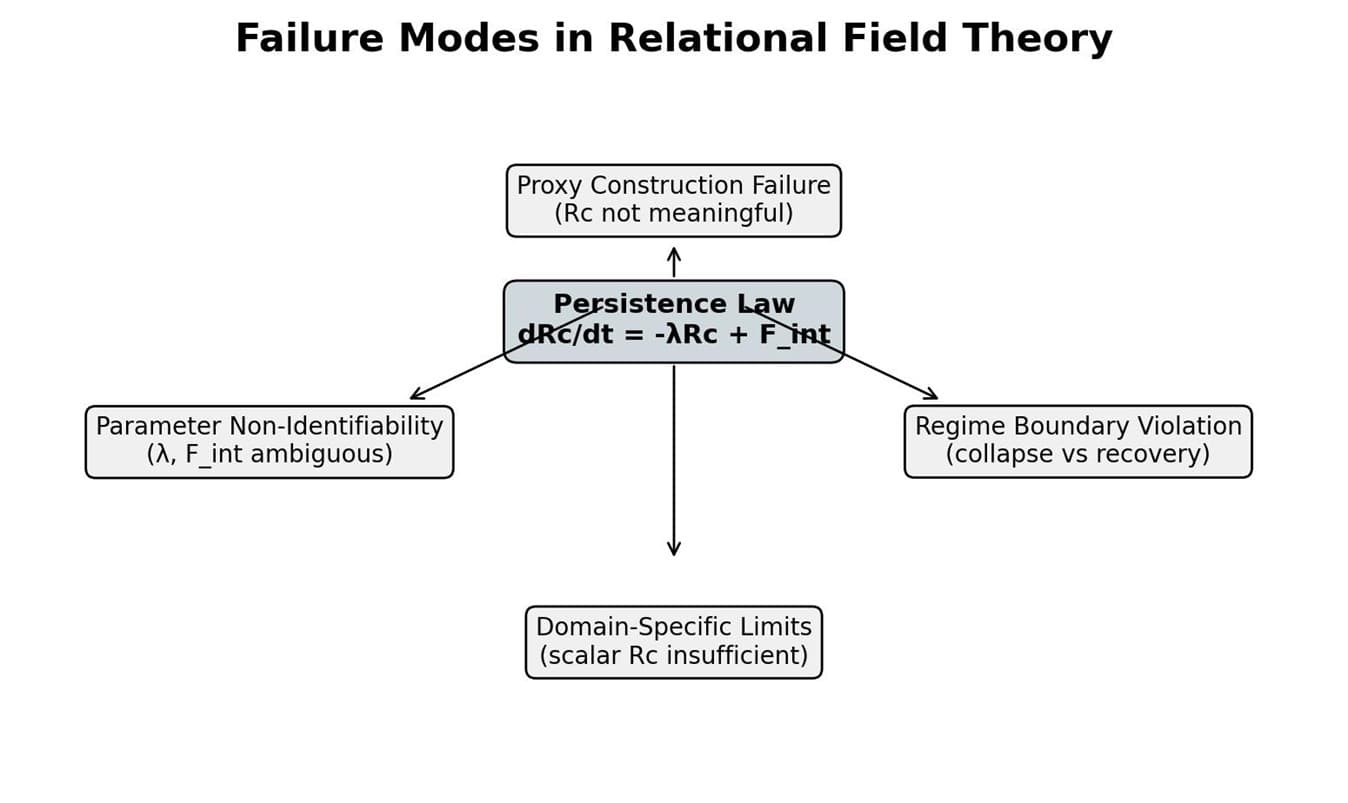
These diagnostics are intended to be robust under reasonable variations in coherent-structure identification methods. Failure of these diagnostics to exhibit dominance scaling or persistence would provide direct evidence against the applicability of the RFT mechanism in Navier–Stokes turbulence.
These diagnostics allow the hypothesis of relational dominance in turbulence to be empirically confirmed or falsified using modern DNS datasets.


Discussion